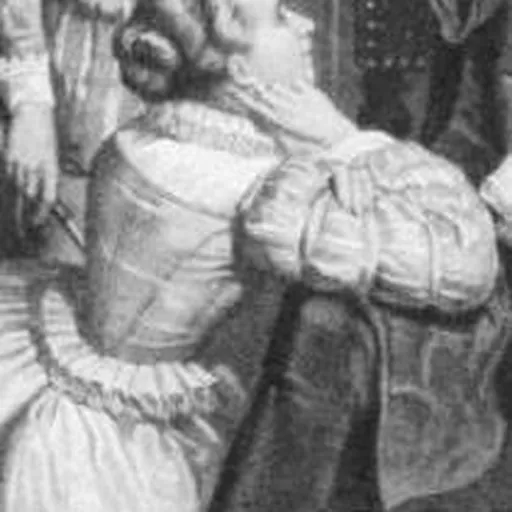
About Judith Quiney
Lived 1585 – 1662 (aged 76–77). Judith Quiney was an English writer.
Judith Quiney (; 2 February 15859 February 1662) was the younger daughter of William Shakespeare and Anne Hathaway and the fraternal twin of their only son, Hamnet Shakespeare. She married Thomas Quiney, a vintner of Stratford-upon-Avon. The circumstances of the marriage, including Quiney's misconduct, may have prompted the rewriting of Shakespeare's will. Thomas was struck out, while Judith's inheritance was attached with provisions to safeguard it from her husband. The bulk of Shakespeare's estate was left, in an elaborate fee tail, to his elder daughter, Susanna, and her male heirs.
Judith and Thomas Quiney had three children. By the time of Judith Quiney's death, she had outlived her children by many years. She has been depicted in several works of fiction as part of an attempt to piece together unknown portions of her father's life.
Birth and early life Judith Shakespeare was the daughter of William Shakespeare and Anne Hathaway. She was the younger sister of Susanna and the twin sister of Hamnet. Hamnet, however, died at the age of eleven. Their baptisms on 2 February 1585 were recorded as "Hamnet & Judeth sonne & daughter to William Shakspere" by the vicar, Richard Barton of Coventry, in the parish register for Holy Trinity Church, Stratford-upon-Avon. The twins were named after a husband and wife, Hamnet and Judith Sadler, The infraction was a minor one apparently caused by the minister, as three other couples were also wed that February. Quiney was nevertheless summoned by Walter Nixon to appear before the consistory court in Worcester. (This same Walter Nixon was later involved in a Star Chamber case and was found guilty of forging signatures and taking bribes.) Quiney failed to appear by the required date. The register recorded the judgement, which was excommunication, on or about 12 March 1616. It is unknown if Judith was also excommunicated, but in any case the punishment did not last long. In November of the same year, they were back in church for the baptism of their firstborn child.
The marriage did not begin well. Quiney had recently impregnated another woman, Margaret Wheeler, who died in childbirth along with her child; both were buried on 15 March 1616. A few days later, on 26 March, Quiney appeared before the Bawdy Court, which dealt, among other things, with "whoredom and uncleanliness." Confessing in open court to "carnal copulation" with Margaret Wheeler, he submitted himself for correction and was sentenced to open penance "in a white sheet (according to custom)" before the Congregation on three Sundays. He also had to admit to his crime, this time wearing ordinary clothes, before the Minister of Bishopton in Warwickshire. The first part of the sentence was remitted, essentially letting him off with a five-shilling fine to be given to the parish's poor. As Bishopton had no church, but only a chapel, he was spared any public humiliation.
Chapel Lane, Atwood's, and The Cage Where the Quineys lived after their marriage is unknown. Judith owned her father's cottage on Chapel Lane, Stratford; while Thomas had held, since 1611, the lease on a tavern called "Atwood's" on High Street. This house was known as "The Cage" and is the house traditionally associated with Judith Quiney. In the 20th century The Cage was for a time a Wimpy Bar before being turned into the Stratford Information Office.
The Cage provides further insight into why Shakespeare would not have trusted Judith's husband. Around 1630 Quiney tried to sell the lease on the house but was prevented by his kinsmen. In 1633, to protect the interests of Judith and the children, the lease was signed over to the trust of John Hall, Susanna's husband, Thomas Nash, the husband of Judith's niece, and Richard Watts, vicar of nearby Harbury, who was Quiney's brother-in-law and who had officiated at Thomas and Judith's wedding. Eventually, in November 1652, the lease to The Cage ended up in the hands of Thomas' eldest brother, Richard Quiney, a grocer in London.
William Shakespeare's last will and testament
The inauspicious beginnings of Judith's marriage, in spite of her husband and his family being otherwise unexceptional, In the first bequest of the will, there had been a provision "vnto my sonne in L[aw]"; but "sonne in L[aw]" was then struck out, with Judith's name inserted in its stead. To this daughter he bequeathed £100 "in discharge of her marriage porcion"; another £50 (£ in ) if she were to relinquish the Chapel Lane cottage; and, if she or any of her children were still alive at the end of three years following the date of the will, a further £150 (£ in ), of which she was to receive the interest but not the principal. This money was explicitly denied to Thomas Quiney unless he were to bestow on Judith lands of equal value. In a separate bequest, Judith was given "my broad silver gilt bole."
Shakespeare Quiney died at six months of age. Richard and Thomas Quiney were buried within nine days of each other, 21 and 19 years old, respectively.
Death
Judith Quiney was announced dead on 9 February 1662, a week after her 77th birthday. She outlived her last surviving child by 23 years. She was buried in the grounds of Holy Trinity Church, but the exact location of her grave is unknown. She is the subject of the 2003 novel My Father Had a Daughter: Judith Shakespeare's Tale and the 2025 sequel The Owl Was a Baker's Daughter: The Continuing Adventures of Judith Shakespeare, both by Grace Tiffany. The radio play Judith Shakespeare by Nan Woodhouse portrays her as "a loner, yearning to be a part of her playwright father's life". She travels to London to join him and has a troubling affair with a young aristocrat. "Shakespeare's Daughter" is the title of a short story by Mary Burke that was short-listed for a 2007 Hennessy/Sunday Tribune Irish Writer prize.
In A Room of One's Own, Virginia Woolf created a character, "Judith Shakespeare", although she is supposed to be Shakespeare's sister rather than his daughter. Besides the similar names and setting, there is no other direct connection between Judith, Shakespeare's daughter, and Woolf's creation, and in fact Shakespeare's sister was named Joan. In Woolf's story Shakespeare's sister is denied the education of her brother despite her obvious talent. When her father tries to marry her off, she runs away to join a theatre company but is ultimately rejected because of her gender. She becomes pregnant, is abandoned by her partner, and commits suicide. Woolf's Judith was created in an attempt to fill a historical gap. Woolf was making a point about the struggle that a female poet and playwright would have had in the Elizabethan age. Woolf speculated as to why there were so few talented women from that time. "What I find deplorable," she observed, "is that nothing is known about women before the eighteenth century."
Judith's childhood, and the death of her twin brother, are portrayed in Maggie O'Farrell's 2020 novel, Hamnet. Judith is portrayed by Britain's Got Talent series 16 finalist Olivia Lynes in Chloé Zhao's 2025 film adaptation of the novel.
In Kenneth Branagh's 2018 Sony Pictures release All Is True, Kathryn Wilder plays Judith as a rebellious and angry young woman who resents her father's love for her dead twin.
Don’t just read it —
keep it.
Full-length biographies made to live with: read them, listen on the way to work, watch them tonight.
- E-book
- Audio
- Video
Instant download · yours to keep · every purchase keeps this site free
Important facts
Family & relationships
People in Judith Quiney's life
Named in this biography and alive at the same time




Related people
Same field, nearest in time

Contemporaries
People whose lives overlapped Judith Quiney's



Frequently asked questions
Who was Judith Quiney?
younger daughter of William Shakespeare
When was Judith Quiney born?
Judith Quiney was born in 1585 in Stratford-upon-Avon.
When did Judith Quiney die?
Judith Quiney died on 9 February 1662 in Stratford-upon-Avon.
What was Judith Quiney's occupation?
Judith Quiney was a writer.
What nationality was Judith Quiney?
Judith Quiney was English.
Sources & further reading
Cite this page
APA: Biography.guide. (2026). Judith Quiney. https://biography.guide/judith-quiney/
MLA: "Judith Quiney." Biography.guide, https://biography.guide/judith-quiney/.
Chicago: "Judith Quiney." Biography.guide. https://biography.guide/judith-quiney/.
Data last updated: 2026-09-21 · Spot an error? Report a correction.
Portrait: Wikimedia Commons · author & licence
Page generated 2026-09-27 05:00 UTC