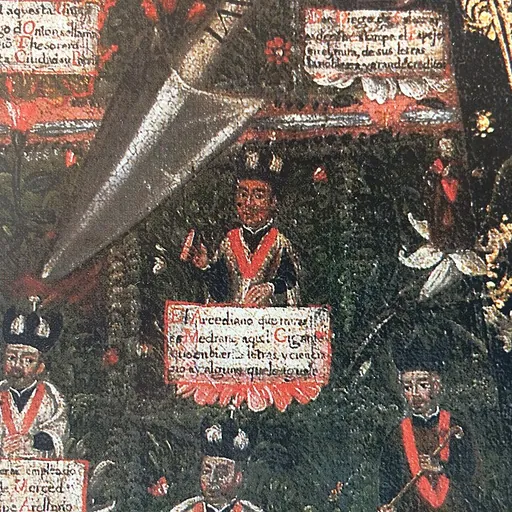
About Juan de Espinosa Medrano
Lived 1629 – 1688 (aged 58–59). Juan de Espinosa Medrano was a cleric, teacher, preacher, writer and playwright.
Juan de Espinosa Medrano (Calcauso?, 1630? – Cuzco, 1688), known in history as ("The Spotty-Faced"), was an Indigenous cleric, sacred preacher, writer, playwright, theologian and polymath from the Viceroyalty of Peru. He is the most prominent figure of the Literary Baroque of Peru and one of the most important intellectuals from Colonial Spanish America (along with the New Spain writers Sor Juana Inés de la Cruz and Carlos de Sigüenza y Góngora).
Juan de Espinosa Medrano is the author of the most famous literary apologetic discourse in the Americas in the 17th century: the (1662). He also wrote autos sacramentales in Quechua; the Spanish comedies (c. 1650) and (c. 1657), out of which only the biblical play (c. 1650) is preserved; panegyric sermons, compiled after his death in a volume called (1695); and a course in Latin of thomistic philosophy, (1688).
He acquired fame in life for the stylistic distinction and conceptual depth of his oeuvre (which was praised for its first-rate accordance to the scholastic and baroque epistemological parameters of his time). His polymathy, erudition and poetic ingenuity in the composition of sermons and literary works gained him the epithets of Sublime Doctor and Indian Demosthenes, as well as the less frequent ones of Criollo Phoenix and Tertullian of the Americas (all used to refer to him while alive). Additionally, after the Peruvian independence from Spanish Imperial rule took place, Juan de Espinosa Medrano's memory begun to be used as an exemplary model of the intellectual and moral potential of the peoples from South America (criollo, mestizos and indigenous populations included).
The circumstances of Juan de Espinosa Medrano's origin, and the details about his first years of life, are—almost in their entirety—unknown. The absence of significant biographical data put forward in the will written by the own author days before his death has further led to speculation about his ethnicity (or race) and identification. It has also led to manipulation and tendentious interpretations of the data preserved about his existence; such distortive reading has been especially pronounced in the many works of biographers, critics or commentators, akin to the political agenda of Indigenismo in Peru. What is incontrovertible, however, is that Juan de Espinosa Medrano always regarded himself both as Criollo and Spanish (an ideological servant of the Empire); evidences for such self-identification are to be found in his oeuvre, in which Juan de Espinosa Medrano sides constantly with the Spaniards, and often describes Native American populations as "enemies", "barbarous" and "idolatrous" (he does not link himself with Native American peoples' cultures and ethnicity, and it is also unthinkable that an indigenous person could have held the power and clergy positions he did during his lifetime).
In the present, the mysteries of his biography and the intrinsic quality of his literary production notwithstanding, the study of the works and life of Juan de Espinosa Medrano has extensively fallen to relegation or oblivion. This way, even if a certain part of his biography still survives in the oral tradition of the region of Apurímac (where it has acquired unusual characteristics) in Cusco as well as in the Peruvian Literary Canon, knowledge of his life and work circumscribes mostly to scholars of literature in Colonial Spanish America.
Biography
Origin and first years Present state of the Seminary of Saint Anthony the Abbot in Cuzco (located in Plaza Nazarenas in the contemporary city of Cusco). The Seminar's facilities have been divided and today make a hotel, a museum and a parish. After a series of studies and archive analysis, the space-time coordinate of Calcauso, 1630, appears to be the most accurate intersection in which to place the origin (the birth) of Juan de Espinosa Medrano. Likewise, Clorinda Matto de Turner's novelization of the author's life as: "He who entered the world in humble cradle, set foot on the steps of book and prayer... Then ascended to reach the literary skies of the America of the South, as king of stars there he shined".
The early and indigenous biography of Juan de Espinosa Medrano by Clorinda Matto Clorinda Matto de Turner, author of a biography on Juan de Espinosa Medrano titled "Don Juan de Espinosa Medrano —that is— the Spotty-Faced Doctor" —included in Pencil Sketches of Acclaimed Americans (1890). Her biographical construction of Espinosa Medrano is now the most familiar in Peruvian popular culture and the Andean provinces in the Republic of Peru. Clorinda Matto de Turner published her famous biographical study "Don Juan de Espinosa Medrano —that is— the Spotty-Faced Doctor" in 1887 in Lima, the capital of Peru. Three years later, after small corrections, she published the biographical study again in Pencil Sketches of Acclaimed Americans (1890),
Ecclesiastical career and intellectual endeavors "The panegyric prayer to James the Great (or Moorslayer)" is one fundamental texts to consult in order to understand Juan de Espinosa Medrano's cultural self-identification. The sermon was preached in the Cathedral of Cuzco and later published in the volume La Novena Maravilla (The Ninth Wonder). Documentation found indicates that by the year 1645, when he was about fifteen years old, Juan de Espinosa Medrano was a student in the Seminary of Saint Anthony the Abbot. His tutors in this institution were: Francisco de Loyola, Augustinian prior and cofounder, in 1559, of the Monastery of Saint Augustine in Cuzco —Loyola stated that young Juan was "an exceptional prowess, and also very virtuous"
In 1655, Juan de Espinosa Medrano's ecclesiastical career starts. He serves, in the first place, at the Parish of the Sanctum (Parroquia del Sagrario) where he conducts a series of marriage ceremonies and baptisms —a final one documentally registered in 1659. From 1669 to 1676, Espinosa Medrano takes charge of the parish of Chincheros (today part of the Sacred Valley of the Incas). Finally, from 1678 to 1683/1684 he acts as priest of the parish of Saint Cristopher (San Cristóbal), one of the most important Indian parishes of Cuzco even today. Lamentablemente, nada concreto se sabe sobre la veracidad y el paradero de este traslado de su obra a Europa.
El segundo evento de importancia para la biografía de Juan de Espinosa Medrano corresponde al envío de una carta a Carlos II, Rey de España, por parte del obispo del Cuzco, Manuel de Mollinedo y Angulo en 1678. Este evento muestra, con mayor claridad, la admiración y alta estima que se tenía hacia al author tanto por parte del ámbito religioso como también por parte del letrado en la ciudad. El nombre de Juan de Espinosa Medrano —se ve aquí— empieza a ser difundido más allá del obispado colonial del Cuzco y el Virreinato del Perú. El obispo recomienda en la carta la asignación de un puesto en la Catedral del Cuzco para Espinosa Medrano y escribe al rey: "es el sujeto más digno que tiene el obispado por sus muchas y relevantes letras y virtud".
It is known that he entered the Dominican seminary of San Antonio Abad in Cuzco. There, as a young student, he wrote many of his plays. He wrote plays in both Spanish and Quechua. He wrote in Spanish the drama Amar su propia muerte (To Love One's Own Death) (ca. 1645). Characters of this play include Sísara, a general of Canaan; Jabín, king of Canaan; Jael; Barac, a general of the armies of Israel.
He wrote in Quechua a religious play, El hijo pródigo (also known as Auto sacramental del hijo pródigo; The Prodigal Son), as well as a mythological piece, El rapto de Proserpina (The Abduction of Proserpina). His defense of Góngora has been viewed as "a plea for recognition on behalf of himself and of writers living and working on the periphery of the Spanish empire."
Don’t just read it —
keep it.
Full-length biographies made to live with: read them, listen on the way to work, watch them tonight.
- E-book
- Audio
- Video
Instant download · yours to keep · every purchase keeps this site free
Important facts
People in Juan de Espinosa Medrano's life
Named in this biography and alive at the same time

Related people
Same field, nearest in time



Contemporaries
People whose lives overlapped Juan de Espinosa Medrano's




Frequently asked questions
Who was Juan de Espinosa Medrano?
Baroque writer, creole author
When was Juan de Espinosa Medrano born?
Juan de Espinosa Medrano was born in 1629 in Viceroyalty of Peru.
When did Juan de Espinosa Medrano die?
Juan de Espinosa Medrano died on 13 November 1688 in Cusco.
What was Juan de Espinosa Medrano's occupation?
Juan de Espinosa Medrano was a cleric, teacher, preacher, writer and playwright.
What nationality was Juan de Espinosa Medrano?
Juan de Espinosa Medrano's recorded nationality: Viceroyalty of Peru.
Sources & further reading
· Wikipedia: Juan de Espinosa Medrano
· DBpedia: Juan de Espinosa Medrano
Cite this page
APA: Biography.guide. (2026). Juan de Espinosa Medrano. https://biography.guide/juan-de-espinosa-medrano/
MLA: "Juan de Espinosa Medrano." Biography.guide, https://biography.guide/juan-de-espinosa-medrano/.
Chicago: "Juan de Espinosa Medrano." Biography.guide. https://biography.guide/juan-de-espinosa-medrano/.
Data last updated: 2026-09-20 · Spot an error? Report a correction.
Portrait: Wikimedia Commons · author & licence
Page generated 2026-09-27 04:57 UTC