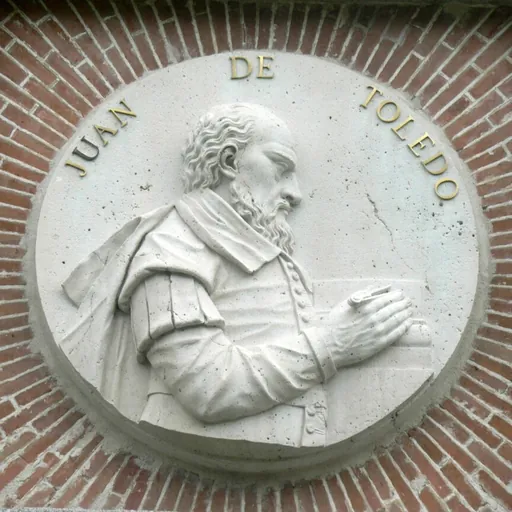
About Juan Bautista de Toledo
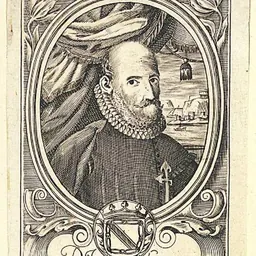
Lived 1515 – 1567 (aged 51–52). Juan Bautista de Toledo was a Spanish architect and sculptor.
Juan Bautista de Toledo (c. 1515 – 19 May 1567) was a Spanish architect. He was educated in Italy, in the Italian High Renaissance. As many Italian renaissance architects, he had experience in both architecture and military and civil public works. He was born, either in Toledo or in Madrid, around 1515. He died on 19 May 1567 in Madrid, and was buried in Madrid in the choir of the primitive “Convento de Santo Tomás, Iglesia de la Santa Cruz”.
Career De Toledo perhaps started his career in architecture in Rome, between 1534 and 1541, working for Michelangelo and Pope Paul III (Alessandro Farnese), completing the courtyard of Palazzo Farnese. Then, possibly, he continued his training in the construction site of St. Peter's Basilica, under the direction of Antonio da Sangallo the Younger. Another hypothesis is that he worked for Antonio da Sangallo the Younger in both Fortaleza da Basso, Florence and St. Peter’s Basilica of Rome.
Juan Bautista de Toledo, an enigmatic and puzzling personality, was known in Florence and Rome as Giovanni Battista de Alfonsis. However, in Naples and Madrid, he was identified as Juan Bautista de Toledo: both Spanish architects had the same hand writing. Perhaps, his true name was Juan Bautista de Toledo Alfonsis.
El Escorial
In El Escorial, his most significant work, on 23 April 1563, in the ceremony of the masonry stone (cornerstone), Juan de Herrera wrote over the visible side of the first stone, "JOANNES BAPTISTA ARCHITECTUS MAJOR. APRILES 23". In the other sides of the first stone, the inscriptions are: in one side, "DEUS OPTIMUS MAXIMUS OPERO ASPICIAT"; and in the other side, "PHILIPUS HISPANIARUM REX A FUNDAMENTIS ERIXIR −1563": "En 23 dias del mes de abril, dia de San Jorge mártir, deste año de 1563 se puso la primera piedra del monasterio en el cimiento del reflectorio, debajo de la silla del prior, que es en la bodega, debajo del dicho reflectorio, la cual piedra es cuadrada y está escrita por todas partes, que da a entender quien es el fundador, y quien es el arquitecto y el día y año en que se pone".
On 18 December 1546 Pope Paul III appointed the Spaniard Joannes Baptista, Deputy Coordinator Architect for St. Peter's Basilica of Rome: "Similis deputatio pro Joanne Bapta. Hispano". On 26 February 1547 “Michelangelo (…) informed the Florentine mason master Niccolo that he was to follow the orders of Giovanni Battista de Alfonsis, his personal choice as successor of Labacco(…)”.
Before his patron Paul III, died in 1549, on 20 September 1548 de Toledo was summoned by the Viceroy Pedro Álvarez de Toledo Giovanni Battista de Alfonsis went to Naples to work under the name of "Juan Bautista de Toledo" in the position of "Maestro Mayor de Obras Reales en el Reino de Nápoles".
In Naples, he designed and rebuilt many buildings, including: the Strada di Toledo (since 1870 called Strada di Roma), the church of St. Giacomo degli Spagnuoli; the square bastions to the Castel Nuovo; a large palazzo at Posillipo, Castel Sant'Elmo; and several fountains.
In 1559, he was appointed Maestro Mayor de Obras Reales (mainly in Madrid and Toledo) by Philip II and summoned back to Madrid. His yearly salary was at first no more than 220 ducats, because Philip's policy, with his Spanish artists at least, was to give them moderate allowances until he had tested their abilities.
He restored the Alcazar de Madrid, Alcazar de Toledo and Convento de los Jerónimos de Madrid. He designed the frontage of the church de las Descalzas Reales He also performed architectural and public works in Casa de Campo de Madrid, Casa Real de Aceca and the Royal Palace of Aranjuez.
In 1561, he was appointed "Arquitecto Real" responsible for the town planning of El Escorial: Monastery, El Escorial village and La Granjilla de La Fresneda. He supervised architectural and public works in San Lorenzo de El Escorial (village), the surroundings of El Escorial (monastery) and La Granjilla until his death in 1567. The monastery was finished by Juan de Herrera in 1584.
The main public works in the town planning of El Escorial were the Aqueduct and Ponds of La Granjilla, the Aqueduct to the Monastery and the two streets joining El Escorial (village) to the Monastery and La Granjilla. El Escorial of Juan Bautista de Toledo and Juan de Herrera is an example of territorial development based on exclusive aesthetic values of global significance.
Furthermore, he designed the overall outline of La Granjilla de La Fresneda. The project was finished with the collaboration of architects, Gaspar de Vega and Juan de Herrera; gardener fray Marcos de Cardona; Furthermore, Dutch dam experts Petre Janson and Spond.
Don’t just read it —
keep it.
Full-length biographies made to live with: read them, listen on the way to work, watch them tonight.
- E-book
- Audio
- Video
Instant download · yours to keep · every purchase keeps this site free
Important facts
more
Juan Bautista de Toledo de Alfonsis, Juan Bautista De ToledoPeople in Juan Bautista de Toledo's life
Named in this biography and alive at the same time



Related people
Same field, nearest in time


Contemporaries
People whose lives overlapped Juan Bautista de Toledo's


Frequently asked questions
Who was Juan Bautista de Toledo?
Spanish artist
When was Juan Bautista de Toledo born?
Juan Bautista de Toledo was born in 1515 in Toledo, Madrid.
When did Juan Bautista de Toledo die?
Juan Bautista de Toledo died on 15 May 1567 in Madrid.
What was Juan Bautista de Toledo's occupation?
Juan Bautista de Toledo was an architect and sculptor.
What nationality was Juan Bautista de Toledo?
Juan Bautista de Toledo was Spanish.
Sources & further reading
· Wikipedia: Juan Bautista de Toledo
· DBpedia: Juan Bautista de Toledo
Cite this page
APA: Biography.guide. (2026). Juan Bautista de Toledo. https://biography.guide/juan-bautista-de-toledo/
MLA: "Juan Bautista de Toledo." Biography.guide, https://biography.guide/juan-bautista-de-toledo/.
Chicago: "Juan Bautista de Toledo." Biography.guide. https://biography.guide/juan-bautista-de-toledo/.
Data last updated: 2026-09-22 · Spot an error? Report a correction.
Portrait: Wikimedia Commons · author & licence
Page generated 2026-09-27 05:01 UTC