
About William Sharington
Lived 1495 – 1553 (aged 57–58). William Sharington was an English architect, politician and mintmaster.
Sir William Sharington (born in around 1495, died before 6 July 1553) was an English landowner and merchant, a courtier of the time of Henry VIII, master and embezzler of the Bristol Mint, member of parliament, conspirator, and High Sheriff of Wiltshire.
Early life Sharington was the eldest son of Thomas Sharington, a gentleman of Cranworth in Norfolk, by his wife Katherine, daughter and heiress of William Pyrton of Little Bentley, Essex. In early life, Sharington is known to have made a visit to Italy, during which he developed an interest in art. Sharington's father left him the manor of Swathing's at Fransham in the Launditch hundred of Norfolk by a will dated 15 October 1519, and Sharington sold it in 1532. The manor had come to Sharington's great-grandfather Henry Sharington, who was steward to the Bishop of Ely, when he married Elizabeth, daughter and heiress of Edmund de Swathing.
Career Sharington's early career is obscure. He married Ursula, an illegitimate daughter of John Bourchier, Lord Berners, who had served as Chancellor of the Exchequer, and was a friend of Sharington. By 1538, he was in the service of Sir Francis Bryan, who was a soldier and diplomat, thus becoming a friend of Thomas Seymour, who was also in Bryan's service. Seymour was one of the brothers of Jane Seymour, who in 1536 became King Henry VIII's third queen consort. By 1539, Sharington had been appointed a page of the king's robes, and in 1540 was promoted to Groom of the Robes. The king trusted him, and in 1541 he was made a page of the Privy chamber and in 1542 a Groom of the Chamber. Also in 1542, he was appointed steward and constable of Castle Rising, in his home county of Norfolk. In 1544, he joined the household of Queen Catherine Parr. At about the same time, for his friend John Dudley, later Duke of Northumberland, Sharington designed a range of new buildings at Dudley Castle which were erected within the old castle's walls and which have been called the Sharrington Range.
In June 1541 Sharington leased the manor of Heytesbury, Wiltshire, from the Crown, making him the most powerful man in those parts for the next seven years. He began to buy land on a large scale. In 1543 he spent more than £1,000, and in 1548 over £2,800, by which time he owned fourteen manors in Wiltshire and others in the neighbouring counties of Somerset, Dorset, and Gloucestershire. He sat as member of parliament for Heytesbury in 1545, and for Bramber (a rotten borough in Sussex) in 1547. He was knighted at the coronation of King Edward VI on 20 February 1547.
In 1547, Sharington was appointed to commissions to report on the king's mints and on the Admiralty, as a chantry commissioner for Gloucestershire, Gloucester, and the city of Bristol, and as a Justice of the Peace for Wiltshire. Sharington had sought the protection of Seymour in the event of the discovery that he was profiting dishonestly from his office at the mint, and Seymour persuaded Sharington to supply funds for his plot. He asked Sharington whether he could make £10,000, enough money to keep ten thousand armed men in action for a month, and Sharington had said he could and that Seymour "should lack no money". However, the plot was discovered and in January 1549, both men were arrested, Sharington on charges of coining base money, clipping, and other frauds. Sharington confessed, blaming Seymour, and suffered an attainder, forfeiting his landed estates and being ejected from his seat in parliament, while Seymour was beheaded. The reason stated for Sharington's attainder was that he had coined testoons for personal gain. However, all testoons of the period struck in quantity by English mints were produced in base silver.
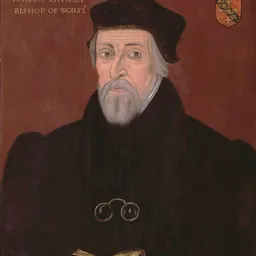
The Articles of high treason laid against Thomas Seymour included the following: In saving his neck, Sharington had successfully sought the help of Francis Talbot, 5th Earl of Shrewsbury, and of Thomas Wriothesley, 1st Earl of Southampton, and had pleaded with Somerset himself. Without Thomas Seymour, they saw Sharington as no political threat to them, and he was also helped by Hugh Latimer, who referred to him in a sermon preached before the king during Lent of 1549, calling him "an honest gentleman, and one that God loveth ... a chosen man of God, and one of his elected". In November 1549 Sharington was pardoned, and on the payment of £12,867, he recovered his estates.
Portrait A sketch of Sharington by Hans Holbein the Younger was acquired by King Charles II in 1675 and is still in the Royal Collection at Windsor Castle. Inscribed at the foot 'William Sharinton', the drawing is in black and coloured chalks on pink-primed paper.
Mint mark Some coins of the Bristol mint during Sharington's control of it, including gold sovereigns of Henry VIII, bear as mint mark the letters "W. S." combined into a monogram, for 'William Sharington'.
Don’t just read it —
keep it.
Full-length biographies made to live with: read them, listen on the way to work, watch them tonight.
- E-book
- Audio
- Video
Instant download · yours to keep · every purchase keeps this site free
Important facts
People in William Sharington's life
Named in this biography and alive at the same time





Related people
Same field, nearest in time




Contemporaries
People whose lives overlapped William Sharington's




Frequently asked questions
Who was William Sharington?
member of the Parliament of England; (1495-1553)
When was William Sharington born?
William Sharington was born in 1495.
When did William Sharington die?
William Sharington died on 16 July 1553.
What was William Sharington's occupation?
William Sharington was an architect, politician and mintmaster.
What nationality was William Sharington?
William Sharington was English.
Sources & further reading
· Wikipedia: William Sharington
Cite this page
APA: Biography.guide. (2026). William Sharington. https://biography.guide/william-sharington/
MLA: "William Sharington." Biography.guide, https://biography.guide/william-sharington/.
Chicago: "William Sharington." Biography.guide. https://biography.guide/william-sharington/.
Data last updated: 2026-09-26 · Spot an error? Report a correction.
Page generated 2026-09-27 05:16 UTC