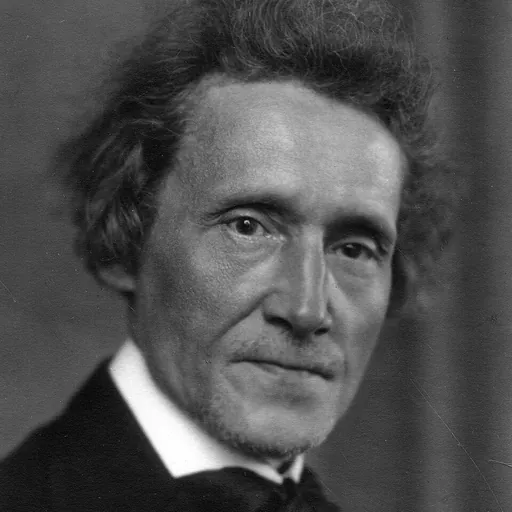
About Józef Albin Herbaczewski
Lived 1876 – 1944 (aged 68). Józef Albin Herbaczewski was a Lithuanian poet, writer, philologist, playwright, literary critic and opinion journalist.
Juozapas Albinas Herbačiauskas or Józef Albin Herbaczewski (20 October 1876 – 3 December 1944) was a Polish-Lithuanian occult writer, poet, literary critic, playwright, publicist and translator. Described as modernist and expressionist in style, Herbačiauskas was one of the pioneers of the essay in Lithuanian literature.
Biography Early life Juozas Albinas Herbačiauskas was born on 20 October 1876 in the village of (modern-day Vilkaviškis district) in Congress Poland within the Russian Empire. His father, Kajetonas Herbačiauskas (also spelled Gerbačiauskas, Garbukas) was probably a Polish sacristan. Herbačiauskas was a second cousin to Jonas Basanavičius. Herbačiauskas's brother Bolesław Szczęsny Herbaczewski also became a writer, and studied in Warsaw with Mikalojus Konstantinas Čiurlionis, but considered himself Polish.
Studies Herbačiauskas attended the Marijampolė Gymnasium, where he was expelled in 1894 for collecting Lithuanian language literature and possessing a Lithuanian calendar, which were prohibited by the Russian government. Mykolas Biržiška notes that Herbačiauskas's father was caught with a calendar with Polish characters (Latin characters were prohibited since the January Uprising), but Herbačiauskas himself took the blame. Herbačiauskas considered himself a herald of the Lithuanian cause among the Poles, which was expressed in his work Odrodzenie Litwy wobec idei polskiej (Lithuanian Revival and the Idea of Poland) of 1905.
In 1907, Herbačiauskas established and was the editor of the Gabija almanac, an almanac dedicated to the memory of Antanas Baranauskas.
In 1919-1920, he was in Vilnius and Kaunas mediating in Polish–Lithuanian negotiations on behalf of Józef Piłsudski and Leon Wasilewski. At the time, Herbačiauskas supported the idea of a union or federation of the two countries. Nothing came of the talks, and the conflict over Vilnius Region between the two countries only deepened. Herbačiauskas expressed his disappointment in a number of works: Kur eini, lietuvi? (Where are you going, Lithuanian?, 1919), Rozważania na czasie (Timely Considerations, 1921), and O Wilno i nie tylko o Wilno (About Vilnius and Not Only About Vilnius, 1922).
He returned to Lithuania by the invitation of Balys Sruoga and Vincas Krėvė-Mickevičius as an already established author and occultist. Especially since his writings of the time seemed suspicious to many and he faced accusations of disloyalty to the Polish state. Herbačiauskas titled himself the "ambassador of the kingdom of the dead", and it is said that he prophesized the Second World War. His trips to Poland and contacts with Polish politicians in 1927 and 1928 also raised suspicions. In 1933, Herbačiauskas and his wife moved to Poland, as Polish Minister of Foreign Affairs Józef Beck invited him to give lectures on Lithuania at the University of Warsaw.
Family About 1900, Herbačiauskas married Teona Maria Jastrzębowska, daughter of Władysław Jastrzębowski, a January Uprising fighter and illustrator, and Franciszka Teona née Stawecka. Jastrzębowska's grandfathers were Wojciech Jastrzębowski, a botanist, inventor and participant in the November Uprising, and Edward Michał Stawecki, publisher and participant in the Hungarian Revolution of 1848 and the January Uprising. Jastrzębowska's brother was Wojciech Jastrzębowski, a sculptor, soldier of the Polish Legions, who fought against the Bolsheviks and Ukrainians, in the interwar period rector of the Academy of Fine Arts in Warsaw and a senator. Their sister was Stefania Maria Jastrzębowska "Okrzejowa", a member of the Polish Military Organization attached to the 1st Brigade of the Polish Legions, she died tragically in Lublin on 14 April 1919.
Herbačiauskas' brother Boleslaw Szczęsny Herbaczewski (1875–1943) was a writer and official in the Polish administration. In 1919, during the period of the Polish-Lithuanian fighting and the Sejny uprising, he served as starosta of Sejny.
Don’t just read it —
keep it.
Full-length biographies made to live with: read them, listen on the way to work, watch them tonight.
- E-book
- Audio
- Video
Instant download · yours to keep · every purchase keeps this site free
Important facts
People in Józef Albin Herbaczewski's life
Named in this biography and alive at the same time



Related people
Same field, nearest in time
Contemporaries
People whose lives overlapped Józef Albin Herbaczewski's

Frequently asked questions
Who was Józef Albin Herbaczewski?
Lithuanian poet
When was Józef Albin Herbaczewski born?
Józef Albin Herbaczewski was born on 20 October 1876.
When did Józef Albin Herbaczewski die?
Józef Albin Herbaczewski died on 3 December 1944 in Kraków.
What was Józef Albin Herbaczewski's occupation?
Józef Albin Herbaczewski was a poet, writer, philologist, playwright, literary critic and opinion journalist.
What nationality was Józef Albin Herbaczewski?
Józef Albin Herbaczewski was Lithuanian.
Sources & further reading
· Wikipedia: Józef Albin Herbaczewski
· DBpedia: Juozapas Albinas Herbačiauskas
Cite this page
APA: Biography.guide. (2026). Józef Albin Herbaczewski. https://biography.guide/jozef-albin-herbaczewski/
MLA: "Józef Albin Herbaczewski." Biography.guide, https://biography.guide/jozef-albin-herbaczewski/.
Chicago: "Józef Albin Herbaczewski." Biography.guide. https://biography.guide/jozef-albin-herbaczewski/.
Data last updated: 2026-09-23 · Spot an error? Report a correction.
Portrait: Wikimedia Commons · author & licence
Page generated 2026-09-27 05:07 UTC