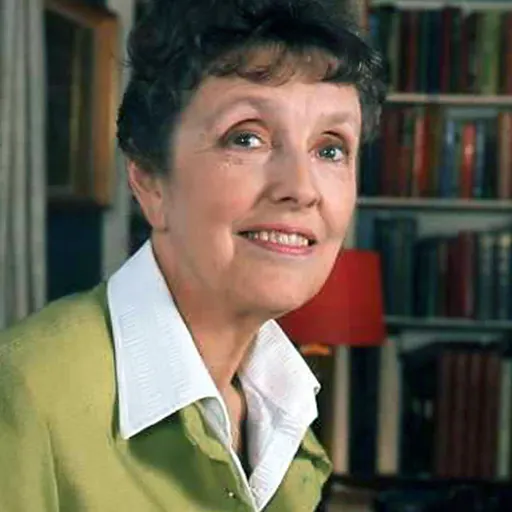
About Joyce Grenfell
Lived 1910 – 1979 (aged 69). Joyce Grenfell was a British comedian, singer, actor, songwriter, film actor and stage actor.
Joyce Irene Grenfell (née Phipps; 10 February 1910 – 30 November 1979) was an English diseuse, singer, actress and writer. She was known for the songs and monologues she wrote and performed, at first in revues and later in her solo shows. She never appeared as a stage actress, but had roles, mostly comic, in many films, including Miss Gossage in The Happiest Days of Your Life and Police Sergeant Ruby Gates in the St Trinian's series (from 1954). She was a well-known broadcaster on radio and television. As a writer, she was the first radio critic for The Observer, contributed to Punch and published two volumes of memoirs.
Born to an affluent Anglo-American family, Grenfell had abandoned early hopes of becoming an actress until she was invited to perform a comic monologue in a West End revue in 1939. Its success led to a career as an entertainer, giving her creations in theatres in five continents between 1940 and 1969.
Life and career Early years Born in Montpelier Square, Knightsbridge, London, Grenfell was the daughter of an American socialite, Nora Langhorne, one of five daughters of Chiswell Langhorne, (an American railway millionaire), and of the architect Paul Phipps, the grandson of Charles Paul Phipps and a second cousin of the diseuse Ruth Draper, in whose professional footsteps she followed. The Phipps family were wealthy clothiers, whose success allowed them to join the gentry of their native Wiltshire. Nancy Astor was one of her maternal aunts; and lived in a cottage on the estate, a mile from the main house, in the early years of her marriage.
Joyce Phipps had an upper middle-class London childhood. Among her friends was Virginia Graham, with whom she kept up a lifelong correspondence, and who wrote Grenfell's biography in the Oxford Dictionary of National Biography. Grenfell attended the Francis Holland School in central London, and the Claremont Fan Court School, in Esher, Surrey. She then went to a finishing school in Paris at the age of 17. After this she enrolled at the Royal Academy of Dramatic Art in London, but found the hard work of learning the craft of acting less glamorous than she had imagined and left after a single term. She supposed at the time that this "was the finish of my dreams of becoming an actress".
In 1927 she had met Reginald Pascoe Grenfell (1903–1993), a mining executive and later a lieutenant-colonel in the King's Royal Rifle Corps. They were married two years later, on 12 December 1929 at St Margaret's, Westminster, and remained together until her death nearly 50 years later. They were unable to have children of their own.
Early career In the late 1930s Grenfell contributed verses to Punch and helped to entertain her aunt's guests at Cliveden. After one lunch, J. L. Garvin, the editor of The Observer, engaged her as the paper's first radio critic. At an informal supper given by the BBC producer Stephen Potter in January 1939, she agreed to his request to entertain her fellow guests with a monologue of her own devising. This was "Useful and Acceptable Gifts", in which she played a gauche lecturer at a meeting of the Women's Institute. The impresario Herbert Farjeon was among the guests and he invited her to perform the piece in his forthcoming revue at the Little Theatre, London. The Tatler found her two monologues "quite the best items in the programme". The Sketch devoted a full page to photographs of her in her different characters. The Bystander thought that Grenfell challenged the celebrated Ruth Draper "on her own pitch ... carry[ing] off the acting honours of this gay and intelligent entertainment."
During the Second World War Grenfell wrote for and appeared in three more West End revues: Diversion and Diversion No. 2 at Wyndham's Theatre in 1940 and 1941, and Light and Shade at the Ambassadors in 1942. In early 1942 she met the composer Richard Addinsell. Together they wrote many successful songs including "I'm Going to See You Today" and "Turn Back the Clock", which, in the words of the biographer Janie Hampton, "aptly caught the public mood". For BBC radio, together with Potter, she wrote and starred in an occasional radio series called How to …, which ran intermittently from 1943 until 1962 offering humorous advice on how (and how not) to do things. In 1943 she made her only attempt at acting in a stage play: she resigned from the cast of a West End production of the American comedy Junior Miss after the first three days of rehearsal, finding that onstage she could only perform looking straight at an audience, and could not "act sideways", although she found some film acting roles "fun to do".
In the later years of the war Grenfell toured in the UK for ENSA, sometimes with Addinsell accompanying her at the piano. In late 1943 the head of ENSA, Basil Dean, invited the two to tour troop camps and hospitals in North Africa, the Middle East and elsewhere. Addinsell's health was too fragile to permit him to accept, and Grenfell recruited Viola Tunnard, later better known as a close colleague of Benjamin Britten. In 1944 and 1945 they performed in Algeria, Malta, Sicily, Italy, Iran, Iraq, India and Egypt. Coward had been a family friend since Grenfell was a girl. At first he had viewed her transition from amateur to professional with some doubt. Within a few years he had come to recognise her professionalism, her skill as a performer ("good in all she does on the stage") and the quality of her monologues, even if "she shouldn't write lyrics." In addition to her own two numbers, she sang Coward's comic catalogue of domestic disasters "That is the End of the News", "disguised as a schoolgirl with pigtails, all my make-up off, a shiny face and a terrible grin."
After the 1947 revue Tuppence Coloured, Grenfell developed new sketches including the first of her six Nursery School monologues, with the harassed teacher's recurring cry to one of her unseen charges, "George – don't do that...." In the 1951 revue Penny Plain she performed her "Joyful Noise" (music by Donald Swann), a parody of an amateur choir ("And some of us cannot sing much, And some can't sing at all, But how we love our outings to the Royal Albert Hall"). After this, Grenfell and Tunnard made another tour entertaining British troops in North Africa.
Joyce Grenfell Requests the Pleasure (1954) was her first more or less solo West End show (there were three dancers providing interludes between Grenfell's numbers). The Stage commented that any doubts that Grenfell could sustain a solo evening were quickly dispelled: blockindent|Miss Grenfell satirises, gently but inevitably, 20 different women, including the earnest but misguided devotee of health through rhythm, the arty curiosity-shop owner, the offhand sales-girl, the mercenary writer of children's stories (a gem, this!), the Victorian hostess whose husband had left her, the humourless American discoverer of folk songs of many lands, the shrinking but eager girl at the local palais, the incompetent but ardent Scottish dancer, the modern miss, and the Swedish visitor at a cocktail party.
During the 1950s and 1960s Grenfell appeared in several film roles including "Lovely Ducks", the shooting gallery attendant in Stage Fright (1950), Miss Gossage in The Happiest Days of Your Life (1950), Police Sergeant Ruby Gates in the St Trinian's series, Mrs Barham in The Americanization of Emily and Hortense Astor in The Yellow Rolls-Royce.
The rest of Grenfell's stage career was in a series of solo shows in London and on tour. Between 1957 and 1970 she gave her show Joyce Grenfell in Australia, Canada, Hong Kong, New Zealand, Singapore, Switzerland and the United States, as well as around Britain and in the West End. Her last live performance was at Windsor Castle for the Queen's Waterloo Dinner in 1973.
Last years and legacy Soon after the Windsor Castle show Grenfell was taken ill with an eye condition, which was subsequently diagnosed as cancer. As a convinced Christian Scientist (like her aunt Nancy), she was averse to doctors and hospitals. Her husband did not share her beliefs and prevailed on her to undergo treatment.
Grenfell was appointed an Officer of the Order of the British Empire (OBE) in 1946 for her war work. It was confirmed after her death that she was to have been made a Dame Commander (DBE) in the 1980 New Year Honours List. In 1998, the Royal Mail memorialised Grenfell with her image on a postage stamp as part of a series of stamps celebrating five comedians, drawn by Gerald Scarfe.
Grenfell's widower, Reggie Grenfell, died at their home at 34 Elm Park Gardens, Chelsea, London, on 31 March 1993, aged 89. A blue plaque is on the wall stating that Joyce Grenfell lived in Flat 8 from 1957 to 1979.
In 2002 her friend Janie Hampton published a biography, Joyce Grenfell. Maureen Lipman toured with the one-woman show Re: Joyce!, which she co-wrote with James Roose-Evans. In it she recreates some of Grenfell's best-known sketches. Lipman also presented the radio programme Choice Grenfell, compiled from Grenfell's writings. Roose-Evans also edited Darling Ma, a 1997 collection of Grenfell's letters to her mother.
Stage performances
The Little Revue – Little Theatre, London (1939–40) Diversion – Wyndham's Theatre, London (1940–41) Light and Shade – Ambassador's Theatre, London (1942) ENSA tours of UK (1942) ENSA tour of North Africa with Viola Tunnard (1944) ENSA tour of the Middle East and India with Viola Tunnard (1944–45) Sigh No More – Piccadilly Theatre, London (1945–46) Tuppence Coloured – UK tour, followed by Lyric Theatre, Hammersmith and Globe Theatre, London (1947–48) Penny Plain – St Martin's Theatre, London and UK tour (1951–52) Six-week tour for British troops in Libya and Egypt with Viola Tunnard (1952) Joyce Grenfell Requests the Pleasure – UK tour, then Fortune Theatre and St Martin's Theatre, London, then another UK tour (1954–55) Joyce Grenfell Requests the Pleasure – Bijou Theatre, New York City (1955) Joyce Grenfell at Home – tour of Canada, Washington DC and Lyceum Theatre, New York City, with George Bauer (1956) Tour of Northern Rhodesia with Viola Tunnard (1956) Joyce Grenfell at Home – tour of Dublin and the UK, then Lyric Theatre, Hammersmith (1957) Joyce Grenfell Bids You Good Evening – tour of North America, with George Bauer (1958) Meet Joyce Grenfell – Philip Street Theatre, Sydney, with William Blezard (1959) Meet Joyce Grenfell – tour of UK with William Blezard (1960) Joyce Grenfell – Haymarket Theatre, London, followed by UK tour with William Blezard (1962) Joyce Grenfell – tour of Australia with William Blezard (1963) Tours of Canada, Switzerland and Hong Kong with William Blezard (1964) Tours of UK, Australia and New Zealand with William Blezard (1966) Tours of UK, Hong Kong, US and Canada with William Blezard (1967) Tour of UK with William Blezard (1968) Tour of Australia and New Zealand with William Blezard (1969) Tours of UK and US with William Blezard (1970) Tour of UK with William Blezard (1972) Waterloo Dinner, Windsor Castle (1973)
Film performances Year Title Role Notes1941 A Letter from Home American Mother Short1943 The Demi-Paradise Sybil Paulson The Lamp Still Burns Dr. Barrett 1947 While the Sun Shines Daphne Designing Women Miss Arty Short1949 Alice in Wonderland Ugly Duchess / Dormouse Poet's Pub Miss Horsefell-Hughes Tuppence Coloured TV movieA Run for Your Money Mrs. Pargiet 1950 Stage Fright 'Lovely Ducks' The Happiest Days of Your Life Miss Gossage 1951 The Galloping Major Maggie the Waitress Laughter in Paradise Elizabeth Robson The Magic Box Mrs. Claire 1952 Penny Plain TV movieThe Pickwick Papers Mrs. Leo Hunter 1953Genevieve Hotel Proprietress The Million Pound Note Duchess of Cromarty 1954 Forbidden Cargo Lady Flavia Queensway The Belles of St. Trinian's P.W. Sgt. Ruby Gates 1957 The Good Companions Lady Parlitt Blue Murder at St Trinian's Sergeant Ruby Gates 1958 Happy Is the Bride Aunt Florence 1960 The Pure Hell of St Trinian's Sergeant Ruby Gates 1963 The Old Dark House Agatha Femm 1964 The Americanization of Emily Mrs. Barham The Yellow Rolls-Royce Hortense Astor
Publications
Notes, references and sources
Don’t just read it —
keep it.
Full-length biographies made to live with: read them, listen on the way to work, watch them tonight.
- E-book
- Audio
- Video
Instant download · yours to keep · every purchase keeps this site free
Important facts
People in Joyce Grenfell's life
Named in this biography and alive at the same time




Related people
Same field, nearest in time


Contemporaries
People whose lives overlapped Joyce Grenfell's





Frequently asked questions
Who was Joyce Grenfell?
British comedian, singer, actress (1910-1979)
When was Joyce Grenfell born?
Joyce Grenfell was born on 10 February 1910 in Knightsbridge.
When did Joyce Grenfell die?
Joyce Grenfell died on 30 November 1979 in Chelsea.
What was Joyce Grenfell's occupation?
Joyce Grenfell was a comedian, singer, actor, songwriter, film actor and stage actor.
What nationality was Joyce Grenfell?
Joyce Grenfell was British.
Sources & further reading
Cite this page
APA: Biography.guide. (2026). Joyce Grenfell. https://biography.guide/joyce-grenfell/
MLA: "Joyce Grenfell." Biography.guide, https://biography.guide/joyce-grenfell/.
Chicago: "Joyce Grenfell." Biography.guide. https://biography.guide/joyce-grenfell/.
Data last updated: 2026-09-21 · Spot an error? Report a correction.
Portrait: Wikimedia Commons · author & licence
Page generated 2026-09-27 04:59 UTC