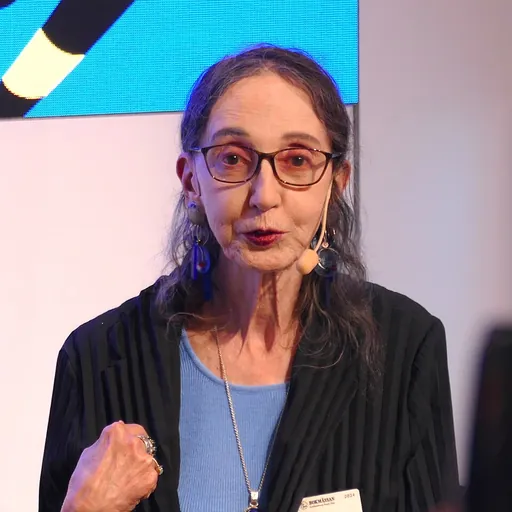
About Joyce Carol Oates
Born 1938. Joyce Carol Oates is an American playwright, poet, novelist, essayist, autobiographer and writer.
Joyce Carol Oates (born June 16, 1938) is an American writer. Oates published her first book in 1963, and has since published 58 novels, a number of plays and novellas, and many volumes of short stories, poetry, and nonfiction. Her novels Black Water, What I Lived For (1994), and Blonde (2000), and her short story collection Lovely, Dark, Deep: Stories (2014) were each finalists for the Pulitzer Prize. She has won many awards for her writing, including the National Book Award for her novel Them (1969), From 2016 to 2020, she was a visiting professor at the University of California, Berkeley, where she taught short fiction in the spring semesters. She now teaches at Rutgers University, New Brunswick.
Early life and education Oates was born in Lockport, New York, the eldest of three children of Carolina (née Bush), a homemaker of Hungarian descent, and Frederic James Oates, a tool and die designer. She grew up on her parents' farm outside the town.
Her brother, Fred Jr., and sister, Lynn Ann, were born in 1943 and 1956, respectively. Lynn Ann has autism Oates grew up in the working-class farming community of Millersport, New York.
Her widowed paternal grandmother, Blanche Woodside (née Morningstar), lived with the family and was "very close" to Joyce. After Blanche's death, Joyce learned that Blanche's father had killed himself. She also found out that Blanche was Jewish who hid her identity in order to escape persecution and chose not to disclose this to Oates. Oates eventually drew on aspects of her grandmother's life in writing the novel The Gravedigger's Daughter (2007). When Oates was a child, her next-door neighbor pleaded guilty to charges of arson and attempted murder of his family, and was sentenced to a prison term at Attica Correctional Facility.
Oates attended the same one-room school her mother had attended as a child. In her early teens, she read the work of Charlotte Brontë, Emily Brontë, Fyodor Dostoevsky, William Faulkner, Ernest Hemingway, and Henry David Thoreau, writers whose "influences remain very deep".
Oates began writing at the age of 14, when Blanche gave her a typewriter. She was the first in her family to complete high school.
University Oates earned a scholarship to attend Syracuse University, where she joined the Phi Mu fraternity for women. She found Syracuse to be "a very exciting place academically and intellectually", and trained herself by "writing novel after novel and always throwing them out when I completed them". It was at this point that Oates began reading the work of Franz Kafka, D. H. Lawrence, Thomas Mann, and Flannery O'Connor, and she noted, "these influences are still quite strong, pervasive". and graduated valedictorian from Syracuse University with a B.A. summa cum laude in English in 1960, and received her M.A. from the University of Wisconsin–Madison in 1961. She was a Ph.D. student at Rice University but left to become a full-time writer.
Evelyn Shrifte, president of the Vanguard Press, met Oates soon after Oates received her master's degree. "She was fresh out of school, and I thought she was a genius", Shrifte said. Vanguard published Oates' first book, the short-story collection By the North Gate, in 1963.
Career In 1964, the Vanguard Press published Oates' first novel, With Shuddering Fall, when she was 26 years old. In 1966, she published "Where Are You Going, Where Have You Been?", a short story dedicated to Bob Dylan and written after listening to his song "It's All Over Now, Baby Blue". The story is loosely based on the serial killer Charles Schmid, also known as "The Pied Piper of Tucson". It has been anthologized many times and adapted as a 1985 film, Smooth Talk, which starred Laura Dern. In 2008, Oates said that of all her published work, she is most noted for "Where Are You Going, Where Have You Been?"
Another early short story, "In the Region of Ice" (Atlantic Monthly, August 1966
Since then, she has published an average of two books a year. Frequent topics in her work include rural poverty, sexual abuse, class tensions, desire for power, female childhood and adolescence, and occasionally the "fantastic". Violence is a constant in her work, even leading Oates to have written an essay in response to the question: "Why Is Your Writing So Violent?"
In the early 1980s, Oates began writing stories in the Gothic and horror genres; in her foray into these genres, Oates said she was "deeply influenced" by Kafka and felt "a writerly kinship" with James Joyce. She is a fan of poet and novelist Sylvia Plath, describing Plath's sole novel The Bell Jar as a "near perfect work of art", but though Oates has often been compared to Plath, she disavows Plath's romanticism about suicide, and among her characters, she favors cunning, hardy survivors, both women and men.
In 1996, Oates published We Were the Mulvaneys, a novel following the disintegration of an American family, which became a best-seller after being selected by Oprah's Book Club in 2001.
Since at least the early 1980s, Oates has been rumored to be a favorite to win the Nobel Prize in Literature by oddsmakers and critics.
One review of Oates's 1970 story collection The Wheel of Love characterized her as an author "of considerable talent" but at that time "far from being a great writer".
Oates's 2006 short story "Landfill" was criticized because it drew on the death, several months earlier, of John A. Fiocco Jr., a 19-year-old New Jersey college student.
In 1998, Oates received the F. Scott Fitzgerald Award for Achievement in American Literature, which is given annually to recognize outstanding achievement in American literature.
In The Frenzy, released in June 2026, Oates' fiction is a collection of psychologically suspenseful short stories.
Ontario Review Oates founded The Ontario Review, a literary magazine, in 1974 in Canada, with Raymond J. Smith, her husband and fellow graduate student, who would eventually become a professor of 18th-century literature. The magazine's mission, according to Smith, the editor, was to bridge the literary and artistic culture of the US and Canada: "We tried to do this by publishing writers and artists from both countries, as well as essays and reviews of an intercultural nature." In 1978, Sylvester & Orphanos published A Sentimental Education, a collection of short stories.
In 1980, Oates and Smith founded Ontario Review Books, an independent publishing house. In 2004, Oates described the partnership as "a marriage of like minds – both my husband and I are so interested in literature and we read the same books; he'll be reading a book and then I'll read it – we trade and we talk about our reading at meal times ...". Foer recalled later that Oates took an interest in his writing and his "most important of writerly qualities, energy", noting that she was "the first person to ever make me think I should try to write in any sort of serious way. And my life really changed after that."
Oates has taught creative short fiction at UC Berkeley since 2016 and offers her course in spring semesters.
Views Religion Oates was raised Catholic, but as of 2007 she identified as an atheist. In an interview with Commonweal magazine, Oates stated: "I think of religion as a kind of psychological manifestation of deep powers, deep imaginative, mysterious powers which are always with us."
Politics Oates supports gun control. She was a vocal critic of US President Donald Trump and his policies during his first term, both in public and on Twitter.
Oates opposed the shuttering of cultural institutions on Trump's first inauguration day as a protest against the President, stating that this "would only hurt artists. Rather, cultural institutions should be sanctuaries for those repelled by the inauguration."
In January 2019, Oates stated that "Trump is like a figurehead, but I think what really controls everything is just a few really wealthy families or corporations."
On November 8, 2025, Oates took to X (formerly Twitter), posting a critique of a user that most readers assumed to be X owner Elon Musk, though he is not named specifically. Her critique read "So curious that such a wealthy man never posts anything that indicates that he enjoys or is even aware of what virtually everyone appreciates— scenes from nature, pet dog or cat, praise for a movie, music, a book (but doubt that he reads); pride in a friend's or relative's accomplishment; condolences for someone who has died; pleasure in sports, acclaim for a favorite team; references to history. In fact he seems totally uneducated, uncultured. The poorest persons on Twitter may have access to more beauty & meaning in life than the 'most wealthy person in the world.'"Extensive online discourse ensued, with coverage of the "feud" published in Newsweek, Forbes, Slate, Literary Hub, and other periodicals. LitHub 's story included the headline "Elon Musk Gets Roasted on His Own Platform by Joyce Carol Oates," observing that Oates' post gets "...at the heart of Elon's broken humanity, itemizing with a surgeon's precision that which he has so clearly lost, and will likely never regain." Musk replied with a flurry of posts critiquing Oates' body of literary work and her use of punctuation in the original critical post, as well as seemingly adjusting the tone and content of subsequent posts in the following weeks to include more references to his media consumption and coworkers. working from "8 till 1 every day, then again for two or three hours in the evening." Her prolificacy has become one of her best-known attributes, although often discussed disparagingly. Martyn Bedford wrote in Literary Review that "perhaps she is a victim of her own productivity." In 2004, The Guardian noted that, "Nearly every review of an Oates book, it seems, begins with a list [of her publication totals]". In The New York Review of Books in 2007, Michael Dirda suggested that disparaging criticism of Oates "derives from reviewer's angst: How does one judge a new book by Oates when one is not familiar with most of the backlist? Where does one start?"
In 2006, The Times listed them, On Boxing (1987), Black Water, and High Lonesome: New & Selected Stories, 1966–2006 (2006) as "The Pick of Joyce Carol Oates". In 2007, Entertainment Weekly listed its Oates favorites as Wonderland, Black Water, Blonde, I'll Take You There (2002), and The Falls (2004). In 2003, Oates herself said that she thinks she will be remembered for, and would most want a first-time Oates reader to read, them and Blonde, although she "could as easily have chosen a number of titles."
In a 2025 interview with The New Yorker, the novelist Garth Risk Hallberg suggested that "a new [Oates] reader should begin with the collection High Lonesome." He also deemed the novels them, I Lock My Door Upon Myself (1990), and Blonde "essential" Oates works.
Personal life
Oates met Raymond J. Smith, a fellow graduate student, at the University of Wisconsin–Madison, and they married in 1961.
After six months of near suicidal grieving for Smith, Oates met Charles G. Gross, a professor in the Psychology Department and Neuroscience Institute at Princeton, at a dinner party at her home. In early 2009, Oates and Gross were married. On April 13, 2019, Oates announced via Twitter that Gross had died at the age of 83.
As a diarist, Oates began keeping a detailed journal in 1973, documenting her personal and literary life; it eventually grew to "more than 4,000 single-spaced typewritten pages". In 2008, Oates said she had "moved away from keeping a formal journal" and instead preserved copies of her e-mails. While running, Oates mentally envisions scenes in her novels and works out structural problems in already-written drafts; she formulated the germ of her novel You Must Remember This (1987) while running, when she "glanced up and saw the ruins of a railroad bridge", which reminded her of "a mythical upstate New York city in the right place". She is an honorary member of the Simpson Literary Project, which annually awards the $50,000 Simpson/Joyce Carol Oates Literary Prize to a mid-career writer. She has served as the Project's artist-in-residence several times.
Don’t just read it —
keep it.
Full-length biographies made to live with: read them, listen on the way to work, watch them tonight.
- E-book
- Audio
- Video
Instant download · yours to keep · every purchase keeps this site free
Important facts
People in Joyce Carol Oates's life
Named in this biography and alive at the same time





Related people
Same field, nearest in time


Contemporaries
People whose lives overlapped Joyce Carol Oates's




Frequently asked questions
Who is Joyce Carol Oates?
American author (born 1938)
When was Joyce Carol Oates born?
Joyce Carol Oates was born on 16 June 1938 in Lockport.
What is Joyce Carol Oates's occupation?
Joyce Carol Oates is a playwright, poet, novelist, essayist, autobiographer and writer.
What nationality is Joyce Carol Oates?
Joyce Carol Oates is American.
Sources & further reading
· Wikipedia: Joyce Carol Oates
Cite this page
APA: Biography.guide. (2026). Joyce Carol Oates. https://biography.guide/joyce-carol-oates/
MLA: "Joyce Carol Oates." Biography.guide, https://biography.guide/joyce-carol-oates/.
Chicago: "Joyce Carol Oates." Biography.guide. https://biography.guide/joyce-carol-oates/.
Data last updated: 2026-09-20 · Spot an error? Report a correction.
Page generated 2026-09-27 05:09 UTC