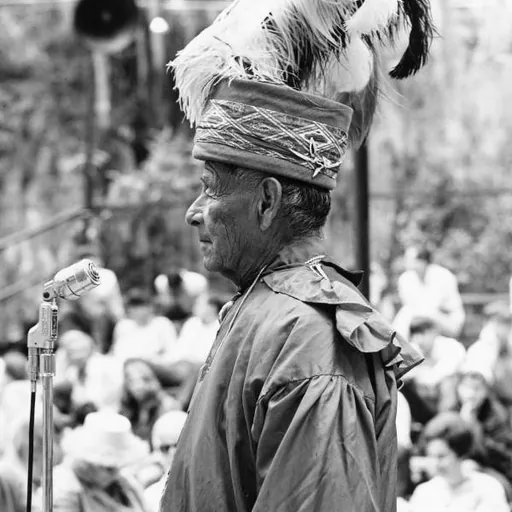
Josie Billie
Seminole medicine man and Baptist Minister
About Josie Billie
Lived 1887 – 1980 (aged 92). Josie Billie was an American medicine man, christian minister, baptist and seminole.
Josie Billie (12 December 1887 – 26 February 1980) was a Mikasuki-speaking Seminole medicine man, doctor, and Baptist preacher. Billie was a member of the Panther clan of the Seminoles in southern Florida. He actively collaborated with American anthropologists and researchers like Ethel Cutler Freeman, Frances Densmore, Robert Greenlee, Robert Solenberger (on behalf of anthropologist Frank G. Speck) and William Sturtevant. Billie served as a public spokesman for the Florida Seminoles and created recordings of traditional folk songs and information about the traditional Seminole religion. As of 2017, his camp is part of the Tribal Register of Historic Places.
Early life Josie Billie (Katcha Nokofti) was born on December 12, 1887 to Connie Pajo (Ko-nip-ha-tco) and Little Nancy Osceola. Connie Pajo was also known as Billie Cornpatch. Billie was married to Lucy Tiger (Seminole, 1901–1983).
Josie Billie lived on the Big Cypress Indian Reservation in Hendry County, Florida. holds significant political and judicial authority at the annual Green Corn Dance. Because of his role as a prominent medicine man, Josie Billie acted as the spokesman for the Big Cypress Reservation in 1944 when the Seminole wanted separated cattle trustees. Freeman continued to conduct fieldwork almost every winter between 1940 and 1943 among the Seminole people. Freeman studied Seminole religion and myths and recorded discussions with Josie Billie related to Seminole religion and magic in private sessions at the Archbold Biological Station in 1954. Sturtevant met Josie Billie in the summer of 1950 and wrote his doctoral dissertation about Billie, who informed much of his research. Sturtevant noted that Billie was older than two of his other informants, Joseph Jumper and Chester Billie, and much more knowledgeable about Seminole tradition.
Like Densmore and Freeman, Sturtevant also recorded Seminole folk songs in 1951, including “Scalping Sickness,” “Bear Sickness with blowing,” “Bear sickness without blowing,” “Lullaby,” “Father Dance,” “Snake Dance,” and “Crazy Dance.” Josie Billie was one of the performers for these recordings. Also, like Freeman, Sturtevant studied changes in myths over time related to acculturation and contact with surrounding white settlements, stating that “Josie Billie is older, much more knowledgeable on Seminole tradition, and in most senses less ‘acculturated’ than my other two informants." Josie Billie therefore appeared in many ethnographic recordings of traditional Seminole myths and folk songs.
Beyond his work with American anthropologists, Josie Billie also participated in the Florida Folk Festival, which was founded in 1953 and still exists today. Josie Billie also performed folk songs that were recorded by Foster Bares at the Florida Folk Festivals, including the 1959 Florida Folk Festival in White Springs. Billie's role as an informant for these American anthropologists and participant in this festival facilitated access to traditional Seminole folk songs, myths, and medical knowledge.
Religious practice Josie Billie and 21 other Seminole were baptized into the Southern Baptist Church at the Big Cypress schoolhouse on January 21, 1945. After Josie Billie converted to Christianity, he became a Baptist minister in 1945 and attended the Florida Baptist Institute in 1946. After his conversion to Christianity and ordination, his medicine bundle passed to his brother Ingraham Billie. However, there is still controversy around the passing of the medicine bundle, as Billie continued to practice traditional Seminole medicine after converting to Christianity. Billie's conversion reflects growing numbers of Christian converts among the Seminole tribe. Many Mikasuki-speaking Seminole, who had originally settled the Big Cypress Reservation in 1937, later converted to Christianity. Leadership of the annual Green Corn Dance passed to Ingraham Billie, keeper of the medicine bundle and Billie's brother.
While the medicine man was a key spiritual and political role in the Seminole tribe, the influence of medicine men declined as representatives of Christian denominations, most notably Baptists, became active among the Seminole. Among the two establishments that Billie helped to create related to cattle trustees, persons who had converted to Christianity were often selected for higher trustee positions. In the 1940s, about one third of the Florida Seminole population had become Southern Baptists, as a result of contact with Baptists ministers like Stanley Smith.
Stanley Smith was an Oklahoma Creek Baptist minister who facilitated the conversion of many Seminole to Christianity at Big Cypress, where Josie Billie lived. Originally sent by the Creek, Seminole, Witchita Baptist Association, his appointment with the Seminole tribe was confirmed by the Home Mission Board of the Southern Baptist Convention in January 1944. After he arrived on the Big Cypress Reservation in 1943, Smith was involved in Josie Billie's conversion to Christianity. By the early 1950s, Baptists churches had been established on three of the four major reservations, and Bill Osceola ministered to the Big Cypress reservation. Baptist, English-speaking cattle owners dominated the political hierarchy of the Seminole Tribe of Florida from its formation in 1957 through the 1970s.
Later life By the 1970s, the Native American population in Florida was roughly 2,000. The Seminole continued to live in southern Florida on four main reservations: Hollywood, Big Cypress, Brighton, and the Tamiami Trail. Josie Billie remained active at the Big Cypress Indian Reservation until his death on February 26, 1980, at the age of 92.
The Seminole Tribe of Florida Tribal Historic Preservation Office completed an investigation of the Josie Billie Camp in 2017, and it is now listed on the Tribal Register of Historic Places. The Josie Billie Camp is in the northern part of the Big Cypress Indian Reservation, where it was believed to have been established by Josie Billie and Lucy Tiger in 1943.
Recordings of Josie Billie's discussions on Seminole culture and religion are part of the Ethel Cutler Freeman Papers and the William C. Sturtevant Papers at the National Anthropological Archives.
Don’t just read it —
keep it.
Full-length biographies made to live with: read them, listen on the way to work, watch them tonight.
- E-book
- Audio
- Video
Instant download · yours to keep · every purchase keeps this site free
Important facts
People in Josie Billie's life
Named in this biography and alive at the same time



Related people
Same field, nearest in time


Contemporaries
People whose lives overlapped Josie Billie's





Frequently asked questions
Who was Josie Billie?
Seminole medicine man and Baptist Minister
When was Josie Billie born?
Josie Billie was born on 12 December 1887 in Immokalee.
When did Josie Billie die?
Josie Billie died on 24 February 1980.
What was Josie Billie's occupation?
Josie Billie was a medicine man, christian minister, baptist and seminole.
What nationality was Josie Billie?
Josie Billie was American.
Sources & further reading
Cite this page
APA: Biography.guide. (2026). Josie Billie. https://biography.guide/josie-billie/
MLA: "Josie Billie." Biography.guide, https://biography.guide/josie-billie/.
Chicago: "Josie Billie." Biography.guide. https://biography.guide/josie-billie/.
Data last updated: 2026-09-22 · Spot an error? Report a correction.
Portrait: Wikimedia Commons · author & licence
Page generated 2026-09-27 05:00 UTC