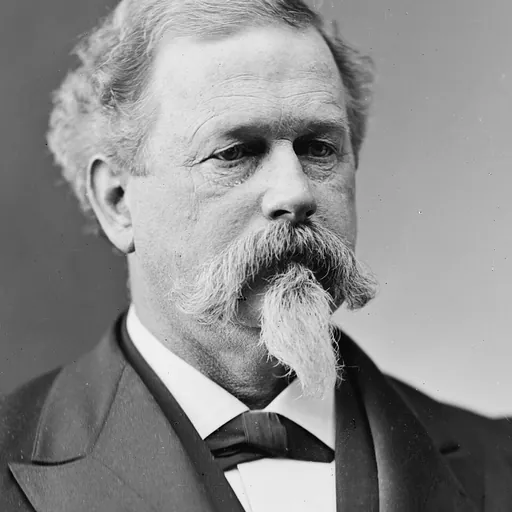
Joseph Roswell Hawley
Union Army general, politician
About Joseph Roswell Hawley
Lived 1826 – 1905 (aged 78). Joseph Roswell Hawley was an American politician, military officer, governor, major general, jurist and lawyer.
Civil War
Hawley served in the Federal army with distinction throughout the Civil War, rising from the rank of captain to that of brevet major general of volunteers. In April 1861, Hawley helped recruit and organize an infantry company. He was mustered into the three-month 1st Connecticut Infantry with the rank of captain of Company A on April 22. He first saw combat at the First Battle of Bull Run in July, receiving praise from his brigade commander, General Erasmus D. Keyes.
After mustering out, he then assisted Col. Alfred H. Terry in raising the 7th Connecticut Infantry, a three-year regiment, and was named as lieutenant colonel. He participated in the Port Royal Expedition in November, and commanded the forces assigned to garrison two captured forts. He was a part of the four-month siege that culminated in the capture of Fort Pulaski in April 1862. Again, he commanded the garrison force. With Colonel Terry's promotion to brigade command, Hawley succeeded him as commander of the 7th Connecticut, leading the regiment in the battles of James Island and Pocotaligo.
He was in Brannan's expedition to Florida in January 1863, and commanded the post at Ferandina, near Jacksonville. In April, he participated in an unsuccessful expedition to capture Charleston, South Carolina. In the summer, he commanded a brigade on Morris Island during the siege of Charleston, and was involved in the attacks on Fort Wagner in September. During the autumn, he procured enough Spencer breech-loading rifles to outfit his regiment with the rapid-fire weapon.
The following year, Hawley commanded a brigade under General Truman Seymour in the Battle of Olustee in Florida. He and his men were reassigned to the front lines in Virginia as a part of Terry's Division, X Corps, Army of the James. He was in the battles of Drewry's Bluff, Deep Run, Derbytown Road, and other actions near Bermuda Hundred and Deep Bottom. With openings created by battlefield losses and reassignments, Hawley commanded a division during the Siege of Petersburg and was promoted in September 1864 to brigadier general of volunteers. Concerned over keeping the peace during the November elections, Hawley commanded a hand-picked brigade shipped to New York City to safeguard the election process.
In January 1865, Hawley succeeded his mentor Alfred Terry as divisional commander when Terry was sent to command troops in the attacks on Fort Fisher. Hawley later joined him in North Carolina as chief of staff for the X Corps. After the capture of Wilmington, North Carolina, Hawley took over command of the forces in southeastern North Carolina. In June, following the surrender of the Confederate armies, Hawley rejoined Terry and served as chief of staff for the Department of Virginia, serving until October when he returned home to Connecticut. He was breveted as a major general in September 1865, and mustered out of the army on January 15, 1866.
Postbellum
After the war, Hawley served as governor of Connecticut from April 1866 to April 1867, but was defeated in the 1867 election. A few months after stepping down from that office, he bought the Hartford Courant newspaper, which he combined with the Press. Under his editorship, this became the most influential newspaper in Connecticut and one of the leading Republican papers in the country.
Hawley was the permanent chairman of the Republican National Convention in 1868, was a delegate to the conventions of 1872, 1876 and 1880. He represented Connecticut in the U.S. Congress from December 1872 until March 1875 and again in 1879–81, having lost the two elections in between. From 1873 to 1876, he served as president of the United States Centennial Commission, which planned and ran the Centennial Exhibition in Philadelphia. He was also a trustee of Hamilton College and received his LL. D. degree in 1875 (and another one from Yale in 1888).
Hawley was a United States senator from 1881 to 1905, being one of the key Republican leaders both in the House and the Senate. He was chairman of the committee on civil service, and vigorously promoted civil service reform legislation. He also chaired a special committee called to investigate the production of military ordnance and warships. In this capacity, he wrote a detailed report on the heavy steel industry and gun making in the United States and England.
He died in Washington, D.C., two weeks after stepping down from the Senate after his fourth term. At the time, he was the longest serving senator from Connecticut.
Hawley has a battery named in his honor at Fort Baldwin, in Phippsburg, Maine.
Personal life Hawley and his wife Harriet Foote Hawley adopted one of her nieces after the girl's parents died; as Margaret Foote Hawley she would go on to achieve some note as a painter of portrait miniatures. Harriet's sister Kate Foote Coe lived with the Hawleys while she was working as a newspaper correspondent in Washington.
Don’t just read it —
keep it.
Full-length biographies made to live with: read them, listen on the way to work, watch them tonight.
- E-book
- Audio
- Video
Instant download · yours to keep · every purchase keeps this site free
Important facts
People in Joseph Roswell Hawley's life
Named in this biography and alive at the same time



Related people
Same field, nearest in time




Contemporaries
People whose lives overlapped Joseph Roswell Hawley's





Frequently asked questions
Who was Joseph Roswell Hawley?
Union Army general, politician (1826–1905)
When was Joseph Roswell Hawley born?
Joseph Roswell Hawley was born on 31 October 1826 in Laurinburg.
When did Joseph Roswell Hawley die?
Joseph Roswell Hawley died on 18 March 1905 in Washington, D.C..
What was Joseph Roswell Hawley's occupation?
Joseph Roswell Hawley was a politician, military officer, governor, major general, jurist and lawyer.
What nationality was Joseph Roswell Hawley?
Joseph Roswell Hawley was American.
Sources & further reading
· Wikipedia: Joseph Roswell Hawley
Cite this page
APA: Biography.guide. (2026). Joseph Roswell Hawley. https://biography.guide/joseph-roswell-hawley/
MLA: "Joseph Roswell Hawley." Biography.guide, https://biography.guide/joseph-roswell-hawley/.
Chicago: "Joseph Roswell Hawley." Biography.guide. https://biography.guide/joseph-roswell-hawley/.
Data last updated: 2026-09-20 · Spot an error? Report a correction.
Page generated 2026-09-27 05:09 UTC