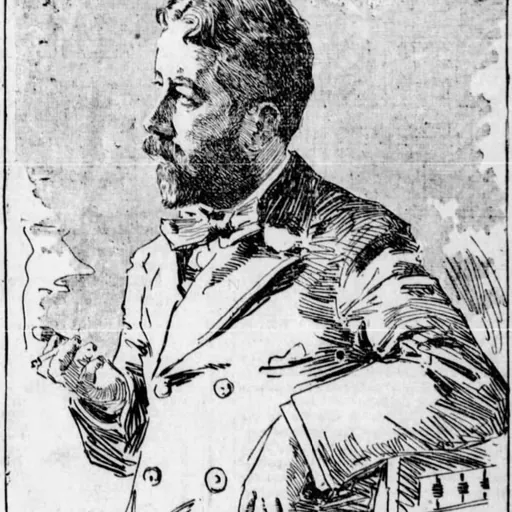
About Joseph Redding
Lived 1859 – 1932 (aged 72–73). Joseph Redding was an American composer and lawyer.
Joseph Deighn Redding (September 13, 1859 – November 21, 1932) was an American composer, librettist, lyricist, lawyer, and civil servant. He is best known for arguing the United States Supreme Court legal case United States v. Kagama and for his contributions to American opera which include writing the libretto to Victor Herbert's Natoma and composing the score to Fay Yen Fah (1925). The latter work was the first grand opera composed by an American to have its premiere in Europe, an achievement for which Redding was awarded the Legion of Honour by the government of France. He served terms as president of the San Francisco Arts Administration and San Francisco's Bohemian Club, and also served a term as commissioner of the California Department of Fish and Game. A talented chess polymath, he was an amateur chess player who won several games against recognized chess masters, including Johannes Zukertort and George H. D. Gossip. and the Central Pacific Railroad. He also was a regent for California State University and served a term as president of the board of the California Academy of Sciences. At the time of Benjamin Redding's death in 1882 he was serving a term as commissioner of the California Department of Fish and Game (CDFG). B. B. Redding's ties to the CDFG dated back to its inception in 1852 and he was an active force in that agency until his death thirty years later. Both Joseph Redding and his younger brother, Dr. George Herbert Huntington Redding (born December 16, 1860), would later serve terms as commissioner of the CDFG after the death of their father. He attended schools in the Sacramento City Unified School District before entering the California Military Academy (CMA) in Oakland, California, in 1871. He began playing chess seriously while attending this school.
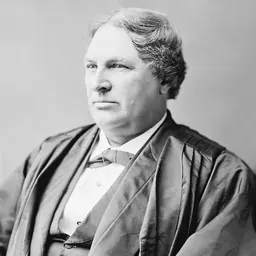
Law career Supreme Court Justice Samuel Freeman Miller, author of the opinion for United States v. Kagama. After graduating from Harvard, Redding joined the San Francisco legal firm of Hall McAllister at the age of 21. In 1886, at the age of 27, he argued an important case before the United States Supreme Court, United States v. Kagama, in which he represented Kagama, a Yurok Native American accused of murder. A landmark case, it upheld the constitutionality of the Major Crimes Act of 1885.
In 1886 Redding won another important case, Goldmark v. Kreling, before the United States District Court for the Northern District of California which was an early ruling protecting the rights of authors and composers. This ruling set an important legal precedent and was frequently cited as a protection for the copyright of sound recordings in California prior to the passage of the CLASSICS Act in 1972.
Redding developed a reputation for his skill in court cases involving contested wills. One of his prominent cases in this area involved the will of American industrialist and railway magnate Collis Potter Huntington. Redding represented Clara von Hatzfeldt in a suit in which she claimed part of the inheritance under the argument that she was Huntington's adopted daughter. Redding was successful in earning her a judgement of six million dollars in that 1901 court case; and his fee of $300,000 was at that time the highest amount of money earned by a lawyer in a court case inclusive of only individual people as opposed to corporations. In 1886 he was elected president of the San Francisco Arts Administration. Redding was a friend of composer and conductor Henry Kimball Hadley, and it is largely through Redding's advocacy that Hadley was appointed the first music director of the San Francisco Symphony in 1911. Hadley tasked Redding with finding the San Francisco Symphony's first concertmaster, and accordingly Dutch violinist Eduard Tak was hired following Redding's recommendation.
Redding wrote the libretto for Hadley's 1912 musical The Atonement of Pan, another work created for performance by the BC. Henry A. Melvin, an associate justice of the Supreme Court of California, was a member of the BC and a talented amateur performer in the BC's musical entertainments. Melvin recorded the song "Noon and night" from The Atonement of Pan for Victor Talking Machine Company ("Victor") in 1913.
Natoma
Redding wrote the libretto to the 1911 opera Natoma by composer Victor Herbert which starred Mary Garden in the title role at its premiere. The opera premiered at the Metropolitan Opera House in Philadelphia. This was followed by further performances at the Metropolitan Opera in New York. Andreas Dippel's opera company also toured the work nationally for performances in more than thirty American cities.
Reviews for Redding's libretto were harsh, particularly by the New York press. Opera scholar Elise Kuhl Kirk dismissed criticisms of Redding's libretto, stating that "such harsh diatribe was unfounded and no doubt illustrated American critics' unwillingness to accept the new verismo literature as viable opera. Perhaps what they missed was operatic thunder, as in the work of Verdi, Wagner, and Puccini. What they got was closer to Viennese operetta with recitative."
Despite negative reviews, Natoma was more warmly received by audiences and had a better overall popular reception. The aria "Spring Song" proved popular enough that it was later recorded twice for Victor by sopranos Lucy Isabelle Marsh and Alma Gluck.
Fay Yen Fah, "Song to Hawaii", and other compositions
Redding composed the music to the 1917 musical The Land of Happiness. premiered at the Monte Carlo Opera in February 1925. It was the first grand opera composed by an American to have its premiere in Europe, Tenor John McCormack recorded his song "Sweet Peggy O'Neil" for Victor in 1920. In the year Redding published this song, Hawaiian-themed music dominated the market in sheet music sales by America's music publishing empire, Tin Pan Alley.
Despite Redding's lack of connection to the state, the music editor for "Song to Hawaii", Charles E. King, was from Hawaii, and the work was recorded by several musicians who were either Hawaiian or specialized in performing Hawaiian music. These included separate recordings made by the Hawaiian entertainers Johnny Noble (with the Olympic swimmer and musician Samuel Kahanamoku), Keaumoku Louis, Prince Lei Lani, and Frank Ferera; the latter of whom recorded the work with guitarist Anthony Franchini. The song was also recorded by vaudeville entertainers Wright & Dietrich (Horace Wright and Rene Dietrich), who later became more closely associated with jazz. Johnny Noble also recorded Redding's song "The Winds from Over the Sea" in 1929.
Family life and death Joseph Redding married Myra Cowles in 1882. Their marriage lasted until Redding's death fifty years later. Their daughter, Josephine Redding, received the Legion of Honor for her work as a nurse in France during World War I. She died at the age of twenty-two in New York.
Joseph Redding died on November 21, 1932, at the age of 73 after a seven-year-long illness. His death occurred in his sleep at his home at 1000 Mason St. San Francisco, California. His funeral occurred at Grace Cathedral, San Francisco, on November 23, 1932.
Don’t just read it —
keep it.
Full-length biographies made to live with: read them, listen on the way to work, watch them tonight.
- E-book
- Audio
- Video
Instant download · yours to keep · every purchase keeps this site free
Important facts
People in Joseph Redding's life
Named in this biography and alive at the same time




Related people
Same field, nearest in time


Contemporaries
People whose lives overlapped Joseph Redding's



Frequently asked questions
Who was Joseph Redding?
American composer and writer
When was Joseph Redding born?
Joseph Redding was born in 1859 in Sacramento.
When did Joseph Redding die?
Joseph Redding died in 1932 in San Francisco.
What was Joseph Redding's occupation?
Joseph Redding was a composer and lawyer.
What nationality was Joseph Redding?
Joseph Redding was American.
Sources & further reading
Cite this page
APA: Biography.guide. (2026). Joseph Redding. https://biography.guide/joseph-redding/
MLA: "Joseph Redding." Biography.guide, https://biography.guide/joseph-redding/.
Chicago: "Joseph Redding." Biography.guide. https://biography.guide/joseph-redding/.
Data last updated: 2026-09-20 · Spot an error? Report a correction.
Page generated 2026-09-27 05:09 UTC