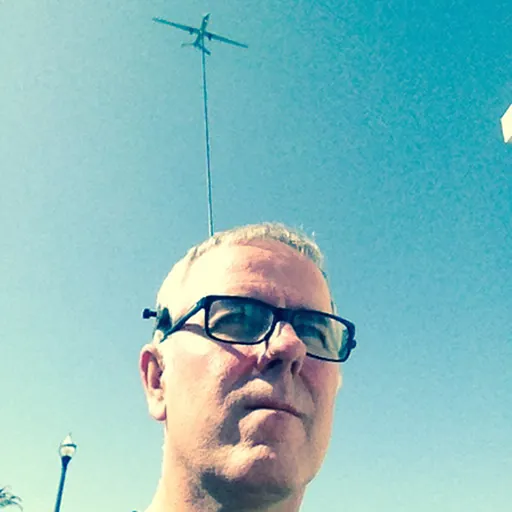
About Joseph DeLappe
Born 1963. Joseph DeLappe is an American visual artist and university teacher.
Joseph DeLappe (born 1963) is an American artist and academic best known for his art intervention pieces that explore contemporary issues in politics through new media installations and interactive gaming performances.
Early life and education
A native of San Francisco, California, Joseph DeLappe graduated from Sacred Heart High School and went on to receive his Associate in Arts from City College of San Francisco followed by a Bachelor's in Graphic Design from San Jose State University as well as an MA Computers in Art & Design and a Master of Fine Arts in Pictorial Arts from the CADRE Laboratory for New Media. DeLappe directed the media program at the University of Nevada in Reno for twenty-three years and now works as a professor at Abertay University in Dundee, Scotland.
Work
Joseph DeLappe has always worked in new media through which he expresses a distaste for power politics, stating that when he got engaged in political art it defined his purpose. DeLappe's 2006 intervention, Dead-in-Iraq, used an on-line game, America's Army, created by the US Defense department as a recruitment tool to memorialize the name and date of death for every US service member who died in Iraq, observing that America's Army was nothing but a sanitized metaphor to entice young people to enlist.
In 2008, DeLappe merged on-line gaming, performance art and sculpture in a reenactment of Mahatma Gandhi's 1930 Salt March at Eyebeam Art and Technology, NYC and in Second Life, a virtual world and then recreating Gandhi (Cardboard Gandhi, 2008–2009) out of corrugated cardboard in monumental scale.
The performance, "Quake," required six people connected to the same “Quake III Arena,” an online shooter server, to reenact an episode of “Friends.” Each performer would log onto the system as a character from the sitcom and type the performance in the messaging system of the game. The dialogue would be simultaneously typed into the messaging system and recited by the player. The performers were constantly killed and respawned to continue the performance. The first performance was conducted in the Digital Media Studio of UNR in 2002, and the second was in the Sheppard Fine Arts Gallery in 2003. This is another instance, much like the intervention in “dead-in-iraq,” where DeLappe uses a computer game for cultural and political criticism. In this computer game, there are no real consequences of dying and the main objective is to kill as many people as possible. The slaughtering of the “Friends” characters as opposed to nameless users works to expose the shameful violence present in many computer games.
Joseph DeLappe combines his knowledge of communications media, concrete materials and on-line gaming with political commentary stating that games are a huge cultural phenomenon ignored by most of the art world, something he finds challenging.
In October 2014 DeLappe initiated the Rubber Stamp Currency Intervention. He created a set of three stamps for the public to purchase and participate in this project. The three stamps consisted of a drone, a person holding their hands above their head, and a wave line.
His art practice also has a participatory aspect as demonstrated in his 2014 In Drones We Trust where he produced Predator drone rubber stamps that were intended to mark currency in a manner that people seeing the money would begin to think about the drones being used to target people in foreign countries.
Killbox (2016), created with Malath Abbas, Tom DeMajo, and Albert Elwin (as the Biome Collective) is a computer game that explores the cost and consequences of drone warfare. The work is a two-player game named after a military term, Kill box, for an area targeted for destruction. The game, a winner of a 2016 Bafta award expresses the inhumanity of drone strikes.
DeLappe was the Director of the Digital Media program in the Art Department of the University of Nevada, Reno until 2017 when he accepted the position of Professor of Games and Tactical Media at Abertay University in Dundee, Scotland. DeLappe was named a Fellow in Fine Arts by the Guggenheim Foundation in 2017.
Don’t just read it —
keep it.
Full-length biographies made to live with: read them, listen on the way to work, watch them tonight.
- E-book
- Audio
- Video
Instant download · yours to keep · every purchase keeps this site free
Important facts
Related people
Same field, nearest in time





Contemporaries
People whose lives overlapped Joseph DeLappe's



Frequently asked questions
Who is Joseph DeLappe?
digital media artist (born 1963)
When was Joseph DeLappe born?
Joseph DeLappe was born in 1963 in San Francisco.
What is Joseph DeLappe's occupation?
Joseph DeLappe is a visual artist and university teacher.
What nationality is Joseph DeLappe?
Joseph DeLappe is American.
Sources & further reading
Cite this page
APA: Biography.guide. (2026). Joseph DeLappe. https://biography.guide/joseph-delappe/
MLA: "Joseph DeLappe." Biography.guide, https://biography.guide/joseph-delappe/.
Chicago: "Joseph DeLappe." Biography.guide. https://biography.guide/joseph-delappe/.
Data last updated: 2026-09-23 · Spot an error? Report a correction.
Portrait: Wikimedia Commons · author & licence
Page generated 2026-09-27 05:07 UTC