
About Joseph Curran
Lived 1906 – 1981 (aged 75). Joseph Curran was an American trade unionist.
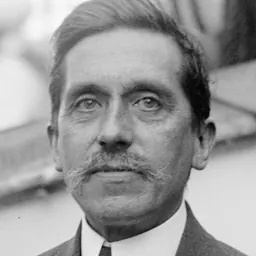
Joseph Curran (March 1, 1906 – August 14, 1981) was a merchant seaman and an American labor leader. He was founding president of the National Maritime Union (or NMU, now part of the Seafarers International Union of North America) from 1937 to 1973, and a vice president of the Congress of Industrial Organizations (CIO).
Early life Curran was born on Manhattan's Lower East Side. His father died when he was two years old, and his mother boarded with another family. He attended parochial school, but when he was 14 he was expelled during the seventh grade for truancy.
He worked as a caddie and factory worker before finding employment in 1922 in the United States Merchant Marine. He worked as an able seaman and boatswain, washing dishes in restaurants when not at sea and sleeping on a Battery Park bench at night. It was during this time that he received his lifelong nickname "Big Joe."
The strike was essentially a sitdown strike. Curran and the crew refused to leave the ship, for the owners would have simply replaced them with strikebreakers. The crew remained aboard and continued to do all their duties except cast off the lines. The California remained tied up for three days.
In May 1937, Curran and other leaders of his nascent movement formed the National Maritime Union (NMU). The Seamen's Defense Committee reconstituted itself as a union. It held its first convention in July, and 30,000 seamen switched their membership from the ISU to the NMU. Curran was elected president of the new organization. Elected secretary-treasurer of the union was Jamaican-born Ferdinand Smith. Thus, from its inception NMU was racially integrated. Within six years, nearly all racial discrimination was eliminated in hiring, wages, living accommodations and work assignments.
A hallmark of the new union was the formation of hiring halls in each port. The hiring halls ensured a steady supply of experienced seamen for passenger and cargo ships, and reduced the corruption which plagued the hiring of able seamen. The hiring halls also worked to combat racial discrimination and promote racial harmony among maritime workers.
Within a year, the NMU had more than 50,000 members, and most American shippers were under contract. Stripped of most of its membership, the ISU became almost moribund.
Curran was also a strong supporter of far-left-wing causes. In August 1940, he urged unions in the New York City area to support an "emergency peace mobilization" opposing U.S. entry into the war in Europe.
In 1940, Curran was elected a vice president of the CIO. When the CIO and AFL merged in 1955, he was appointed a vice president of the merged organization as well.
Greater New York Industrial Union
Curran was also elected president of the Greater New York Industrial Union.
The Greater New York Industrial Union (GNYIU) was organized by the CIO in 1940 as a central labor body for New York City. CIO-affiliated local unions in New York City and the nearby vicinity were its primary members. At the organization's founding convention on July 24, 1940, Curran was elected president of GNYIU. Saul Kills, a member of the American Newspaper Guild, was elected its secretary-treasurer. The organization had 250 local union affiliates, representing more than 500,000 workers.
By 1948, however, there were serious concerns about communist infiltration of the GNYIU. The United States House of Representatives appointed a special investigative subcommittee to look into the matter. Several CIO unions were investigated, including the United Electrical, Radio and Machine Workers of America, the Teachers Union of the City of New York, the United Public Workers of America and the Department Store Employees Union.
CIO president Philip Murray appointed a three-member board in October 1940 to forestall the House investigation. The board members reported to Murray that Curran, Kills and the GNYIU executive board had been advocating pro-communist policies. The GNYIU was on the verge of supporting Henry A. Wallace in an independent bid for president as well. The national CIO executive board revoked the charter of the GNYIU in November 1940. Curran denied that he was a communist before both the CIO executive board and the Joint Commerce Committee of the U.S. Congress. Curran became increasingly anti-communist thereafter. In 1946, he pulled the NMU out of a Committee for Maritime Unity which was led by Harry Bridges. After World War II, he purged thousands of members and elected leaders he suspected of harboring communist sympathies.
In 1960, Curran, along with several other union leaders, visited the Soviet Union as "guests of the USSR Sea and River Workers Union," visiting various ports and Khrushchev in the Kremlin, according to the October, 1960, edition of the journal "USSR."
Other roles Curran served on a number of other committees, boards and positions with other organizations.
For many years, he was chair of the AFL-CIO's Maritime Committee. He was also co-chair of the Labor-Management Maritime Committee, a body established by AFL-CIO maritime unions and U.S. shipping companies to discuss and resolve labor issues.
Curran was also vice chairman of the Seafarer's Section of the International Transportworkers Federation, an international confederation of maritime unions.
Curran was also vice president of the United Seamen's Service.
Retirement and death Curran suffered a heart attack in 1953 which left him somewhat less physically able than before. Over the next few years, he gradually cut back his workload, and stopped visiting local unions and attending most union meetings. In the mid-1960s, he turned over most of the union's daily business to secretary-treasurer Shannon J. Wall.
By the mid-1960s, Curran was being criticized for ignoring his members' needs and concerns. His $85,000-a-year salary was one of the highest in the American labor movement even though his union was small and shedding members. He enjoyed an unlimited expense account, and traveled by chartered jet and private limousine. He cajoled the union's executive board into building a massive, Art Deco headquarters in Manhattan, and had the edifice named after himself.
In 1966, with the surreptitious help of NMU staffers, union member James B. Morrissey challenged the results of Curran's 1966 re-election as fraudulent. The Department of Labor agreed, but a re-run election did not change the outcome.
In 1973, shortly after Curran won re-election for a thirteenth term as union president, Morrissey sued Curran and charged him with misappropriating union funds. In a precedent-setting ruling in Morrissey and Ibrahim v. Curran, 650 F.2d 1267 (1981), the U.S. Court of Appeals for the Second Circuit established a broad right for union members to sue union officers for improper financial practices.
Morrissey's barrage of lawsuits against Curran led him to retire suddenly on March 5, 1973. Long-time secretary-treasurer Shannon J. Wall succeeded him as president.
Curran retired to Boca Raton, Florida. He died there of cancer on August 14, 1981.
Family Curran married Retta Toble, a former cruise ship waitress, in 1939. The couple had a son, Joseph Paul Curran, Jr. Retta Curran died in 1963. In 1965, Curran married Florence Stetler.
Don’t just read it —
keep it.
Full-length biographies made to live with: read them, listen on the way to work, watch them tonight.
- E-book
- Audio
- Video
Instant download · yours to keep · every purchase keeps this site free
Important facts
People in Joseph Curran's life
Named in this biography and alive at the same time





Related people
Same field, nearest in time




Contemporaries
People whose lives overlapped Joseph Curran's

Frequently asked questions
Who was Joseph Curran?
American sailor and labor leader (1906-1981)
When was Joseph Curran born?
Joseph Curran was born on 1 March 1906 in New York City.
When did Joseph Curran die?
Joseph Curran died on 14 August 1981 in Boca Raton.
What was Joseph Curran's occupation?
Joseph Curran was a trade unionist.
What nationality was Joseph Curran?
Joseph Curran was American.
Sources & further reading
Cite this page
APA: Biography.guide. (2026). Joseph Curran. https://biography.guide/joseph-curran-trade-unionist/
MLA: "Joseph Curran." Biography.guide, https://biography.guide/joseph-curran-trade-unionist/.
Chicago: "Joseph Curran." Biography.guide. https://biography.guide/joseph-curran-trade-unionist/.
Data last updated: 2026-09-22 · Spot an error? Report a correction.
Page generated 2026-09-27 05:23 UTC