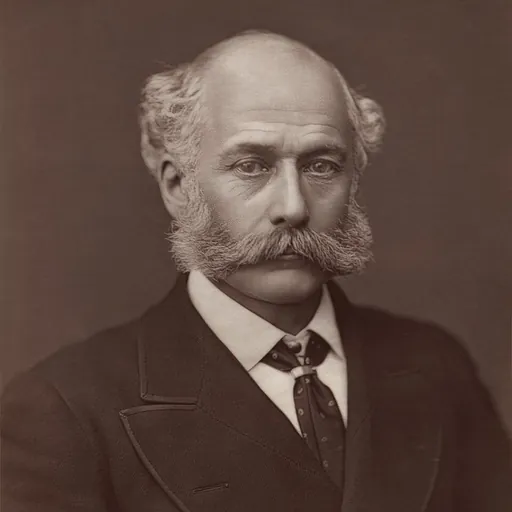
About Joseph Bazalgette
Lived 1819 – 1891 (aged 71). Joseph Bazalgette was a British architect, civil engineer and engineer.
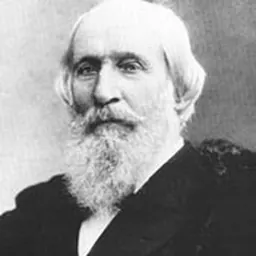
Sir Joseph William Bazalgette (; 28 March 1819 – 15 March 1891) was a British civil engineer. As Chief Engineer of London's Metropolitan Board of Works, his major achievement was the creation of the London Main Drainage, the sewerage system for central London, in response to the Great Stink of 1858, which was instrumental in relieving the city of cholera epidemics, while beginning to clean the River Thames.
According to the BBC, "Bazalgette drove himself to the limits in realising his subterranean dream".
Bazalgette was knighted by Queen Victoria in 1875, and he was elected President of the Institution of Civil Engineers in 1883. He later designed the second and current Hammersmith Bridge, which opened in 1887.
Early life Bazalgette was born at Hill Lodge, Clay Hill, Enfield, the son of Joseph William Bazalgette (1783–1849), a retired Royal Navy captain, and Theresa Philo née Pilton (1796–1850). His grandfather, Louis Bazalgette, a tailor and financier, was an economic migrant from Ispagnac in Lozère, France, who became principal tailor to the Prince of Wales, the future George IV, and subsequently became wealthy.
In 1827, when Joseph was eight years old, the family moved into a newly built house in Hamilton Terrace, St John's Wood, London. He spent his early career articled to the noted engineer Sir John Macneill, working on railway projects, and amassed sufficient experience (partly in China and Ireland) in land drainage and reclamation to enable him to set up his own London consulting practice in 1842.
In 1845, the house in Hamilton Terrace was sold, and Joseph married Maria Kough, from County Kilkenny in Ireland. At the time, he was working so hard on expanding the railway network that two years later, in 1847, he suffered a nervous breakdown.
In 1847, while he was recovering, London's Metropolitan Commission of Sewers ordered that all cesspits should be closed and that house drains should connect to sewers and empty into the Thames. A cholera epidemic ensued, killing 14,137 Londoners in 1849.
Bazalgette was appointed Assistant Surveyor to the Metropolitan Commission in 1849, taking over as Engineer in 1852 after his predecessor died of "harassing fatigues and anxieties." Soon after, another cholera epidemic struck in 1853, killing 10,738. Medical opinion at the time held that cholera was caused by foul air: a so-called "miasma". Physician John Snow had earlier advanced a different explanation, which is now known to be correct: cholera was spread by contaminated water, but his view was not then generally accepted. The innovative use of Portland cement has ensured the tunnels were in good order 150 years later.
The plan included major pumping stations at Deptford (1864) and at Crossness (1865) on the Erith marshes, both on the south side of the Thames and at Abbey Mills (in the River Lea valley, 1868) and on the Chelsea Embankment (close to Grosvenor Bridge; 1875), north of the river. The outflows were diverted downstream, where they were collected in two large sewage outfall systems on the north and south sides of the Thames, called the Northern and Southern Outfall Sewers. The sewage from the Outfall Sewers was originally collected in balancing tanks in Beckton and Crossness, then dumped, untreated, into the Thames at high tide. The system was opened by Albert Edward, Prince of Wales in 1865, although the whole project was not completed for another ten years.
Partly as a result of the Princess Alice disaster, extensive sewage treatment facilities were built to replace the balancing tanks in Beckton and Crossness in 1900. The biological treatment of sewage was first undertaken in 1885 by William Dibdin, chief chemist for the Metropolitan Board of Works, based on a proposal by Edward Frankland.
The basic premise of this expensive project, that miasma spreads cholera infection, was wrong. However, the new sewer system's unintended consequence was removing the causal bacterium from the water supply, thereby eliminating cholera in areas served by the sewers. Instead of the incorrect premise causing the project to fail, the new sewers mostly eliminated cholera, and also decreased the incidence of typhus and typhoid epidemics.
Bazalgette's capacity for hard work was remarkable; every connection to the sewerage system by the various Vestry Councils had to be checked, and Bazalgette did this himself, and the records contain thousands of linen plans with handwritten comments in Indian ink on them "Approved JWB", "I do not like 6" used here and 9" should be used. JWB", and so on.
Family
Scion of a Huguenot family, Bazalgette was brought up at 17 Hamilton Terrace, St John's Wood in North West London. In 1845, he moved to Morden, then in 1873 to Arthur Road, Wimbledon, where he died in 1891. He was buried at nearby St Mary's Church, Wimbledon.
Married in 1845, in Westminster, to Maria Kough (1819–1902), daughter of Edward Kough, Esq., JP (Ireland), of Wexford. Sir Joseph and Lady Bazalgette had eleven children, many who had issue: Joseph William Bazalgette, born 20 February 1846 Charles Norman Bazalgette, Esq. (3 March 1847 – 1888), married 6 December 1879 Ethel Mary Boustead (daughter of John Boustead (15 April 1822 British Ceylon – 20 October 1904 15 Princes Gate, Knightsbridge, London) Norman Bazalgette, gentleman (1883–1911), married 1903 Mary Leslie MacGregor (daughter of John S. MacGregor, of Edinburgh)
A Greater London Council blue plaque commemorates him at 17 Hamilton Terrace in St John's Wood in North London, as well as a formal monument on the Victoria Embankment by the River Thames in central London. In July 2020, the City of London Corporation announced that a new public space west of Blackfriars Bridge, formed following construction of the Thames Tideway Scheme, would be named the Bazalgette Embankment.
Dulwich College has a scholarship in his name, either for design and technology or for mathematics and science.
Other works
Albert Embankment (1869) Victoria Embankment (1870) Chelsea Embankment (1874) Maidstone Bridge (1879) Albert Bridge (1884; modifications) Putney Bridge (1886) Hammersmith Bridge (1887) The Woolwich Free Ferry (1889) Battersea Bridge (1890) Shaftesbury Avenue (1886) Early plans for the Blackwall Tunnel (1897) Charing Cross Road Garrick Street Northumberland Avenue Proposal for what later became Tower Bridge
Notable descendants Christopher Bazalgette (great-grandson), amateur cricketer Will Bazalgette (great-grandson), RAFVR pilot awarded the Victoria Cross Edward Bazalgette (great-great-grandson), musician and television director Sir Peter Bazalgette (great-great-grandson), television producer
Note
Don’t just read it —
keep it.
Full-length biographies made to live with: read them, listen on the way to work, watch them tonight.
- E-book
- Audio
- Video
Instant download · yours to keep · every purchase keeps this site free
Important facts
People in Joseph Bazalgette's life
Named in this biography and alive at the same time



Related people
Same field, nearest in time


Contemporaries
People whose lives overlapped Joseph Bazalgette's




Frequently asked questions
Who was Joseph Bazalgette?
British civil engineer (1819–1891)
When was Joseph Bazalgette born?
Joseph Bazalgette was born on 28 March 1819 in London Borough of Enfield.
When did Joseph Bazalgette die?
Joseph Bazalgette died on 15 March 1891 in Wimbledon.
What was Joseph Bazalgette's occupation?
Joseph Bazalgette was an architect, civil engineer and engineer.
What nationality was Joseph Bazalgette?
Joseph Bazalgette was British.
Sources & further reading
· Wikipedia: Joseph Bazalgette
Cite this page
APA: Biography.guide. (2026). Joseph Bazalgette. https://biography.guide/joseph-bazalgette/
MLA: "Joseph Bazalgette." Biography.guide, https://biography.guide/joseph-bazalgette/.
Chicago: "Joseph Bazalgette." Biography.guide. https://biography.guide/joseph-bazalgette/.
Data last updated: 2026-09-22 · Spot an error? Report a correction.
Portrait: Wikimedia Commons · author & licence
Page generated 2026-09-27 05:04 UTC