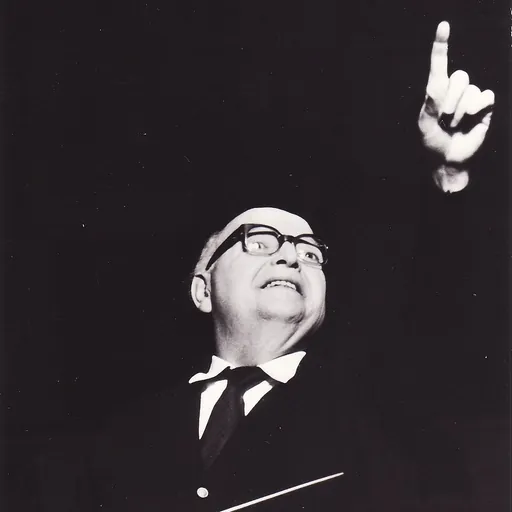
About Josef Krips
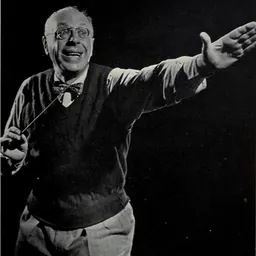
Lived 1902 – 1974 (aged 72). Josef Krips was an Austrian conductor and violinist.
Josef Alois Krips (8 April 1902 – 13 October 1974) a medical doctor and amateur singer, and his mother was Aloisia, née Seitz. and Eusebius Mandyczewski. Krips moved to Belgrade, where he worked for a year with the Belgrade Opera and Philharmonic, until Yugoslavia also became involved in World War II. For the rest of the war, he worked as an "industrial clerk" in a food factory.
On his return to Austria at the end of the war in 1945 Krips was one of the few conductors allowed to perform, since he had not worked under the Nazi régime. He was the first to conduct the Vienna Philharmonic and the Salzburg Festival in the postwar period. Working with fellow conductors Clemens Krauss and Karl Böhm, Krips helped restore the Vienna State Opera and Vienna Philharmonic to their prewar levels.
From 1950 to 1954, Krips was principal conductor of the London Symphony Orchestra. Afterwards, he led the Buffalo Philharmonic Orchestra from 1954 to 1963. Under Krips' leadership, the orchestra expanded in the length of its performance season and in the number of musicians that the orchestra employed. Krips took the orchestra on tours in eastern United States and Canada, including the Maritime Provinces. Krips appeared as guest conductor with the New York Philharmonic in the Fall of 1964, and the program included works by Brahms, Copland, and Schumann.
Leaving the Buffalo Philharmonic in 1963, During his tenure with the San Francisco Symphony, Krips conducted 210 works with the orchestra. Of these works, 91 works were by twentieth century composers. In San Francisco, Krips conducted several world premieres. Krips premiered the First Symphony of Kirke Mechem in 1965. He premiered William Walton's Improvisations on an Impromptu of Benjamin Britten in 1970.
Krips made his Covent Garden debut in 1947 and his Metropolitan Opera in 1966, guest conducting frequently from then on. Krips made his first appearance with the Boston Symphony Orchestra at the 1968 Berkshire Festival.
Personal life
Krips was married three times.
His first wife was Maria Heller, a woman who was widowed and ran a fashion salon in Aussig (a small town, located between Dresden and Prague), where Krips had his first engagement abroad. The wedding took place in Vienna on August 12, 1925. His wife died in a car accident in June 1928.
His second wife was Maria "Mitzi" Wilheim, a singer whom Krips had coached and married in 1947. The two remained together until Wilheim's death on April 8, 1969. According to Ewen and the New York Times, Krips' third wife was "the former Baroness Marietta von Prohaska." The Boston Symphony Orchestra Archives has a photograph of Krips and his third wife attending a Tanglewood concert, where she is identified as "Baroness Harriet Prochazka." Krips' third wife died on 12 January 2015.
Krips' brother, Henry Krips, emigrated to Australia and was the chief conductor of the South Australian Symphony Orchestra (later known as the Adelaide Symphony Orchestra) for 23 years (1949–1972).
Recordings Krips's first recording was made for Odeon Records in Vienna on 13 January 1937, conducting the Orchestra of the Wiener Staatsoper in two Rossini numbers from the Bernhard Paumgartner operetta Rossini in Neapel, sung by Richard Tauber. Krips conducted the Vienna premiere of the work ten days earlier.
In 1955, Krips made a critically acclaimed recording of Mozart's Don Giovanni with the Vienna State Opera featuring Cesare Siepi, Fernando Corena, Walter Berry, Suzanne Danco, Lisa Della Casa and Hilde Gueden.
In 1956, Krips conducted the Symphony of the Air in stereo recordings of the five Beethoven piano concertos with Arthur Rubinstein for RCA Victor. With the RCA Victor Symphony Orchestra Rubinstein and Krips also recorded Brahms Second Piano Concerto in 1958.
During the years 1950–1958, Krips recorded various works by Mozart, Brahms, Dvořák, Schubert, Schumann, Tchaikovsky, Beethoven, Johann Strauss, Richard Strauss, Haydn, and Mendelssohn. These performances included the Vienna Philharmonic, the London Symphony Orchestra, and the Israel Philharmonic.
In January 1960, Krips recorded Beethoven's nine symphonies for Everest Records. For this set of recordings, Krips conducted the London Symphony Orchestra, and for the Symphony No. 9, the soloists included Donald Bell, baritone, Jennifer Vyvyan, soprano, Rudolf Petrak, tenor, and Shirley Carter (later known as Shirley Verrett), mezzo-soprano. The BBC Chorus, under the chorusmaster Leslie Woodgate also performed. This series of recordings was popular with music critics and the public, and the recordings have been reissued several times in authorized and in bootleg editions.
Krips did not make any commercial recordings with the San Francisco Symphony, although many of his concerts were broadcast in stereo by San Francisco station KKHI.
Don’t just read it —
keep it.
Full-length biographies made to live with: read them, listen on the way to work, watch them tonight.
- E-book
- Audio
- Video
Instant download · yours to keep · every purchase keeps this site free
Important facts
People in Josef Krips's life
Named in this biography and alive at the same time




Related people
Same field, nearest in time



Contemporaries
People whose lives overlapped Josef Krips's




Frequently asked questions
Who was Josef Krips?
Austrian musician (1902-1974)
When was Josef Krips born?
Josef Krips was born on 8 April 1902 in Vienna.
When did Josef Krips die?
Josef Krips died on 13 October 1974 in Geneva.
What was Josef Krips's occupation?
Josef Krips was a conductor and violinist.
What nationality was Josef Krips?
Josef Krips was Austrian.
Sources & further reading
Cite this page
APA: Biography.guide. (2026). Josef Krips. https://biography.guide/josef-krips/
MLA: "Josef Krips." Biography.guide, https://biography.guide/josef-krips/.
Chicago: "Josef Krips." Biography.guide. https://biography.guide/josef-krips/.
Data last updated: 2026-09-20 · Spot an error? Report a correction.
Portrait: Wikimedia Commons · author & licence
Page generated 2026-09-27 04:57 UTC