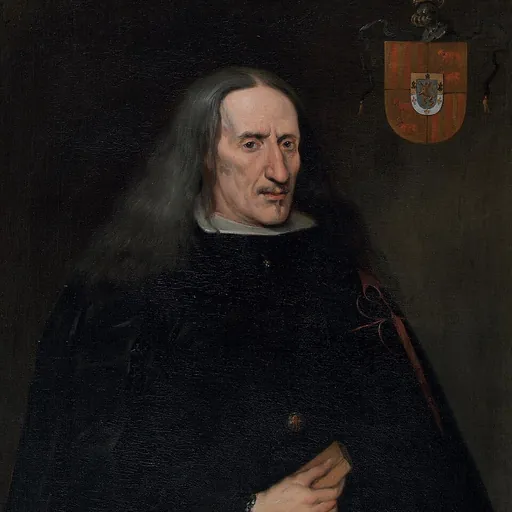
About José Pellicer
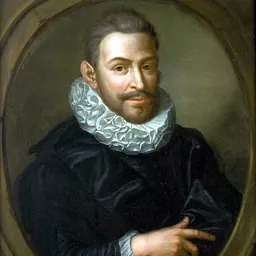
Lived 1602 – 1679 (aged 77). José Pellicer was a writer, literary critic, historian, genealogist, poet and chronicler.
José Pellicer de Ossau y Tovar (26 April 160216 December 1679) was a Spanish publicist for Gaspar de Guzmán, Count-Duke of Olivares, poet, genealogist, and historian of Castile and Aragon.
Life José Pellicer was born in Zaragoza on 26 April 1602. He studied Grammar in Consuegra under Juan García Genzor and later moved to Salamanca, where he studied Canon Law at the University. He went on to study Philosophy at the University of Alcalá; on 11 May 1620 he married Sebastiana de Ocáriz, by whom he had five children: Marco Antonio, Hipólito Raimundo, Enrique Manuel, Luisa María and Antonia Josefa.
Pellicer was a skilled linguist, trained in Latin, Greek, Hebrew, Italian, and French. His classical learning is displayed in his commentary on the works of Góngora. He held the title of chronicler of Castile and of Aragon from 1629 and 1637, respectively. In 1640, he was appointed to the exalted position of chief chronicler (cronista mayor) of Aragon, filling the vacancy left by the death of Bartolomé Leonardo de Argensola. At that time, Pellicer was also named official examiner of the histories and chronicles of all the kingdoms ruled by the Aragonese crown. He conceived the ambitious project of writing a general history of Spain that could supersede Juan de Mariana's classic Historiae de rebus Hispaniae.
An expert genealogist, he also stood out as a poet and literary critic. In 1630, he published an annotated edition of Luis de Góngora's most famous and difficult poems. His incisive analyses of Góngora's subtleties are of great assistance to any student of the poet. Pellicer corresponded on historical subjects with the archeologist and poet Rodrigo Caro. His wide and miscellaneous historical lore is manifested in his genealogical and other works, which show, however, more the spirit of an antiquarian than of a historian.
As a man of letters he is most known for his polemical writings, and his poems on historical and mythological subjects, such as the Rapto de Ganímedes (1624), or the Poema de Lucrecia (1622). Pellicer's poetry is deeply influenced by Góngora. His Spanish translation of John Barclay's Argenis (1626) was highly praised by Baltasar Gracián.
Pellicer is considered the greatest genealogist of seventeenth-century Spain. He exercised a truly modern critical spirit in genealogical studies, basing his work on written sources – published works, archival and public documents – and correcting the claims of contemporary printed works he found to be in error. His work was continued toward the end of the century by Luis de Salazar y Castro.
His Avisos históricos, which recount current events occurred from May 1639 to November 1644, are considered an early example of Spanish journalism. The Avisos históricos report a wide range of national and international news and represent an important source of information for the historian of early modern Spain. Pellicer's Avisos were published in Antonio Valladares' Semanario erudito, vols. 31-33 (Madrid, 1787–91).
Pellicer died in Madrid on 16 December 1679.
Works
Enrique Tierno Galván (ed.), Avisos históricos, Madrid, Taurus (col. Ser y Tiempo. Temas de España, vol. 31), 1965.
Don’t just read it —
keep it.
Full-length biographies made to live with: read them, listen on the way to work, watch them tonight.
- E-book
- Audio
- Video
Instant download · yours to keep · every purchase keeps this site free
Important facts
People in José Pellicer's life
Named in this biography and alive at the same time




Related people
Same field, nearest in time
Contemporaries
People whose lives overlapped José Pellicer's






Frequently asked questions
Who was José Pellicer?
Spanish writer and literary critic (1602-1679)
When was José Pellicer born?
José Pellicer was born on 26 April 1602 in Zaragoza.
When did José Pellicer die?
José Pellicer died on 16 December 1679 in Madrid.
What was José Pellicer's occupation?
José Pellicer was a writer, literary critic, historian, genealogist, poet and chronicler.
What nationality was José Pellicer?
José Pellicer's recorded nationality: Kingdom of Aragon.
Sources & further reading
· DBpedia: José Pellicer de Ossau Salas y Tovar
Cite this page
APA: Biography.guide. (2026). José Pellicer. https://biography.guide/jose-pellicer/
MLA: "José Pellicer." Biography.guide, https://biography.guide/jose-pellicer/.
Chicago: "José Pellicer." Biography.guide. https://biography.guide/jose-pellicer/.
Data last updated: 2026-09-23 · Spot an error? Report a correction.
Portrait: Wikimedia Commons · author & licence
Page generated 2026-09-27 05:05 UTC