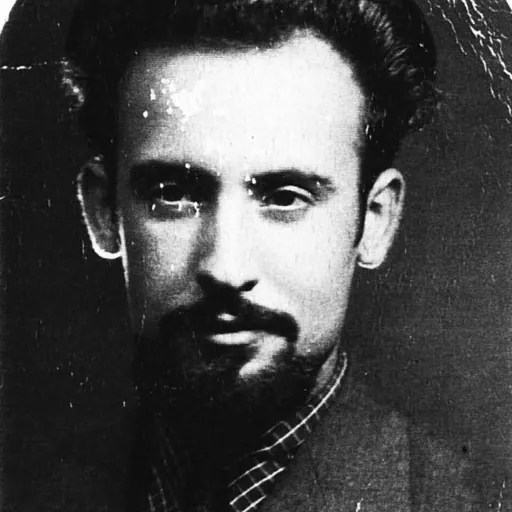
About José Pellicer Gandía
Lived 1912 – 1942 (aged 30). José Pellicer Gandía was a Spanish anarcho-syndicalist, anarchist, trade unionist, mechanic, politician and anarchist militiaman.
José Pellicer Gandía (1912–1942) was a Valencian anarchist revolutionary primarily known for commanding the Iron Column during the Spanish Civil War. Born into a well-off family, after the establishment of the Second Spanish Republic, Pellicer became an anarchist and joined the Confederación Nacional del Trabajo (CNT). He participated in a series of anarchist uprisings throughout the 1930s, establishing defence committees that set the foundation for the militias that would fight in the civil war. He co-founded the Iron Column, which pushed the Nationalists out of Valencia and into the province of Teruel, where he fought on the front lines. During the war, he came into conflict with the Communist Party of Spain (PCE), with the Servicio de Información Militar (SIM) arresting and imprisoning him. Despite this, he continued to fight in the Spanish Republican Army after the Iron Column's dissolution, as commander of the 83rd Mixed Brigade and later within the 109th Mixed Brigade. With the end of the war, he was captured and executed by the Francoist dictatorship.
Biography Early life and activism On 28 April 1912, José Pellicer Gandía was born in Valencia. He grew up in a well-off family, which provided him with a decent education. Interested in political philosophy and versed in multiple languages, he was soon attracted to anarchism, due to a sense of altruism and idealism. Around this time, during an Esperanto class, he met the Valencian physician Maruja Veloso, whom he later married. Pellicer worked as a bookkeeper, joining the Confederación Nacional del Trabajo (CNT) in 1932.
He later joined the Federación Anarquista Ibérica (FAI), within which he participated in a series of anarchist uprisings throughout the mid-1930s, including an insurrectionary strike in Manresa in 1932 and the Revolution of 1934. He also participated in the founding of the CNT defence committees, which later evolved into militia formations that would fight against the Spanish coup of July 1936.
Spanish Civil War With the outbreak of the Spanish Civil War, Pellicer co-founded the Iron Column. Together with 1,000 other men in the column, Pellicer seized weapons from the local army barracks in Valencia and pushed the Nationalists back into Aragon, fighting first in Sarrión, then the Escandón Pass, before the front stabilised outside Teruel. During the fighting on Teruel front, Pellicer distinguished himself as a fighter. He also displayed the qualities of a charismatic anarchist thinker, during the Iron Column's time propagandising to the local peasantry in the province of Teruel.
Command of the column was held under the collective leadership of a War Committee, on which Pellicer himself served as a member. In October 1936, after a member of the column was killed by Republican authorities in Valencia, the column quit the front and attacked the Communist Party headquarters at the Plaza de Tetuán, where Pellicer was wounded in the fighting. After it was restructured on 4 December 1936, Pellicer remained on the War Committee as its delegate to the Valencia headquarters.
In March 1937, the Iron Column was dissolved and reorganised into the 83rd Mixed Brigade of the Spanish Republican Army. Pellicer was appointed as its commander and given the rank of Major; soon after he was wounded on the front at Albarracín. In August 1937, he was arrested by the Servicio de Información Militar (SIM), under the pretext that he had "failed to explain the use of some automobile tyres", and imprisoned in Barcelona until the end of the month. After his release, he was restored to his command of the 83rd Brigade and flew back to Valencia by plane. In October 1937, he was transferred to the command of the 4th Battalion of the 109th Mixed Brigade.
During the last months of the war, Pellicer was in Alacant, where he was arrested by the Italian Army and tortured by the victorious Spanish nationalists.
Trial and execution After several years of imprisonment, Pellicer was tried by a military tribunal in the province of Valencia on 26 May 1942. He was admonished for his participation in the armed struggle against the Nationalists. The tribunal found him guilty of the charges, with "extremely significant aggravating circumstances", and sentenced him to death. On 8 June 1942, Pellicer was executed in Paterna by the Francoist dictatorship. Although executed by shooting, his death certificate officially recorded that he had died from internal bleeding.
Pellicer's wife had managed to secure clemency for him, but the Falangist authorities kept the clemency order unopened in a box and handed it over to her after Pellicer's execution. After the Spanish transition to democracy, at the request of Pellicer's daughter , the Valencian Military Court released the documents of Pellicer's trial and execution.
Don’t just read it —
keep it.
Full-length biographies made to live with: read them, listen on the way to work, watch them tonight.
- E-book
- Audio
- Video
Instant download · yours to keep · every purchase keeps this site free
Important facts
Related people
Same field, nearest in time

Contemporaries
People whose lives overlapped José Pellicer Gandía's






Frequently asked questions
Who was José Pellicer Gandía?
Spanish politician
When was José Pellicer Gandía born?
José Pellicer Gandía was born on 27 April 1912 in Valencia.
When did José Pellicer Gandía die?
José Pellicer Gandía died on 8 June 1942.
What was José Pellicer Gandía's occupation?
José Pellicer Gandía was an anarcho-syndicalist, anarchist, trade unionist, mechanic, politician and anarchist militiaman.
What nationality was José Pellicer Gandía?
José Pellicer Gandía was Spanish.
Sources & further reading
· Wikipedia: José Pellicer Gandía
· DBpedia: José Pellicer Gandía
Cite this page
APA: Biography.guide. (2026). José Pellicer Gandía. https://biography.guide/jose-pellicer-gandia/
MLA: "José Pellicer Gandía." Biography.guide, https://biography.guide/jose-pellicer-gandia/.
Chicago: "José Pellicer Gandía." Biography.guide. https://biography.guide/jose-pellicer-gandia/.
Data last updated: 2026-09-20 · Spot an error? Report a correction.
Page generated 2026-09-27 05:10 UTC