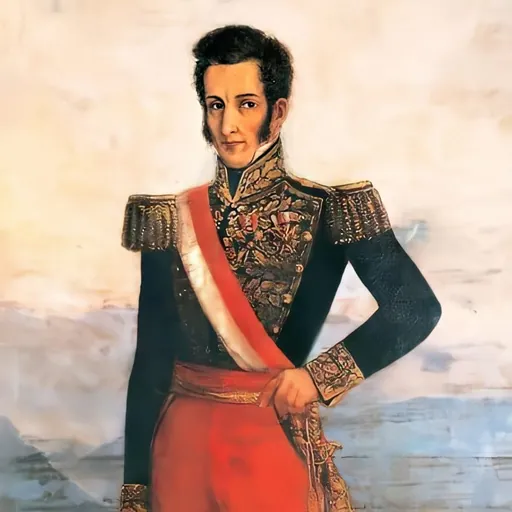
About José de La Mar
Lived 1778 – 1830 (aged 52). José de La Mar was a Peruvian politician and military officer.
José Domingo de la Merced de La Mar y Cortázar (Cuenca (Ecuador),12 May 1776 – San José (Costa Rica), 11 October 1830) was a Peruvian military leader and politician who served as the third President of Peru.
Biography Youth José de La Mar was born on 12 May 1776, at Cuenca in what today is Ecuador. As son of Marcos de La Mar y Migura (1736–1794) and his wife Josefa Paula Cortázar y Lavayen (1748–1815), he spent his early childhood in Spain.
Military career in Spain, France and Peru (1794–1820) With the help of his influential uncle, La Mar entered the Spanish army as a second lieutenant of the regiment of Savoy. In 1794 he participated in the campaign of Roussillon against the French Republic, fighting under the command of the Count of the Union, after which he was promoted to captain (1795). Then he participated in various military actions against revolutionary France, and was already a lieutenant-colonel by the start of Spain's national war against Napoleon's invasion (1808). He participated in the defense of Zaragoza under command of Colonel Palafox (1808–1809). He was seriously injured, and although that city finally capitulated, earned the title of "Hero of the Nation" (Benemérito de la Patria en grado heroico) and was promoted to colonel.
In 1812 he transferred to the front of Valencia, led by General Joaquín Blake, and sent a column of 4,000 veterans grenadiers (the "column La Mar"). Again he was wounded, and was taken to hospital in Tudela, where he was captured by the French. As soon as he was recovered, he was taken to France and confined in the castle of Semur-en-Auxois (Burgundy), where he studied the classics of French culture. After a time, he managed to escape, accompanied by Brigadier Juan María Muñoz y Manito, crossed into Switzerland and then Tyrol and reached the port of Trieste, on the Adriatic Sea, where he sailed back to Spain.
In 1815, Ferdinand VII promoted him to Brigadier, awarded him the Saint Hermenegildo's Cross and appointed him Sub-Inspector of the Viceroyalty of Peru, with the title of Governor of Callao. He arrived at the city in 1816. In 1819, he was promoted to Mariscal de campo.
The War of Independence (1821–1825) The Royalist Cause During the early days of the Peruvian War of Independence, he remained loyal to the King, and defended the Real Felipe Fortress in Callao, the main port of the Viceroyalty, for the Royalists. He repelled a naval attack by the Patriots under command of Thomas Cochrane in March 1819 and again in September 1819 and October 1820.
In 1821, rebel troops advanced towards Lima and Viceroy José de la Serna abandoned the capital on 6 June 1821, leaving De la Mar with explicit orders to resist and wait for reinforcements. He successfully withstood all attempts to capture the fort for nearly 4 months. A Royalist relief army, under command of General José de Canterac was not able to break the siege or to ship supplies and troops into the fortress, and retreated into the mountains. On 19 September, La Mar and his garrison were forced to surrender, due to the lack of supplies. Only two days later, La Mar finally submitted his left foot to amputation, having initially refused treatment of a gangrenous toe.
The Rebel Cause
After the Baquijano Capitulation at Callao, La Mar joined forces with the rebel cause. José de San Martín awarded him with the title of "Division General", a title he accepted reluctantly. In March 1822, he was made a Grand Marshal of Peru.
La Mar served as one of three men on the Supreme Governing Junta of the Republic of Peru from 22 September 1822 to 27 February 1823. He made strenuous efforts to obtain financing for an expedition to take the southern ports of Peru. Under the command of General Rudecindo Alvarado, an army marched south, but was completely defeated at the Battles of Torata and Moquegua. The Royalist general José de Canterac, seeing the city of Lima defenseless, descended from the central mountains and occupied the Peruvian capital easily. The resounding failure of the expedition dented the trust that Peruvian politicians had placed in La Mar. Congress, at the insistence of the Peruvian army, dissolved the Supreme Government Board and relieved the triumvirate of all its political responsibilities. La Mar served as the President of the Congress from November 1823 to December 1823.
La Mar resumed his military functions with the arrival of Simón Bolívar in Peru, who commissioned him to form and train new troops in Trujillo (1824). Having completed the assignment successfully, Bolívar entrusted La Mar with command of the Peruvian Division of the Liberation Army.
Bolívar ordered the final attack on the Royalist troops and led the Patriot armies to the mountains of Peru. Both armies met on the pampas of Junín (6 August 1824), and La Mar had a decisive role in leading the attack that gave victory to the Patriot side in the Battle of Junín. He played the same role in the Battle of Ayacucho (9 December 1924), since it was his directives that inflicted the final defeat on the Spanish and the achievement of Peru's independence.
Don’t just read it —
keep it.
Full-length biographies made to live with: read them, listen on the way to work, watch them tonight.
- E-book
- Audio
- Video
Instant download · yours to keep · every purchase keeps this site free
Important facts
People in José de La Mar's life
Named in this biography and alive at the same time



Related people
Same field, nearest in time



Contemporaries
People whose lives overlapped José de La Mar's



Frequently asked questions
Who was José de La Mar?
President of Peru
When was José de La Mar born?
José de La Mar was born on 12 May 1778 in Cuenca.
When did José de La Mar die?
José de La Mar died on 11 October 1830 in San José.
What was José de La Mar's occupation?
José de La Mar was a politician and military officer.
What nationality was José de La Mar?
José de La Mar was Peruvian.
Sources & further reading
Cite this page
APA: Biography.guide. (2026). José de La Mar. https://biography.guide/jose-de-la-mar/
MLA: "José de La Mar." Biography.guide, https://biography.guide/jose-de-la-mar/.
Chicago: "José de La Mar." Biography.guide. https://biography.guide/jose-de-la-mar/.
Data last updated: 2026-09-20 · Spot an error? Report a correction.
Page generated 2026-09-27 05:10 UTC