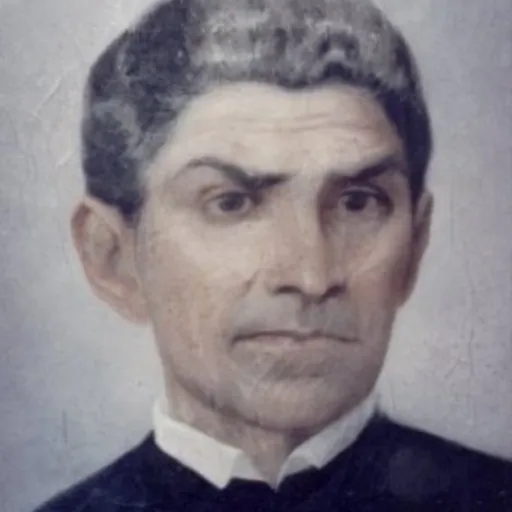
José Antônio Maria Ibiapina
Brazilian politician and Catholic priest
About José Antônio Maria Ibiapina
Lived 1806 – 1883 (aged 76). José Antônio Maria Ibiapina was a Brazilian catholic priest, politician and lawyer.
José Antônio de Maria Ibiapina (August 5, 1806 – February 19, 1883), widely known as Padre Ibiapina, was a Brazilian lawyer, judge, professor, and politician who abandoned his civil career to become a Catholic priest and preach through the interior of Northeastern Brazil.
He helped establish hospitals, schools, churches, cemeteries, and charity houses across Paraíba, Ceará, Pernambuco, Rio Grande do Norte, and Piauí. On March 31 2025, Pope Francis declared him venerable.
Biography
Early life Born José Antônio Pereira in Sobral at the time of colonial Brazil, he was the son of the politician and scrivener Francisco Miguel Pereira, a republican revolutionary executed after the Confederation of the Equator, and Teresa Maria de Jesus, a housewife from a traditional family of Sobral. The surname , a reference to the Serra da Ibiapaba, was adopted by Pereira as a nom de guerre and passed down to his children. Growing up in a sertão environment plagued by poverty, he attended small private schools in Icó before moving to Jardim, where he completed his humanities education, studying Latin under Joaquim Teotônio Sobreira de Melo.
At the age of seventeen, he joined the Seminary of Olinda, but following the death of his mother in childbirth in 1824 and his father's trial in 1825, Ibiapina had to interrupt his studies to care for his four younger siblings. In 1828, he enrolled in the first cohort of the Faculty of Law of Olinda, where his contemporaries included Eusébio de Queiroz and Conselheiro Aguiar, and from which he graduated in October 1832. After his final exams, he was appointed adjunct professor of natural law at the Faculty. Among his students were João Maurício Vanderlei, Baron of Cotegipe, Zacarias de Góis e Vasconcelos, and the future governor of Bahia Álvaro Tibério de Moncorvo Lima.
Career In December 1833, he learned that he had been appointed a judge and took office in 1834, serving until early 1835. In 1833, he was elected general deputy for the province of Ceará, and served in Rio de Janeiro until 1837 as a representative of the Liberal Party. During his mandate, he proposed a bill criminalizing the arrival of enslaved African people to Brazil, which was not approved. Disillusioned with politics, he began working as a lawyer in the old town of Vila Real do Brejo de Areia, where he successfully defended a man facing the death penalty. He inaugurated his own office in Recife in 1840 and practiced for nearly a decade.
In 1850, having bought land in the vicinities of Recife, he abandoned his law career and spent three years on a farm, devoting himself to spiritual life, reading, and treating his asthma. He then decided to sell his possessions and become a priest. He was ordained on July 3 1853, and began teaching sacred oratory and biblical history at the Seminary of Olinda. In Gravatá do Jaburu, he organized the construction of a small hospital for cholera patients. From 1860 to 1864, he pilgrimed in the region of Cariri-Velho through villages and towns, bringing together numerous people in collective efforts (mutirões) to build water dams, schools, chapels, orphanages, and hospitals. From 1865 to 1870, as his fame in the sertão grew, he worked more intensely in the regions of Missão Velha, Pocinhos, Bezerros, and Milagres, and from 1870 to 1872, he was active in the state of Piauí. He last traveled to Triunfo in 1876 before settling in the charity house of Santa Fé, where he died in 1883.
Despite his erudite formation, Ibiapina left very few writings, and his preaching is scarcely documented, as his audiences consisted overwhelmingly of illiterate people. His works include sermons, one travel account, and letters in which he offers spiritual orientations to lay sisters.
Legacy He was known as the .
Don’t just read it —
keep it.
Full-length biographies made to live with: read them, listen on the way to work, watch them tonight.
- E-book
- Audio
- Video
Instant download · yours to keep · every purchase keeps this site free
Important facts
People in José Antônio Maria Ibiapina's life
Named in this biography and alive at the same time
Related people
Same field, nearest in time


Contemporaries
People whose lives overlapped José Antônio Maria Ibiapina's





Frequently asked questions
Who was José Antônio Maria Ibiapina?
Brazilian politician and Catholic priest
When was José Antônio Maria Ibiapina born?
José Antônio Maria Ibiapina was born on 5 August 1806 in Sobral.
When did José Antônio Maria Ibiapina die?
José Antônio Maria Ibiapina died on 19 February 1883 in Solânea.
What was José Antônio Maria Ibiapina's occupation?
José Antônio Maria Ibiapina was a catholic priest, politician and lawyer.
What nationality was José Antônio Maria Ibiapina?
José Antônio Maria Ibiapina was Brazilian.
Sources & further reading
· Wikipedia: José Antônio Maria Ibiapina
Cite this page
APA: Biography.guide. (2026). José Antônio Maria Ibiapina. https://biography.guide/jose-antonio-maria-ibiapina/
MLA: "José Antônio Maria Ibiapina." Biography.guide, https://biography.guide/jose-antonio-maria-ibiapina/.
Chicago: "José Antônio Maria Ibiapina." Biography.guide. https://biography.guide/jose-antonio-maria-ibiapina/.
Data last updated: 2026-09-24 · Spot an error? Report a correction.
Portrait: Wikimedia Commons · author & licence
Page generated 2026-09-27 05:09 UTC