
About Joris van Son
Lived 1623 – 1667 (aged 43–44). Joris van Son was a botanical illustrator and painter.
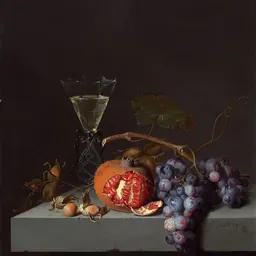
Joris van Son or Georg van Son (baptized 24 September 1623 – buried 25 June 1667 in Antwerp) was a Flemish still life painter who worked in a number of sub-genres but is principally known for his still lifes of fruit. He also painted flowers, banquets, vanitas still lifes and pronkstillevens. He is known to have painted fish still lifes representing the Four Elements, and also collaborated with figure artists on 'garland paintings', which typically represent a devotional image framed by a fruit or flower garland.
Life Joris van Son was born in Antwerp, the son of Joris and Catharina Formenois and was baptized on 24 September 1623 in the Antwerp Cathedral. It is not clear with which artist he trained. His work shows a strong influence of Jan Davidszoon de Heem, a Dutch still life painter who was active in Antwerp from the mid-1630s. This may be an indication that van Son studied with de Heem or was an assistant in de Heem's studio and was very familiar with de Heem's work in his formative years. He became a master in Guild of Saint Luke of Antwerp in the guild year 1643/1644.
In 1647, he became a member of the pious bachelor society, de 'Sodaliteit van de Bejaerde Jongmans', a fraternity for bachelors established by the Jesuit order. This did not stop him from seeking out the company of women. He started a relationship with Cornelia van Heulens. Their relationship produced a daughter, Maria Chatharina, who was born on 3 August 1656. The still life painter Jan Pauwel Gillemans the Elder was her godfather. Not long thereafter, on 22 October 1656, van Son married the mother of his child. Two years later a son, who was named Jan Frans, was born. The last child of the couple, called Maria Chatharina, was baptized on 5 October 1660. The pupils of van Son included Frans van Everbroeck, Jan Pauwel Gillemans the Younger, Cornelis van Huynen, Norbert Montalie and Abraham Herderwijn (Aberam Herderwyn).
Van Son suddenly took ill in May 1667 and died prematurely at the age of 44, in his native city of Antwerp, where he was buried on 25 June 1667. His still lifes are animated by branches of cherries or raspberries, which endow the composition with a great lightness. The objects are distributed on a table or ledge at a level so that an intimacy with the viewer is created.
Garland paintings were usually collaborations between a still life and a figure painter. His collaborators painted the figure or figures inside the cartouche while van Son painted the fruit and flower garland. The Garland of Fruit and Flowers with the Death of Adonis is an example of a collaboration with Erasmus Quellinus. The central images in his garland paintings were devotional as well as secular.
Vanitas still lifes Van Son is also known for his vanitas still lifes, a genre of still lifes which offers a reflection on the meaninglessness of earthly life and the transient nature of all earthly goods and pursuits.
Vanitas still lifes of van Son are listed for the first time in 1666 in Antwerp. Another garland painting with vanitas motif is the Three Putti with Vanitas Symbols within a Decorated Cartouche (At Lempertz on 15 November 2014, Cologne, Lot 1072) where the typical symbols of vanitas also appear: a skull, soap bubbles and opulently glittering vases which reference the transience of things and, in particular, of earthly wealth.
A pure vanitas painting is the Vanitas still-life with a skull, a pistol, a lute with broken strings, a flute (At Christie's on 10 December 2004, London lot 59), in which a wide range of vanitas symbols are displayed on a table. On the lower right of the painting are inscribed the words 'Vanitas, Vanitas. Et omnia Vanitas', which refers to the famous line of the Ecclesiastes, which in the Latin version of the bible called the Vulgate is rendered as Vanitas vanitatum omnia vanitas. In the King James Version it is translated .
Pronkstillevens
A large portion of his output consists of pronkstillevens, the sumptuous still lifes that were popular in Flanders and the Dutch Republic from the 1640s. Van Son's work in this genre was influenced by Jan Davidsz. de Heem. A representative example in this genre is the Pronk still life with overturned silver ewer (Liechtenstein Museum). Pronk still lifes are often interpreted as having a vanitas meaning.
From the late 1650s van Son painted a number of more modest still lifes in which the composition and colouring was rather restrained. An example is the Still life with fruit basket, lobster and oysters (At Hampel 7 April 2016 Munich, lot 189). These more moderate still lifes are not believed to reference the vanitas theme but rather to celebrate the varied gifts of nature.
Don’t just read it —
keep it.
Full-length biographies made to live with: read them, listen on the way to work, watch them tonight.
- E-book
- Audio
- Video
Instant download · yours to keep · every purchase keeps this site free
Important facts
more
J. v. Sonn, J. von Sonn, Van Zoon, Vanzom, Son, Vanzoon, J. van Son, Van Zon, G. Van Son, old Vanzoon, I. van Son, George van Son, VansonPeople in Joris van Son's life
Named in this biography and alive at the same time


Related people
Same field, nearest in time




Contemporaries
People whose lives overlapped Joris van Son's





Frequently asked questions
Who was Joris van Son?
Flemish still life painter (1623-1667)
When was Joris van Son born?
Joris van Son was born in 1623 in Antwerp.
When did Joris van Son die?
Joris van Son died in 1667 in Antwerp.
What was Joris van Son's occupation?
Joris van Son was a botanical illustrator and painter.
What nationality was Joris van Son?
Joris van Son's recorded nationality: Habsburg Netherlands.
Sources & further reading
Cite this page
APA: Biography.guide. (2026). Joris van Son. https://biography.guide/joris-van-son/
MLA: "Joris van Son." Biography.guide, https://biography.guide/joris-van-son/.
Chicago: "Joris van Son." Biography.guide. https://biography.guide/joris-van-son/.
Data last updated: 2026-09-20 · Spot an error? Report a correction.
Page generated 2026-09-27 05:18 UTC