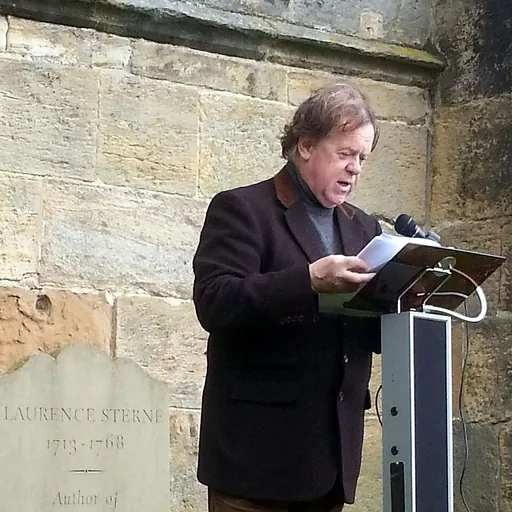
About Jonathan Meades
Born 1947. Jonathan Meades is a British journalist, novelist, television presenter, screenwriter and writer.
Early life and education Jonathan Meades was born in Salisbury, Wiltshire, the only child of John William Meades, a biscuit company sales rep, and Margery Agnes Meades (née Hogg), a primary school teacher. The family lived in an "unbelievably cramped" terraced, thatched cottage in the East Harnham area of the city. Meades was educated until the age of 13 at the nearby Salisbury Cathedral School, within Salisbury Cathedral Close.
He discovered a fascination for place and the built environment whilst accompanying his father on sales trips during school holidays; he would be left unattended and free to explore while the elder Meades conducted his business with the grocer. This later developed into a full-blown passion for architecture following a visit to Edwin Lutyens' Marsh Court on a school cricket trip at the age of 13. and unsure of what to do next, he decided to become an actor after a chance meeting with Charles Collingwood and trained at the Royal Academy of Dramatic Art (RADA) from 1966 to 1969. His contemporaries there included Robert Lindsay, David Bradley, Stephanie Beacham, Michael Kitchen and Richard Beckinsale. teaching them the value of discipline, craft and technique.
Although he ultimately decided against joining the acting profession, On leaving RADA, he was told by the Principal, Hugh Cruttwell, that he might as well abandon acting until he reached middle age, at which point he might become an interesting character actor. When the two met again decades later, after Meades had established himself on television, Cruttwell joked that he had not realised that the character would be called "Jonathan Meades". In 1973 he reviewed a V&A exhibition on Victorian architecture for the magazine, igniting a passion for the style and prompting him to explore even more of London than he had to date. Using the unlimited travel afforded by Red Rover bus passes, he rode on random buses for 20 minutes and then got off, no matter where he was.
After leaving Books and Bookmen in 1975 he wrote for the sex education magazine Curious and joined the staff of Time Out, then became The Observer TV critic in 1977. He moved to Architects' Journal in 1979 and around this time worked on another book, The Illustrated Atlas of the World's Great Buildings, with Philip Bagenal.
In 1981 he became the editor of Richard Branson's short-lived listings magazine Event, then from 1982 was the features editor of Tatler.
Despite his success, he often tired of the repetitive nature of the job and threatened to leave several times. The paper responded by increasing his salary.
Books and other writing In 1982, Harpers & Queen published three short stories which Meades had written about "rural lowlife". These, along with four more, were collected in 1984 as Filthy English, his first volume of fiction. A few more stories appeared in his first anthology of journalism and essays, 1989's Peter Knows What Dick Likes, the title of which is a reference to the supposed superiority of male-on-male fellatio. On its 2013 reissue, Matthew Adams wrote in The Independent, "Where his first collection of stories, Filthy English, achieved the distinction of covering in aggressively vivid prose the disciplines of murder, addiction, incest and bestial pornography, Pompey exhibits an even greater concentration of his aptitude for squalor ... by the end of the opening two pages, which must rank among the most startling affirmations of omniscience in 20th-century literature, the reader has met with an arresting injunction: 'After using this book please wash your hands.
In 2015, the publisher and record label Test Centre released a spoken word vinyl album by Meades entitled Pedigree Mongrel, consisting of readings from Pompey, Museum Without Walls, An Encyclopaedia of Myself and unpublished fiction, combined with soundscapes created by Mordant Music. The sleeve of the album featured photography by Meades, including an abstract self-portrait on the front cover. Also in 2015, Meades, along with Laura Noble, contributed essays to Robert Clayton's photographic collection Estate, which documented life on the soon-to-be-demolished Lion Farm housing estate in Oldbury, West Midlands in 1990.
A book of "borrowed" recipes, The Plagiarist in the Kitchen: A Lifetime's Culinary Thefts, was published by Unbound in 2017. According to Meades, it is "devoted to the idea that you shouldn't try and invent anything in the kitchen, just rely on what has already been done ... I hate the idea of experimental cookery, but I like the idea of experimental literature.".
Isle of Rust, a collaboration with the photographer Alex Boyd featuring text based on Meades' script for his 2009 film about Lewis and Harris, was published by Luath Press in 2019.
(See full bibliography)
Television Meades' first foray into television was in 1985: a short film on the art and architecture of Barcelona for the BBC Two arts magazine programme Saturday Review. He would be credited as the sole author of all his subsequent work. It featured five irreverent, "slightly bonkers" films which explored unusual and neglected aspects of the built environment: informal plotland dwellings along the Severn Valley, nautical culture around the Solent and architectural forms associated with utopianism, bohemians and the military.
Preferring to be thought of as a performer rather than as a presenter, Meades has described his style as "heavy entertainment"; "staged essays" which seek to combine "lecture hall" and "music hall", Geoffrey Hill and Benny Hill.
The 1998 film Heart By-Pass looked affectionately at Birmingham; particularly at how its architecture, transport system and ethnic mix have changed since the 1960s. It featured the music of many of the city's best-known 1960s and 1970s rock bands such as The Moody Blues, The Move, Traffic, Black Sabbath and ELO.
In 2009, Meades toured Scotland in a three-part BBC Four series entitled Jonathan Meades: Off Kilter. He visited Aberdeen, Lewis and Harris (the 'Isle of Rust') and the less-renowned footballing towns of south-west Fife, Clackmannanshire and Falkirk, guided by his foul-mouthed 'ScotNav'.
In a 2017 interview with The Guardian, Meades quoted his director, Francis Hanly, on how their production budgets had declined over the years: "We used to be a convoy, now we are a Smart car".
Jonathan Meades on Jargon aired on BBC Four in May 2018. The BBC Four website described it as a "provocative television essay" which "dissects politics, the law, football commentary, business, the arts, tabloid-speak and management consultancy to show how jargon is used to cover up, confuse and generally keep us in the dark". The Guardian described it as "blisteringly brutal, clever and hilarious", while The Times also declared Meades to be "on blistering form".
Over a period of 25 years, Meades has written and presented four films on the architectural legacy of 20th-century European dictators, the latest of which, Franco Building with Jonathan Meades, looking at Franco's Spain, aired in August 2019. It was followed in April 2016 by an exhibition entitled "Ape Forgets Medication: Treyfs and Artknacks" at the Londonewcastle Project in Shoreditch, London.
Personal life Meades has been married three times and has four daughters from his first two marriages. In 1980 he married Sally Brown, director of the British Theatre Association, and the couple had twins. His second wife was Frances Bentley, managing editor of Vogue, whom he married in 1988. They had two daughters and divorced in 1997. In 2003 he married his girlfriend Colette Forder, a colleague from The Times. Discovering that they found country life boring, they then moved to Marseille in around 2011, where they live in Le Corbusier's apartment block.
In the autumn of 2016, he was rushed to hospital and underwent five hours of cardiac surgery. Earlier in the year he had suffered from pleurisy and an embolism.
Don’t just read it —
keep it.
Full-length biographies made to live with: read them, listen on the way to work, watch them tonight.
- E-book
- Audio
- Video
Instant download · yours to keep · every purchase keeps this site free
Important facts
People in Jonathan Meades's life
Named in this biography and alive at the same time







Related people
Same field, nearest in time






Contemporaries
People whose lives overlapped Jonathan Meades's




Frequently asked questions
Who is Jonathan Meades?
British writer
When was Jonathan Meades born?
Jonathan Meades was born on 21 January 1947 in Salisbury.
What is Jonathan Meades's occupation?
Jonathan Meades is a journalist, novelist, television presenter, screenwriter and writer.
What nationality is Jonathan Meades?
Jonathan Meades is British.
Sources & further reading
Cite this page
APA: Biography.guide. (2026). Jonathan Meades. https://biography.guide/jonathan-meades-journalist/
MLA: "Jonathan Meades." Biography.guide, https://biography.guide/jonathan-meades-journalist/.
Chicago: "Jonathan Meades." Biography.guide. https://biography.guide/jonathan-meades-journalist/.
Data last updated: 2026-09-22 · Spot an error? Report a correction.
Portrait: Wikimedia Commons · author & licence
Page generated 2026-09-27 05:00 UTC