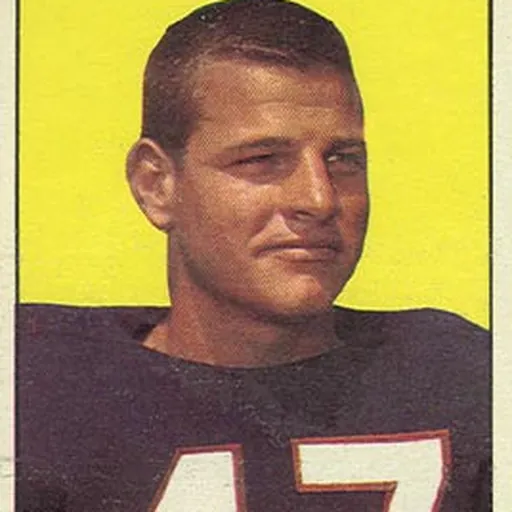
About Johnny Morris
Born 1935. Johnny Morris is an American american football player.
Johnny Edward Morris (born September 26, 1935) is an American former professional football player who was a flanker and halfback for the Chicago Bears in the National Football League (NFL). He spent his entire ten-year career with the Bears, and is the franchise's all-time leader in receiving yards with 5,059. He played college football for the UC Santa Barbara Gauchos. Morris won an NFL championship in 1963. In 1964, he had his best season with 93 receptions for 1,200 yards and 10 touchdowns. His 93 receptions set an NFL record at the time.
Early life Morris was born on September 26, 1935, in Long Beach California. He attended Long Beach Polytechnic High School (Poly). At 140 pounds (63.5 kg), he was deemed too small to play varsity football at Poly, and had to play Class B football. Disheartened, he left football for the school's track team.
College career Morris did not receive any athletic scholarship offers after graduating high school. He attended the University of California, Santa Barbara, where he became a star halfback on the football team under coach Ed Cody. Morris weighed only 160 pounds (72.6 kg). In his final game as a senior in 1957, he returned a kickoff 86 yards for a touchdown. Morris went into that 1957 Thanksgiving Day game with an 8.1 yards per carry rushing average.
As a senior in 1957, Morris was named first-team All-California Collegiate Athletic Association (CCAA) at halfback. One of the other first-team selections was future Pro Football Hall of Fame coach John Madden at tackle.
Professional football Cody had played for George Halas and the Chicago Bears in 1949–50. When NFL teams showed no interest in Morris coming out of college, Cody strongly recommended Morris to Halas, and after looking into Morris he was impressed. After learning the Green Bay Packers subsequently showed an interest in Morris, Halas decided not to wait in taking Morris on as an undrafted free agent, and selected Morris in the 12th round of the 1958 NFL draft (137th overall). However, he was smaller than all of the other running backs during the Bears' 1958 training camp, and Morris anticipated being cut. Bears' quarterback George Blanda admired Morris's determination and made sure to give Morris opportunities to prove himself to Halas. Morris made the team, and went on to a 10-year career with the Bears. He was second in the NFL in yards per kickoff return and sixth in total kickoff return yards.
By his second year with the Bears (1959), Morris was up to 180 pounds (82 kg). He returned 14 punts for 171 yards, including a 78-yard punt return for a touchdown against the Los Angeles Rams; the second longest punt return in Bears' history at the time. He also returned 17 kickoffs for 438 yards.
Morris was mostly kept on the sidelines during the first two games of 1960 with a toe injury, but still wound up being selected to the Pro Bowl that season. In his return to full play against the Rams in the season's third game, he caught touchdown passes of 45 and 66 yards, and had 124 yards on only three receptions. He also gained 32 rushing yards and returned two kickoffs for 39 yards.
Bears offensive backs coach Chuck Mather said Morris made the fewest mistakes of any running back he had, and was a good blocker. However, after recognizing the difficulties Morris created for an individual defender trying to tackle him, the Bears moved him to flanker in 1961 to put him in more one-on-one situations as a receiver. This was in line with an NFL trend to move fast and agile running backs to a receiver position, starting with Dub Jones and Hall of Famer Elroy Hirsch, and continuing with players like Hall of Famers Tommy McDonald, Bobby Mitchell and Lenny Moore. The switch came just before the season started, giving Morris limited time to learn his new position.
In 1961, he caught 36 passes for 548 yards, with four touchdown receptions. He had an 80-yard touchdown catch against the 49ers in a November game, with 123 yards on four receptions. In 1962, he had 58 receptions for 889 yards and five touchdown catches. His longest reception of the season was on a 73-yard touchdown pass from Bill Wade. He was tied for fifth best in total receptions with future Hall of Fame teammate Mike Ditka and Tommy McDonald. He returned 20 punts for 208 yards (10.4 yards per return). His total punt return yards were third best in the NFL, as was his 10.4 return average. However, Morris's ability to play during the season was limited by a badly pulled leg muscle, and his numbers declined to 47 receptions for 705 yards and two touchdowns.
1964 record setting season Morris's best season came in 1964. He was selected first-team All-Pro by the Associated Press (AP), United Press International (UPI) and the Newspaper Enterprise Association (NEA). He only missed the Pro Bowl because of a broken collarbone. His 93-reception record stood until Hall of Fame receiver Art Monk caught 106 passes in 1984, in a 16-game season.
As a receiver, Morris also led the league with 1,200 receiving yards, 10 touchdown receptions, and in averaging 85.7 yards per game. His finished fourth in Most Valuable Player voting behind Hall of Famers Johnny Unitas, Jim Brown and Lenny Moore. He became the sixth player in NFL history to win the receivers' "Triple Crown" with the most receptions, yards and receiving touchdowns in the same season, after Hall of Famers Ray Flaherty, Don Hutson, Pete Pihos, Elroy Hirsch and Raymond Berry. It was his first year with the Bears in which he did not return punts. In 1964, the Bears' top rusher was Jon Arnett, who gained 400 yards in 119 attempts. Sayers was Rookie-of-the Year. The Bears rushed the ball over 100 plays more in 1965 (479) than in 1964 (356).
In 1966, Morris had a knee injury requiring surgery and only played in two games. He returned for one final year with the Bears in 1967. He scrimmaged with the Bears against the college all-stars in preparation for the 1967 Chicago College All-Star Game, and his knee held up. Aside from the 1966 season lost to injury, Morris had the least yards from scrimmage of any year in his career. He is the all-time Bears leader in total receiving yards, and is third all-time in Bears history in total receptions, behind Hall of Fame running back Walter Payton (492, 9.2 yards per catch) and running back Matt Forte(487, 8.5 yards per catch).
In 2019, Bears Centennial Scrapbook authors Dan Pompei and Don Pierson, and the Chicago Tribune, listed Morris as the 44th greatest Bears player ever.
Sportscaster career In 1964, while still playing for the Bears, Morris joined WBBM-TV in Chicago, eventually becoming one of Chicago's most popular television broadcasters. He analyzed Bears' game film during his first few years, while still a player, and later became a sports anchor and sportscaster. As an anchor, Morris worked with his wife Jeannie as a features reporter (before and after their amicable divorce). Except for a six-year stint at rival WMAQ-TV (where he first worked with Jeannie), Morris remained at WBBM until 1992, serving for most of that time as sports director. WBBM first made Morris its sports anchor in 1975 when seeking a suitable replacement for future Sports Broadcasting Hall of Fame and Pro Football Hall of Fame member Brent Musburger. In 1984, WBBM signed him to a nearly $1 million a year long-term contract, equal to the deal with the station's news anchor Walter Jacobson; and significantly greater than sums paid to anchors at rival stations.
He became good friends with film critic Gene Siskel after Siskel was hired by WBBM in 1974. Morris was a pallbearer at Siskel's funeral. During his time at WBBM-TV, he popularized the use of the Telestrator (a device for drawing over still or moving video images) in sports television, which was invented by fellow WBBM-TV employee Leonard Reiffel for his science-related TV series Dimensions on Tomorrow's Living and The World Tomorrow. Among other things, Reiffel was a nuclear physicist who worked under Enrico Fermi, and had also worked at NASA.
Morris also served as a football color commentator for CBS' NFL coverage from 1975 to 1986. He partially retired in 1992, and fully retired in 1996.
Morris was married to sports reporter Jeannie Morris, whom he met at UC Santa Barbara, from 1960 to 1985. The two remained close after their divorce as television colleagues. Jeannie died December 14, 2020.
Don’t just read it —
keep it.
Full-length biographies made to live with: read them, listen on the way to work, watch them tonight.
- E-book
- Audio
- Video
Instant download · yours to keep · every purchase keeps this site free
Important facts
People in Johnny Morris's life
Named in this biography and alive at the same time



Related people
Same field, nearest in time




Contemporaries
People whose lives overlapped Johnny Morris's





Frequently asked questions
Who is Johnny Morris?
American football player (born 1935)
When was Johnny Morris born?
Johnny Morris was born on 26 September 1935 in Long Beach.
What is Johnny Morris's occupation?
Johnny Morris is an american football player.
What nationality is Johnny Morris?
Johnny Morris is American.
Sources & further reading
· DBpedia: Johnny Morris (American football)
Cite this page
APA: Biography.guide. (2026). Johnny Morris. https://biography.guide/johnny-morris-american-football-player/
MLA: "Johnny Morris." Biography.guide, https://biography.guide/johnny-morris-american-football-player/.
Chicago: "Johnny Morris." Biography.guide. https://biography.guide/johnny-morris-american-football-player/.
Data last updated: 2026-09-23 · Spot an error? Report a correction.
Portrait: Wikimedia Commons · author & licence
Page generated 2026-09-27 05:05 UTC