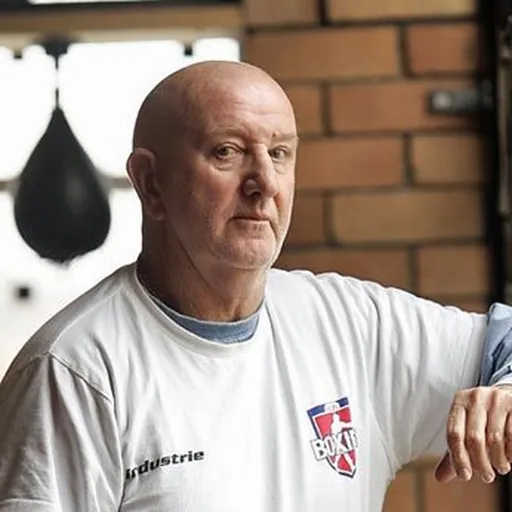
Johnny Lewis
Australian boxing trainer
About Johnny Lewis
Born 1944. Johnny Lewis is a boxing trainer.
John Alfred “Johnny” Lewis OAM (born 18 March 1944) is an Australian boxing trainer and the head coach of six world champions, most notably Jeff Fenech, Jeff Harding, Gairy St. Clair and Kostya Tszyu.
Lewis’ career spans from training amateur boxers on the local Sydney circuit to working with Australian boxing champions and rugby league international representatives. The philosophies and coaching career of Lewis merited him many accolades including an Order of Australia medal and an induction into the International Boxing Hall of Fame, both of which were achieved in 2006. Due to these accolades, Lewis has been asserted as one of Australia's most acclaimed boxing coaches. His family lived in Wallangarra at the time, before moving into a housing commission flat in Erskineville, in Sydney's inner-west.
Lewis' first employment was selling papers at Australian rules football games as well as working the scoreboard at Erskineville Oval for local first-grade Australian Rules matches, where he would listen to coaches’ team talks. An athletic career for Lewis was cut short at age 19 when he sustained an ankle injury after falling off a ladder while sign writing. As a physically disadvantaged boxer, Lewis trained under Dick O’Connor until he was 17, without losing a fight under his guidance. Lewis models much of his coaching style on O’Connor's. A year later, McFaden would re-enter the gym, training alongside Lewis for 3 years. Fernandez also taught Lewis how to wrap hands and clean cuts.
In November 1988, Lewis was appointed head trainer for the Australian Amateur Boxing Team for the Seoul Olympics.
Young Offenders Program In January 1986, Lewis took several of his fighters including Jeff Fenech to Parklea Prison to spar inmates in makeshift rings, the point of which was to demonstrate the outcomes of poor behaviour for his fighters and an appropriate outlet of aggression for the prisoners.
Brian Moore started the Young Offenders Program in the Newtown Police Boys Club. Lewis would join this partnership by continuing to take boxers to prisons across New South Wales.
Professional coaching career
Summary The professional career of Lewis catalysed due to the rapid rise of Jeff Fenech. These accreditations prompted several fighters to also be trained by Lewis. In 1992 was Hill's third fight under Lewis, in which he won a unanimous decision against Frank Tate to gain the vacant WBA light heavyweight title. This was a short-term partnership however as Hill returned to the United States after the victory.
Joe Bugner In 1986, Joe Bugner came out of retirement for one last campaign, aiming to fight heavyweight champion Mike Tyson. Bugner had domestic success after his partnership with Lewis, winning the Australian Heavyweight title.
At the peak of Bugner's comeback, he won a unanimous decision against Greg Page in Sydney. On this card, Johnny Lewis had Jeff Harding finish Johnny Tapau Sr in the second round and Peter Mitrevski winning a decision over Charlie Brown. Rowsell had a more acclaimed amateur career however, with a bronze medal at the 1991 Amateur Boxing World Championships, a gold medal at the Canada Cup and a Commonwealth games silver medal.
Gairy St. Clair In his training with Lewis, Gairy St. Clair won the International Boxing Federation and International Boxing Organization World Super Featherweight Title in South Africa, winning a unanimous decision 116–112, 115–113, 115–114 over Cassius Baloyi. Lewis regarded St Clair as not only one of the best movers he'd trained but seen.
Jeff Malcolm Jeff Malcolm was managed by New South Wales Blues and Australian Kangaroos Rugby League representative Tommy Raudonikis while being trained by Lewis.
Peter Mitrevski Peter Mitrevski won the vacant Australian flyweight title against Charlie Brown in 1988 under the training of Lewis. Lewis stated Mitrevski may not go any further in the sport of boxing, suggesting his retirement.
Paul Briggs Paul Briggs asked Lewis to take over his training after a majority decision loss to Tomasz Adamek for the WBC Light Heavyweight title. After the training of Lewis, Briggs got his rematch against Adamek, only to lose again via majority decision. After this loss, Lewis began to reduce training fighters, giving time to his family. Fenech was cornered by Lewis since his professional debut at Blacktown Police Boys Club, with a win over Craig Easey. Lewis was unimpressed by Fenech's fighting style in the early years and tried to implement discipline in Fenech's life in and out of the ring. Fenech stopped Junior Thompson in the fourth round to win the Australian super-fliyweight title in his third fight. With struggles to cut down to the 115-pound junior bantamweight division, Lewis moved Fenech up to bantamweight.
IBF Title Defences Fenech went 15 rounds with American contender Jerome Coffee before being awarded a unanimous decision victory, 148–140, 146–141 and 145–140. After the title defence, Lewis would have Fenech train under shadow boxing conditions due to broken hand injuries.
Fenech vs Payakaroon Fenech would knock out Samart Payakaroon in the fourth round to win the WBC Super bantamweight title.
Lewis notoriously demoralised opponents by picking up his fighter and pushing him toward the centre of the ring before the beginning of each round.
Fenech would lose a rematch against Nelson,
Jeff Harding Jeff Harding was introduced to Lewis at the 1984 Olympics. Lewis moved Harding up to Light Heavyweight permanently after his New South Wales Cruiserweight title victory in 1988.
Tszyu would capture the IBF light-welterweight title in January 1995 against Jake Rodriguez. In 2001, Tszyu would defeat Zab Judah to become the WBC, WBA and IBF champion. Revealed in his biography by Paul Kent, Lewis would feel a rift with Tszyu after allegedly being underpaid. Further revelations involved the attempts of Lewis to depart as head coach, feeling as if he was not needed in the Tszyu camp.
Philosophies Lewis would tape a white cross on each of his fighter's wrists, one for him and one for his opponent so they may be watched over during the fight. Target pads were seen in all boxing gyms in Australia since then, formerly coaches used larger gloves as the target. At the time, Lewis had two concurrent champions in his gym and held a record of 13–0 in title fights.
In 1989, through rugby league international player, coach and personal friend Bob Fulton, Lewis became a trainer of the Australian Kangaroos 1990 Tour of Great Britain and France.
Personal life Lewis has lived in Erskineville his whole life, working as a signwriter for the Sydney County Council for majority of it, whilst simultaneously training fighters. Lewis has four children, Brent, Leisa, Jackson and Johnnie Jr. At age 61, the gym closure forced Lewis to train fighters at PCYC institutes in Woolloomooloo, South Sydney and Marrickville as well as the HK Ward University of Sydney boxing gym.
Don’t just read it —
keep it.
Full-length biographies made to live with: read them, listen on the way to work, watch them tonight.
- E-book
- Audio
- Video
Instant download · yours to keep · every purchase keeps this site free
Important facts
People in Johnny Lewis's life
Named in this biography and alive at the same time





Related people
Same field, nearest in time




Contemporaries
People whose lives overlapped Johnny Lewis's


Frequently asked questions
Who is Johnny Lewis?
Australian boxing trainer
When was Johnny Lewis born?
Johnny Lewis was born on 18 March 1944 in Sydney.
What is Johnny Lewis's occupation?
Johnny Lewis is a boxing trainer.
Sources & further reading
· DBpedia: Johnny Lewis (boxing trainer)
Cite this page
APA: Biography.guide. (2026). Johnny Lewis. https://biography.guide/johnny-lewis-boxing-trainer/
MLA: "Johnny Lewis." Biography.guide, https://biography.guide/johnny-lewis-boxing-trainer/.
Chicago: "Johnny Lewis." Biography.guide. https://biography.guide/johnny-lewis-boxing-trainer/.
Data last updated: 2026-09-23 · Spot an error? Report a correction.
Portrait: Wikimedia Commons · author & licence
Page generated 2026-09-27 05:07 UTC