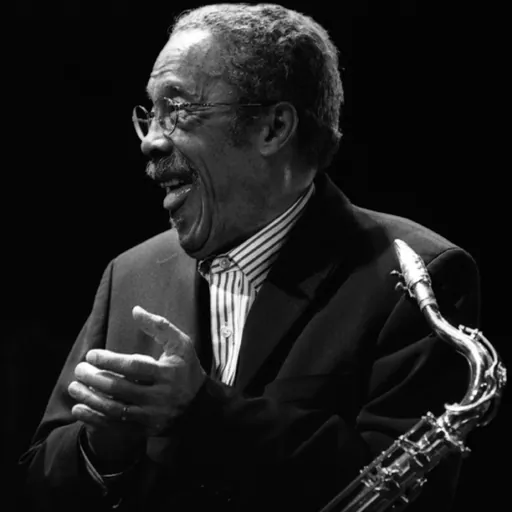
About Johnny Griffin
Lived 1928 – 2008 (aged 80). Johnny Griffin was an American composer, jazz musician, saxophonist and musician.
John Arnold Griffin III (April 24, 1928 – July 25, 2008) was an American jazz tenor saxophonist. Nicknamed "the Little Giant" for his short stature and forceful playing, Griffin began his career in the mid-1940s and continued until the month of his death. A pioneering figure in hard bop, Griffin recorded prolifically as a bandleader in addition to stints with the pianist Thelonious Monk and the drummer Art Blakey, in partnership with his fellow tenor Eddie "Lockjaw" Davis, and as a member of the Kenny Clarke/Francy Boland Big Band after he moved to Europe in the 1960s. In 1995, Griffin was awarded an Honorary Doctorate of Music from Berklee College of Music.
Early life and career Griffin studied music at DuSable High School in Chicago under Walter Dyett,
Alto saxophone was still his instrument of choice when he joined Lionel Hampton's big band,
By mid-1947, Griffin and fellow Hampton band member Joe Morris,
After returning to Chicago from two years in the Army, Griffin began to establish a reputation as one of the premiere saxophonists in that city. Thelonious Monk enthusiastically encouraged Orrin Keepnews of the Riverside label to sign the young tenor, but before he could act Blue Note had signed Griffin.
He joined Art Blakey's Jazz Messengers in 1957, and Gene Ammons, and on the road. Diminutive, he was distinctive as a fashionable dresser, a good businessman, and a well-liked bandleader to other musicians.thumb Griffin was leader on his first Blue Note album Introducing Johnny Griffin in 1956. Also featuring Wynton Kelly on piano, Curly Russell on bass and Max Roach on drums, the recording brought Griffin critical acclaim.
The album A Blowin' Session (1957) featured John Coltrane and Hank Mobley. He played with Art Blakey's Jazz Messengers for a few months in 1957 and in the Thelonious Monk Sextet and Quartet (1958).
Move to Europe Griffin moved to France in 1963 and to the Netherlands in 1978, where he settled in Bergambacht. His relocation was the result of several factors, including income tax problems, a failing marriage and feeling "embittered by the critical acceptance of free jazz" in the United States, as journalist Ben Ratliff wrote. Apart from appearing regularly under his own name at jazz clubs such as London's Ronnie Scott's, Griffin became a "first choice" sax player for visiting US musicians touring the continent during the 1960s and 1970s.
In 1965, he recorded albums with Wes Montgomery. He briefly rejoined Monk's groups (an Octet and Nonet) in 1967. From 1967 to 1969, he was part of the Kenny Clarke/Francy Boland Big Band. and again with the Dizzy Gillespie Big 7 at the Montreux Jazz Festival. In the late 1970s, Griffin recorded with Peter Herbolzheimer and His Big Band, which also included, among others, Nat Adderley, Derek Watkins, Art Farmer, Slide Hampton, Jiggs Whigham, Herb Geller, Wilton Gaynair, Stan Getz, Gerry Mulligan, Rita Reys, Jean "Toots" Thielemans, Niels-Henning Ørsted Pedersen, Grady Tate, and Quincy Jones as arranger.
He also recorded with the Nat Adderley Quintet in 1978, having previously recorded with Adderley in 1958.
In 1978, Griffin and Dexter Gordon returned to the U.S., and the two performed at the Ann Arbor's Eclipse Jazz Festival, before recording Live at Carnegie Hall.
Discography
As leader/co-leader
Studio albums
Live albums
As sideman
With Ahmed Abdul-Malik Jazz Sahara (Riverside, 1958) East Meets West (RCA Victor, 1960)
With Nat Adderley Branching Out (Riverside, 1958) A Little New York Midtown Music (Galaxy, 1978)
With Art Blakey Selections from Lerner and Loewe's... (Vik, 1957) A Night in Tunisia (Vik, 1957) Cu-Bop (Jubilee, 1957) Art Blakey's Jazz Messengers with Thelonious Monk (Atlantic, 1957) Hard Drive (Bethlehem, 1957)
With the Kenny Clarke/Francy Boland Big Band Sax No End (SABA, 1967) Out of the Folk Bag (Columbia, 1967) 17 Men and Their Music (Campi, 1967) All Smiles (MPS, 1968) Faces (MPS, 1969) Latin Kaleidoscope (MPS, 1968) Fellini 712 (MPS, 1969) All Blues (MPS, 1969) More Smiles (MPS, 1969) Volcano (Polydor, 1969) Clarke Boland Big Band en Concert avec Europe 1 (Tréma, 1992) – recorded in 1969
With Dizzy Gillespie The Giant (America, 1973) The Source (America, 1973) The Dizzy Gillespie Big 7 (Pablo, 1975)
With Philly Joe Jones Blues for Dracula (Riverside, 1958) Look Stop Listen (Uptown, 1983) with Dameronia
With Thelonious Monk Thelonious in Action (Riverside, 1958) – live Misterioso (Riverside, 1958) – live
With Bud Powell Bud in Paris (1975, Xanadu) – live recorded in 1960 Earl Bud Powell, Vol. 8: Holidays in Edenville, 64 (Mythic Sound, 1964)
With A. K. Salim Stable Mates (Savoy, 1957) Pretty for the People (Savoy, 1958) – recorded in 1957
With others Chet Baker, Chet Baker in New York (Riverside, 1958) Count Basie, Count Basie Jam Session at the Montreux Jazz Festival 1975 (Pablo, 1975) James Carter, Live at Baker's Keyboard Lounge (Warner Bros., 2004) – recorded in 2001 Tadd Dameron, The Magic Touch (Riverside, 1962) Bennie Green, Glidin' Along (Jazzland, 1961) Johnny Lytle, Nice and Easy (Jazzland, 1962) Blue Mitchell, Big 6 (Riverside 1958) Jimmy Smith, Keep On Comin''' (Elektra/Musician, 1983) Ira Sullivan, Blue Stroll (Delmark, 1961) Clark Terry, Serenade to a Bus Seat (Riverside, 1957) Wilbur Ware, The Chicago Sound (Riverside, 1957) Randy Weston, Little Niles (United Artists, 1958) Wes Montgomery, Full House (Riverside, 1962) Wes Montgomery, Solitude (Paris Live Album) (Verve, 1962) Roy Hargrove, With the Tenors of Our Time (Verve, 1994)
Don’t just read it —
keep it.
Full-length biographies made to live with: read them, listen on the way to work, watch them tonight.
- E-book
- Audio
- Video
Instant download · yours to keep · every purchase keeps this site free
Important facts
People in Johnny Griffin's life
Named in this biography and alive at the same time




Related people
Same field, nearest in time



Contemporaries
People whose lives overlapped Johnny Griffin's





Frequently asked questions
Who was Johnny Griffin?
American musician (1928–2008)
When was Johnny Griffin born?
Johnny Griffin was born on 24 April 1928 in Chicago.
When did Johnny Griffin die?
Johnny Griffin died on 25 July 2008 in Availles-Limouzine.
What was Johnny Griffin's occupation?
Johnny Griffin was a composer, jazz musician, saxophonist and musician.
What nationality was Johnny Griffin?
Johnny Griffin was American.
Sources & further reading
Cite this page
APA: Biography.guide. (2026). Johnny Griffin. https://biography.guide/johnny-griffin/
MLA: "Johnny Griffin." Biography.guide, https://biography.guide/johnny-griffin/.
Chicago: "Johnny Griffin." Biography.guide. https://biography.guide/johnny-griffin/.
Data last updated: 2026-09-20 · Spot an error? Report a correction.
Page generated 2026-09-27 05:09 UTC