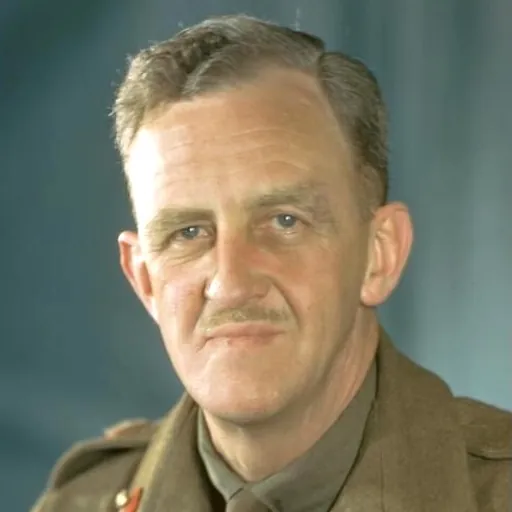
About John Whiteley
Lived 1896 – 1970 (aged 73). John Whiteley was a British engineer and military personnel.
General Sir John Francis Martin Whiteley, (7 June 1896 – 20 May 1970) was a senior British Army officer who became Deputy Chief of the Imperial General Staff (DCIGS). A career soldier, Whiteley was commissioned into the Royal Engineers from the Royal Military Academy, Woolwich in 1915 during the First World War. During the war he served in Salonika and the Middle East.
In May 1940, during the Second World War, he was posted to General Headquarters (GHQ) Middle East in Cairo as Brigadier, General Staff (BGS) (Operations) under General Sir Archibald Wavell. In March 1942 he became chief of staff of the British Eighth Army, participating in the Battle of Gazala and the First Battle of El Alamein. In September 1942 Whiteley joined Lieutenant General Dwight D. Eisenhower's Allied Force Headquarters (AFHQ) as the British Deputy Chief of Staff. When Eisenhower was appointed Supreme Allied Commander for Operation Overlord in January 1944, Whiteley was one of three key British staff officers Eisenhower brought to England to staff the Supreme Headquarters Allied Expeditionary Force (SHAEF). Whiteley initially became Assistant Chief of Staff, Intelligence (G-2) at SHAEF before becoming deputy to the Assistant Chief of Staff, Operations (G-3), Major General Harold R. Bull in May 1944.
After a few months in Germany as Assistant Chief of Staff in the Control Commission, Whiteley was appointed Army Instructor at the Imperial Defence College to initiate the post-war courses under General Sir William Slim as commandant. In 1947 Whiteley was selected for an exchange of appointments with Canada, and became Commandant of the Royal Military College of Canada. He was DCIGS under Slim from 1949 until 1953, when he was promoted to full general, and took up his last appointment, as chairman of the British Joint Services Mission, Washington, D.C., and UK Representative on the NATO Standing Group from 1953 to 1956.
Early life and interbellum John Francis Martin Whiteley was educated at Blundell's School in Tiverton and at the Royal Military Academy at Woolwich. He was commissioned as an officer in February 1915, some six months after the British entry into World War I, into the Royal Engineers of the British Army. During the war he served in Salonika and the Middle East. He was awarded the Military Cross, and was mentioned in despatches.
With the war now over, Whiteley attended the Staff College, Camberley from January 1927 to December 1928. He was married the year after graduating and served in India where he was a Deputy Assistant Adjutant General from 1932 to 1934 before returning to the United Kingdom to serve as a staff officer at the War Office in London from 1932 to 1934. He served there as a GSO2 from January 1935.
Second World War Middle East When the Second World War began in September 1939, Whiteley was serving in the War Office as a General Staff Officer, Grade 1 (GSO1). In May 1940 he was posted to General Headquarters (GHQ) Middle East in Cairo as Brigadier, General Staff (Operations) under General Sir Archibald Wavell. In February 1941, Whiteley conducted a series of meetings with President Franklin D. Roosevelt's emissary to Britain, William J. Donovan, who had been sent to the Middle East on a fact-finding mission.
Whiteley returned via London, where he briefed the Chief of the Imperial General Staff (CIGS), General Sir John Dill and the prime minister, Winston Churchill, on his mission to the United States. Churchill expressed his displeasure with the progress of the Western Desert campaign, In October 1941 Whiteley became Auchinleck's envoy to London to brief the Prime Minister on the plans for Operation Crusader and the reasons why Auchinleck was resisting pressure to advance its date.
North West Europe Whiteley joined Lieutenant General Dwight D. Eisenhower's Allied Forces Headquarters (AFHQ) as the British Deputy Chief of Staff, working with the American Deputy Chief of Staff, Brigadier General Alfred Gruenther, and the Chief of Staff, Brigadier General Walter Bedell Smith. As such, Whiteley, who was duly promoted to major general in February 1943, was involved in the planning and direction of the Tunisian campaign and the Allied invasion of Sicily (codenamed Operation Husky). In August 1943 he acted as an envoy once more, travelling to London to brief Churchill on plans for the Allied invasion of Italy.
A convalescent Winston Churchill meets the outgoing and incoming Supreme Commanders in the Mediterranean, Dwight D. Eisenhower, to Churchill's right, and Henry Maitland Wilson, to his left. Behind them stand (from left to right), John Whiteley, Air Marshal Arthur Tedder, Brigadier G. S. Thompson, Admiral Sir John Cunningham, unknown, Sir Harold Alexander, Captain M. L. Power, Humfrey Gale, Leslie Hollis, and Eisenhower's chief of staff, Walter Bedell Smith.
When Eisenhower was appointed Supreme Allied Commander for Operation Overlord in January 1944, Whiteley was one of three key British staff officers he wanted to take with him to England to staff the Supreme Headquarters Allied Expeditionary Force (SHAEF), the others being Kenneth Strong and Humfrey Gale. Eisenhower encountered resistance to this from the CIGS, now General Sir Alan Brooke, who agreed to transfer Whiteley and, reluctantly, Gale, but not Strong. Accordingly, Whiteley initially became Assistant Chief of Staff, Intelligence (G-2) at SHAEF, with American Brigadier General Thomas J. Betts as his deputy. However Eisenhower eventually had his way and Strong assumed the post on 25 May 1944. Whiteley then became deputy to the Assistant Chief of Staff, Operations (G-3), Major General Harold R. Bull. Whiteley remained in this post for the rest of the war.
Whiteley remained on good terms with the staff at 21st Army Group, particularly de Guingand, who was now its chief of staff, although the relationship between the two headquarters was often stormy.
Post-war After a few months in Germany as Assistant Chief of Staff in the Control Commission, Whiteley was appointed Army Instructor at the Imperial Defence College to initiate the post-war courses under General Sir William Slim as Commandant. In 1947 Whiteley was selected for an exchange of appointments with Canada, and became Commandant of the Royal Military College of Canada in Kingston, Ontario. His next appointment was as Deputy Chief of the Imperial General Staff (DCIGS) at the War Office under Slim and he served in this post from 1949 until 1953. In 1953 Whiteley was promoted general and took up his last appointment as chairman of the British Joint Services Mission in Washington, D.C., and UK Representative on the NATO Standing Group. It fell to him as the representative of the British Chiefs of Staff to conduct the discussions on the introduction of tactical atomic weapons and the consequent adjustments to defence plans.
Following his retirement in 1956, Whiteley and his wife settled in Wiltshire, at The Mill House, Steeple Langford. He died on 20 May 1970, at the age of 73, just a few weeks away from his 74th birthday.
Don’t just read it —
keep it.
Full-length biographies made to live with: read them, listen on the way to work, watch them tonight.
- E-book
- Audio
- Video
Instant download · yours to keep · every purchase keeps this site free
Important facts
People in John Whiteley's life
Named in this biography and alive at the same time





Related people
Same field, nearest in time


Contemporaries
People whose lives overlapped John Whiteley's


Frequently asked questions
Who was John Whiteley?
British Army general (1896–1970)
When was John Whiteley born?
John Whiteley was born on 7 June 1896.
When did John Whiteley die?
John Whiteley died on 20 May 1970.
What was John Whiteley's occupation?
John Whiteley was an engineer and military personnel.
What nationality was John Whiteley?
John Whiteley was British.
Sources & further reading
· DBpedia: John Whiteley (British Army officer)
Cite this page
APA: Biography.guide. (2026). John Whiteley. https://biography.guide/john-whiteley-engineer/
MLA: "John Whiteley." Biography.guide, https://biography.guide/john-whiteley-engineer/.
Chicago: "John Whiteley." Biography.guide. https://biography.guide/john-whiteley-engineer/.
Data last updated: 2026-09-21 · Spot an error? Report a correction.
Portrait: Wikimedia Commons · author & licence
Page generated 2026-09-27 04:59 UTC