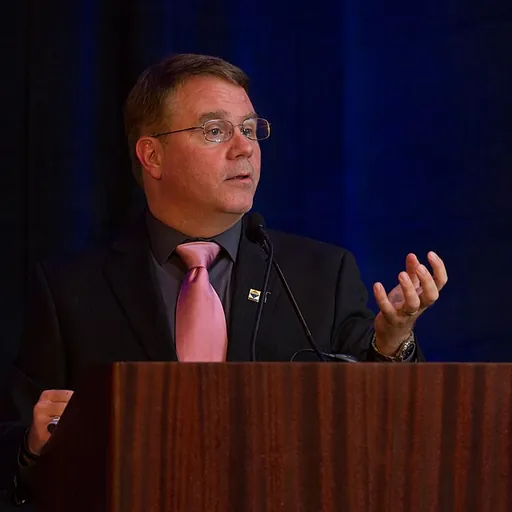
About John Warner
Born 1962. John Warner is an American chemist, entrepreneur, university teacher and researcher.
John Charles Warner (born October 25, 1962) is an American chemist, educator, and entrepreneur, best known as one of the founders of the field of green chemistry. Warner worked in industry for nearly a decade as a researcher at Polaroid Corporation, before moving to academia where he worked in various positions at University of Massachusetts Boston and Lowell. Warner is co-founder, President, and Chief Technology Officer at the Warner-Babcock Institute for Green Chemistry, as well as co-founder and President of Beyond Benign. He is the recipient of the 2014 Perkin Medal, widely acknowledged as the highest honor in American industrial chemistry.
Education Warner was born in Quincy, Massachusetts, to John A. and Natalie Warner as part of a huge family, including 47 first cousins within a one-mile radius. During his childhood, Warner first met his long-time friend and colleague Paul Anastas at age eleven, with whom he later co-authored the defining work in the developing field, Green Chemistry: Theory and Practice.
Anastas and Warner both attended Quincy High School, where Warner was most well known, not as a chemist, but as a musician. There, he played in the marching band and the jazz band, and was voted class musician. He published five papers as an undergraduate by the time he was twenty years old.
After college, Warner pursued graduate studies at Princeton University, where he received a PhD in chemistry after completing a doctoral dissertation, titled "Synthesis of pyrido[2,3-d]pyrimidines (5-deazapteridines)", under the supervision of Edward C. Taylor. and as an Utne Reader "visionary" in 2011.
Warner has invented technologies for companies including Nike, Givaudan, Covestro, Lanxess, and Entegris, as serving on advisory boards for companies including Dow, Nike, Levis, and Apple. In 2022, he took up the role of Distinguished Research Fellow at DUDE CHEM, Berlin and as Green Chemistry Innovation Advisor at GL Chemtec, Ontario. In 2024, Warner was appointed professor of practice at the Rochester Institute of Technology (RIT).
Non-Covalent Derivatization Warner first articulated the concept of Non-Covalent Derivatization (NCD) at a conference in 1997, but he employed this concept in practice as early as 1988. He initially devised this method as a solution to a common engineering problem that hydroquinone (HQ), an essential developer in Polaroid instant photography, is not readily soluble in water. HQ is desired in more modern applications for its potency as a reducing agent, and until Warner, this problem was typically addressed by traditional chemical synthesis, or modifying a target material by attaching various functional groups via covalent bonds, also referred to as "covalent derivatization." Inspired by phenomena he observed in nature, Warner proposed NCD as an alternative means of modifying a target material, not via covalent bonds, but innate intermolecular forces. The applications of this process ranged from film development to more recently cosmetic dermatology. NCD is now most often employed as an effective means of reducing the environmental impact of a process, by the minimizing the materials and energy required and waste produced, and is successfully applied in the production of pharmaceuticals as well as fragrances, agrochemicals, pigments, and food additives. Warner holds patents based on NCD in many of these areas, most notably drugs to treat nervous system disorders, additives to increase recyclability of asphalt, and processes to reverse depigmentation in hair. As the environmental movement grew, the chemical industry was portrayed as the clear antagonist. Anastas and Warner argue that in the past, the role of the chemist in the environment was limited to site monitoring and remediation after an accident, but in a present where so many new chemicals are constantly introduced, it is now imperative that chemists assure that anything created is non-toxic, before it is even synthesized. and the blueprint for chemical industry practice throughout the world. The remainder of the book details how to design environmentally benign chemicals, from evaluating starting materials to examining concrete toxicological mechanisms and giving examples of green processes. Within a few years after the book was released, the number of papers and patents published that included the term green chemistry increased steadily.
Awards Warner has been recognized for his pioneering work with several awards, including: 2002: "Distinguished Chemist of the Year Award" from the American Institute of Chemistry's Northeast Division 2004: "Presidential Award for Excellence in Science, Mathematics and Engineering Mentorship" from the National Science Foundation 2008: "Leadership in Science Award" (with Paul Anastas) from the Council of Scientific Society presidents 2011: "Environmental Merit Award" from the US EPA 2011: "ACS Fellows Award" from the ACS 2012: "Henry Maso Award" from the Society of Cosmetic Chemistry 2014: "Perkin Medal" from the Chemical Heritage Foundation 2016: "AAAS-Lemelson Invention Ambassador" from the American Association for the Advancement of Science and Lemelson Foundation 2016: "Harry & Carol Mosher Award" from the ACS Santa Clara Valley Section
Don’t just read it —
keep it.
Full-length biographies made to live with: read them, listen on the way to work, watch them tonight.
- E-book
- Audio
- Video
Instant download · yours to keep · every purchase keeps this site free
Important facts
People in John Warner's life
Named in this biography and alive at the same time



Related people
Same field, nearest in time



Contemporaries
People whose lives overlapped John Warner's




Frequently asked questions
Who is John Warner?
American green chemist
When was John Warner born?
John Warner was born on 25 October 1962 in United States.
What is John Warner's occupation?
John Warner is a chemist, entrepreneur, university teacher and researcher.
What nationality is John Warner?
John Warner is American.
Sources & further reading
· DBpedia: John Warner (chemist)
Cite this page
APA: Biography.guide. (2026). John Warner. https://biography.guide/john-warner-chemist-1962/
MLA: "John Warner." Biography.guide, https://biography.guide/john-warner-chemist-1962/.
Chicago: "John Warner." Biography.guide. https://biography.guide/john-warner-chemist-1962/.
Data last updated: 2026-09-21 · Spot an error? Report a correction.
Portrait: Wikimedia Commons · author & licence
Page generated 2026-09-27 05:00 UTC