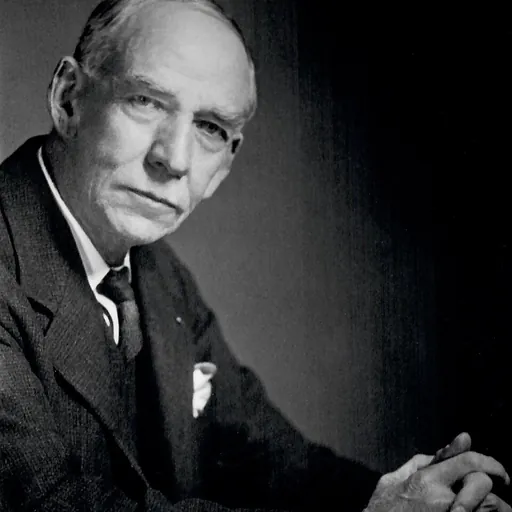
About John Thomas Dunn
Lived 1858 – 1939 (aged 80). John Thomas Dunn was a British chemist, known for Northern Polytechnic Institute and Royal Society of Chemistry.
John Thomas Dunn (19 April 1858 – 3 January 1939) was an English analytical chemist. He was also a teacher and author. He became President of the Royal Society of Chemistry and received the highest honours his scientific colleagues could bestow.
He was Durham University's first Master of Science and subsequently became its first Doctor of Science. He was the founding principal of the Northern Polytechnic Institute in London. He later practised as an analytical and consulting chemist in North East England and was the public analyst for Newcastle upon Tyne, for the county of Northumberland and for several of the major industrial towns of the North East. He was a hereditary freeman of Newcastle upon Tyne. On his death he was described as "the Father of Tyneside Chemistry".
Early life and education
Dunn was born in Newcastle upon Tyne in 1858 to Thomas Dunn, a Newcastle ironmonger and auctioneer and his wife Ann Chicken, the daughter of a labourer at William Armstrong's Newcastle factory. He attended the Percy Street Academy in Newcastle, popularly known as Dr Bruce's School, from about the age of 8. He left school at the age of 13 to work as a clerk for his father and then as a railway booking clerk. In 1874, at the age of 16, Dunn became a student at the three-year-old College of Physical Science in Newcastle, which was then part of the University of Durham, and is now part of Newcastle University.
Specialising in chemistry, at the early age of 19 he became a Bachelor of Science, one of the university's first. and in 1888 he became the university's first Doctor of Science.
Dunn's task in his first year – as founding Principal of the institute (which has since become the main campus of the London Metropolitan University) – was to prepare for its opening and to employ staff, and to enrol as many students as possible so that it might be a success from the moment the doors were opened in October 1896.
The result was 1000 students enrolled in the first year, to be taught by 34 staff. All the students were at elementary level and most attended evening classes while working during the day. Courses ranged from English, mathematics, chemistry and physics to more vocational classes such as machine construction, plumbing, dress-making, and millinery.
A year later Dunn was able to record a further rise in student numbers and to report that there was a growing tendency to take advantage of the institute, especially in the trade and industrial classes.
In 1901, however, after 6 years at the institute, Dunn left academia to practice as an analytical and consulting chemist. At the end of the academic year he left London to return to his roots in Newcastle upon Tyne.
Analytical and consulting chemist
In the early summer of 1901 Dunn joined "Consulting Chemists, Analysts, Assayers and Samplers" J and H S Pattinson as a partner with John Pattinson. The firm had been founded in the year of Dunn's birth – 1858 – and set up offices and a laboratory at 75 The Side in Newcastle upon Tyne, where they concentrated on coal purity testing and food analysis.
With Dunn as a partner they moved to larger offices and laboratories nearby at 10 Dean Street in Newcastle who had been tried for the manslaughter of one of his patients in 1867, but was cleared of all charges. They had one child, Laura.
Dunn was an enthusiastic supporter of many organisations. Apart from his long-term membership of the Literary and Philosophical Society of Newcastle upon Tyne, which he had joined at the age of 14 in 1872, and of which he became a vice-president, he was a member of Newcastle's Liberal Club and joined the Newcastle branch of Rotary International, serving as its president in 1921–22 and representing Newcastle Rotarians at the International Conference in Minneapolis in 1928. Dunn held office as Senior Steward of the Guild.
Many admiring obituaries were published in newspapers and professional journals. One obituarist described him as "the Father of Tyneside Chemistry". His junior partner Charles Bloxam wrote in the journal of the Royal Society of Chemistry that:
"An eminent man has gone from us, but his example remains, and fortunately the many who came in contact with him during his early scholastic and university life, and later in his numerous public and professional activities, have had the opportunity to profit by it. A cultured and scholarly man, of quiet and kindly disposition, tolerant of the views of others, yet ever ready stoutly to defend his own opinions with a vigour that surprised those who were unacquainted with the depths of his character".
Don’t just read it —
keep it.
Full-length biographies made to live with: read them, listen on the way to work, watch them tonight.
- E-book
- Audio
- Video
Instant download · yours to keep · every purchase keeps this site free
Important facts
People in John Thomas Dunn's life
Named in this biography and alive at the same time




Related people
Same field, nearest in time



Contemporaries
People whose lives overlapped John Thomas Dunn's


Frequently asked questions
Who was John Thomas Dunn?
19th and 20th-century analytical chemist and academic
When was John Thomas Dunn born?
John Thomas Dunn was born on 19 April 1858 in Newcastle upon Tyne.
When did John Thomas Dunn die?
John Thomas Dunn died on 3 January 1939 in Newcastle upon Tyne.
What was John Thomas Dunn's occupation?
John Thomas Dunn was a chemist.
What was John Thomas Dunn known for?
John Thomas Dunn was known for Northern Polytechnic Institute and Royal Society of Chemistry.
What nationality was John Thomas Dunn?
John Thomas Dunn was British.
Sources & further reading
· DBpedia: John Thomas Dunn (chemist)
Cite this page
APA: Biography.guide. (2026). John Thomas Dunn. https://biography.guide/john-thomas-dunn-chemist/
MLA: "John Thomas Dunn." Biography.guide, https://biography.guide/john-thomas-dunn-chemist/.
Chicago: "John Thomas Dunn." Biography.guide. https://biography.guide/john-thomas-dunn-chemist/.
Data last updated: 2026-09-20 · Spot an error? Report a correction.
Portrait: Wikimedia Commons · author & licence
Page generated 2026-09-27 04:58 UTC