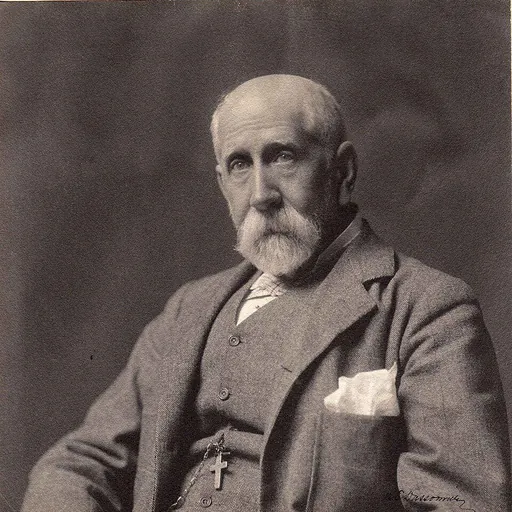
John T. Arundel
British guano and copra entrepreneur and botanical collector
About John T. Arundel
Lived 1841 – 1919 (aged 78). John T. Arundel was a British businessperson and botanical collector, known for Copra and Guano.
John T. Arundel (1 September 1841 – 30 November 1919) was an English entrepreneur who was instrumental in the development of the mining of phosphate rock on the Pacific islands of Nauru and Banaba (Ocean Island). Williams & Macdonald described him as "a remarkable example of that mid-Victorian phenomenon, the upright, pious and adventurous Christian English businessman."
Early life His father owned a gentleman's outfitter in the City of London and a warehouse business on the Thames estuary; the family lived at Gravesend, Kent. They were active in the Congregational Church, and through a church connection he joined Houlder Brothers & Co., a firm that provided ships for migration to New Zealand and Australia.
John T. Arundel & Co.
In 1871, with financial support from Houlder Brothers and Co., he established John T. Arundel & Co. The initial activities were carried out by the two companies. Houlder Brothers leased Flint Island from the British government, and Arundel managed the guano digging in the central part of the island from 1875 to 1880.
John T. Arundel & Co went on to engage in mining guano on other Pacific islands, established coconut plantations, and traded in copra and other commodities. Baker Island from 1886 to 1899, which is now claimed as an unincorporated territory of the United States. Howland Island from 1886 to 1899, which is geographically part of the Line Islands and now claimed as an unincorporated territory of the United States. Manra or Sydney Island in 1884, which is geographically part of the Phoenix Islands and is part of Kiribati. Raine Island in the Torres Strait, Rocky Island off Mornington Island in the Gulf of Carpentaria, Lady Elliot Island off Bundaberg, Queensland and several islands in the Capricorn and Bunker Group in the waters off Northern Australia.
Albert Ellis, a prospector who worked for John T. Arundel & Co., later acknowledged that the company was not making money although the company was gaining experience in the mining and shipping of guano and phosphate rock in what were sometimes difficult conditions, with many of these islands having no safe anchorage for shipping.
Despite this attempt to broaden the operations of the company, it remained chronically short of capital throughout its existence and was lent money from time to time by its directors. The analysis confirmed that it was high grade phosphate. Ellis and other company employees travelled to Banaba to confirm that the soil of that island was largely phosphate rock. Ellis went on to Nauru, at that time a German territory, and confirmed it also consisted of large deposits of phosphate rock.
The PPC investigated phosphate deposits on Makatea in the Tuamotus in French Polynesia and formed a company, the Compagnie des Phosphates de l'Océanie, with a Tahitian syndicate that was also investigating the potential of Makatea. This gave the PPC a virtual monopoly on the sources of high grade phosphate in the Pacific.
In 1919, the business of the PPC in Nauru and Banaba was acquired by the board of the British Phosphate Commission.
Chronology 1841 Born in England. His paternal grandfather, John Arundel, was Home Secretary of the London Missionary Society. 1884 His second daughter was born on Sydney Island, and was named Sydney. 1885, 3 March. Lectured at the Geographical Society of the Pacific, San Francisco, California. 1886 Resumed guano mining on Baker Island, Howland Island and Jarvis Island. 1902 The Pacific Islands Company became the Pacific Phosphate Company, and began phosphate mining on Banaba in 1901 and in Nauru in 1906. 1909 (September) The S.S. Ocean Queen was wrecked on the reef at Makatea; a bent connecting rod caused the engines to stop and the current carried the ship onto the reef. 1909 (October) In San Francisco, Arundel became a member of the Pacific Union Club. He suffered a heart attack and subsequently resigned as deputy chairman of the PPC.
Publications
Don’t just read it —
keep it.
Full-length biographies made to live with: read them, listen on the way to work, watch them tonight.
- E-book
- Audio
- Video
Instant download · yours to keep · every purchase keeps this site free
Important facts
People in John T. Arundel's life
Named in this biography and alive at the same time


Related people
Same field, nearest in time


Contemporaries
People whose lives overlapped John T. Arundel's
Frequently asked questions
Who was John T. Arundel?
British guano and copra entrepreneur and botanical collector (1841-1919)
When was John T. Arundel born?
John T. Arundel was born on 1 September 1841 in England.
When did John T. Arundel die?
John T. Arundel died on 1 December 1919 in Bournemouth.
What was John T. Arundel's occupation?
John T. Arundel was a businessperson and botanical collector.
What was John T. Arundel known for?
John T. Arundel was known for Copra and Guano.
What nationality was John T. Arundel?
John T. Arundel was British.
Sources & further reading
Cite this page
APA: Biography.guide. (2026). John T. Arundel. https://biography.guide/john-t-arundel/
MLA: "John T. Arundel." Biography.guide, https://biography.guide/john-t-arundel/.
Chicago: "John T. Arundel." Biography.guide. https://biography.guide/john-t-arundel/.
Data last updated: 2026-09-22 · Spot an error? Report a correction.
Page generated 2026-09-27 05:09 UTC