
About John Strother Griffin
Lived 1816 – 1898 (aged 81–82). John Strother Griffin was an American politician.
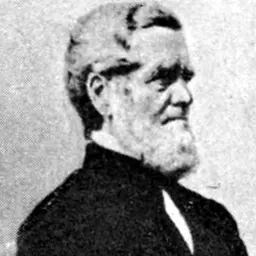
John Strother Griffin (1816–1898) was a surgeon attached to the General Stephen W. Kearney expedition from New Mexico to California, a landowner and founder of East Los Angeles and a member of the Common Council of the city of Los Angeles, where he was one of the first university-trained physicians to settle.
Family
John Strother Griffin was born in Fincastle, Virginia, on June 25, 1816, to John Caswell Griffin and Mary Talbot Hancock, both of Virginia. He had five siblings, George Hancock, William Preston, Julia Elizabeth, Caroline Margaret and Elizabeth Croghan. An uncle was William Clark of the Lewis and Clark Expedition, and a later brother-in-law was Confederate General Albert Sidney Johnston. ten years before Griffin's death on August 23, 1898. Griffin succumbed in his Eastside Los Angeles home, 1109 Downey Ave., where he lived with his nephew and niece, Mr. and Mrs. Hancock M. Johnston, and their children. Funeral services were conducted in the home and at the gravesite in Evergreen Cemetery by Joseph Widney. Pallbearers were J. M. Griffith, Harris Newmark, S. Lazard, Reginaldo Del Valle, Major Ben Truman and James Craig. Besides the Johnsons, he was survived by two nieces, Mrs. George J. Denis and Mrs. William B. Pritchard. where he received a medical degree in 1837. At that time the university listed his "place of origin" as "Kentucky".
Career
Military
In 1840, Griffin was appointed assistant surgeon in the Army and served under General William J. Worth in Florida and, with the rank of captain, on the Southwest frontier at Fort Gibson, Griffin came to California for the first time with General Kearney on the trek from New Mexico in 1846. He was stationed in San Diego and in Los Angeles in charge of the military hospitals, visited the California Gold Country during the 1849 Gold Rush and was stationed in Benicia until 1852. In that period he was given duty in an expedition against the Yuma Indians on the Colorado River. He was assigned to Washington, D.C., in 1853 and resigned from the service in 1854.
The California Historical Society in 1944 published Griffin's diary relating his wartime experiences, under the title A Doctor Comes to California — The Diary of John S. Griffin, M.D., 1846–1847.
Doctor Griffin's story concerns the hardships endured by General Kearney's small force as it crossed the unknown and trackless deserts, and it recounts what took place in the battles of San Pascual, San Gabriel, La Mesa and Los Angeles, and reveals his methods of treatment for wounds and diseases afflicting the soldiers in his charge. The narrative is most interesting.
One of his staff was Bridget (Biddy) Mason, who worked for him as a midwife and nurse, becoming known for her herbal remedies. She earned $2.50 a day, considered a good wage for African-American women at that time. In 1856, Mason had been declared a person "free forever" in a successful suit she filed as a slave brought from slave-holding Texas into the free state of California in 1851. The judge rendering the decision was Benjamin Hayes, the brother of Griffin's wife.
James King of William
Griffin was summoned all the way to San Francisco to advise doctors on the treatment of James King of William, the editor of the San Francisco Evening Bulletin, who had been shot at close range on May 14, 1856, by James P. Casey, whom King had identified in the newspaper as having had a criminal record in New York.
Medical historian John Long Wilson wrote that King, who was active during the San Francisco Committee of Vigilance era:
dared to expose scoundrels in both public and private domains; and by relentlessly pursuing a campaign against them, he changed the course of history in the beleaguered city. It is of special interest to us that the violence erupting as a result of his biting editorials had extraordinary medical dimensions.
Doctors who first treated King had inserted a sponge into the bullet wound to stanch the bleeding and were debating whether to remove it in order to fight a severe infection that had arisen. After examining King on May 18, Griffin advised against the removal, fearing hemorrhage from a severed subclavian artery. King died on May 20.
Wilson opined that:
Dr. Griffin's conspicuous army service in Southern California combined with his sterling personal qualities no doubt contributed to his rapid rise to leadership in civic and business affairs in Los Angeles, and to his acquisition of a large surgical practice within a few years. Although memorial statements about his career say that he sought new treatments and was not hesitant to discard old methods, we have no specifics as to the meaning of these generalities and we have no information about his experience with vascular surgery. In any case, we know that he sided with ... [his] timid colleagues and advised against removing the sponge. Assuming that it was not already too late to make a difference, we must conclude that it was Griffin's opinion that sealed the fate of James King of William.
Smallpox epidemic
In return for his work in stemming a smallpox epidemic, the city of Los Angeles awarded Griffin a plot of land on what was called the "Enchanted Hill" where Lincoln High School was later built (now 3501 North Broadway).
Real estate and politics
Griffin was called "the father of East Los Angeles"
Legacy
Griffin Avenue in Montecito Heights and Lincoln Heights is named for him.
Don’t just read it —
keep it.
Full-length biographies made to live with: read them, listen on the way to work, watch them tonight.
- E-book
- Audio
- Video
Instant download · yours to keep · every purchase keeps this site free
Important facts
People in John Strother Griffin's life
Named in this biography and alive at the same time





Related people
Same field, nearest in time



Contemporaries
People whose lives overlapped John Strother Griffin's



Frequently asked questions
Who was John Strother Griffin?
American physician and businessman
When was John Strother Griffin born?
John Strother Griffin was born on 25 June 1816.
When did John Strother Griffin die?
John Strother Griffin died in 1898.
What was John Strother Griffin's occupation?
John Strother Griffin was a politician.
What nationality was John Strother Griffin?
John Strother Griffin was American.
Sources & further reading
· Wikipedia: John Strother Griffin
· DBpedia: John Strother Griffin
Cite this page
APA: Biography.guide. (2026). John Strother Griffin. https://biography.guide/john-strother-griffin/
MLA: "John Strother Griffin." Biography.guide, https://biography.guide/john-strother-griffin/.
Chicago: "John Strother Griffin." Biography.guide. https://biography.guide/john-strother-griffin/.
Data last updated: 2026-09-25 · Spot an error? Report a correction.
Page generated 2026-09-27 05:07 UTC