
About John Stearns
Lived 1951 – 2022 (aged 71). John Stearns was an American baseball player.
John Hardin Stearns (August 21, 1951 – September 15, 2022), nicknamed "Bad Dude", was an American professional baseball catcher and coach in Major League Baseball (MLB). He played for the New York Mets from 1975 to 1984 after playing a single game for the Philadelphia Phillies in 1974.
Stearns was a two-sport star in college, and he entered professional baseball after being selected in both the MLB and National Football League drafts. He was a four-time MLB All-Star, but struggled with injuries in the latter portion of his career. After his retirement as a player, Stearns served as a coach for the New York Yankees, Baltimore Orioles, and New York Mets of MLB, as well as in Minor League Baseball.
Early life Stearns attended Thomas Jefferson High School in Denver, Colorado. He played three sports in high school, winning state championships in baseball and basketball. He was drafted as a defensive back by the Buffalo Bills in the 17th round of the 1973 NFL draft. The Philadelphia Phillies selected Stearns in the first round, with the second overall pick in the 1973 Major League Baseball draft, and he chose to turn professional in baseball.
In his first season as a Met, Stearns spent as the backup catcher behind veteran Jerry Grote, the Mets' regular catcher since . Stearns had a .125 average in August and .167 average in September. His 25 doubles were most on the team and 12 home runs tied Steve Henderson and John Milner for the team lead.
Stearns got into a bench clearing brawl in the fourth game of the 1979 season. With the Montreal Expos at Shea Stadium on April 11, Stearns and Expos catcher Gary Carter collided at home when Carter tried to score from first on a throwing error by Mets pitcher Pete Falcone. Right fielder Elliott Maddox made a perfect throw to the plate to get Carter. Following the play, a fight broke out when Stearns felt that Carter unnecessarily threw an elbow at him. Both benches and bullpens emptied, and both players were ejected from the game. Stearns set career highs in games played in 1979, but at age 27, it was his last season with 100 or more games. He also set personal highs in at-bats, hits, and doubles. Although he struggled to get above .200, a good June resulted in selection to his second All-Star Game (although he did not play). The Mets finished 1979 with 99 losses, and 35 games behind the division champion Pittsburgh Pirates. Well out of contention in the second half, they experimented by playing Stearns at both first base and third base, as well as in the outfield, but he finished out the season back behind the plate.
Stearns was selected to his third All-Star Game and logged his first All-Star Game at bat, grounding out in the fifth inning. A three-hit, three-runs batted in game highlighted his July, but just a week later, on July 26, a broken finger on a foul tip ended his season.
Injuries (1981–1986) The injury that ended his 1980 season was the first of several injuries that would plague the rest of his career. Stearns started on the disabled list. After missing the first two weeks, he was eased back with pinch-hitting duty and play at first and third base. He started catching regularly again in late May and was hitting fairly well, when the 1981 Major League Baseball strike canceled two months of the season starting in mid-June. Play resumed in mid-August and Stearns finished with a respectable .271 average, but his run production dropped quite a bit from 1980 and he had only 14 extra base hits all season. He continued hitting well after the break, but after a month, began suffering the effects of elbow tendinitis. Unable to throw, he played in only four games, all as a pinch-runner. In , he spent some time with triple A Tidewater Tides and logged only one big league game in the first five months. He was well enough to play in September, but only played sporadically. After the season, the Mets traded Hubie Brooks, Mike Fitzgerald, Herm Winningham, and Floyd Youmans to Montreal for Carter. Stearns became a free agent and attempted a comeback with the Winter League's Ponce Lions, until re-injuring his elbow. Another comeback with the Cincinnati Reds' AAA Denver Zephyrs in was going well, until he was hit by a pitch in mid-May. Stearns made one final attempt at a comeback with the Texas Rangers, competing for a spot on their Opening Day roster in spring training in .
Post-playing career
In late , the Milwaukee Brewers hired Stearns as a scout and minor league instructor. In , he was the New York Yankees' bullpen coach. He was then hired by the Toronto Blue Jays as the manager of the AA-level Knoxville Blue Jays for and , reaching the post-season in the latter season.
Stearns spent as a Cincinnati Reds scout, and as an ESPN broadcaster. He returned to the Reds as the manager of their rookie-level team, the Princeton Reds, in . The team won the Appalachian League championship and Stearns was named Manager of the Year. Afterwards, Stearns managed the Peoria Javelinas of the Arizona Fall League and won his second minor league championship of the year. He was added to the Reds coaching staff during the 1995 campaign by manager Davey Johnson who defied team owner Marge Schott's refusal to pay the salary for an additional coach. Schott was oblivious to the situation because it was never mentioned in her presence and Stearns wore a jersey without his name on the back.
Stearns was announced on January 5, 1996, as the first base coach on Johnson's staff with the Baltimore Orioles. He left the Orioles two years later in January 1998 when he was not retained by Ray Miller who had succeeded Johnson as manager.
In , Stearns returned to the New York Mets as an advance scout. He was then made the Mets' bench coach in 2000. He was dismissed after the season, but re-hired as the third base coach. Younger fans witnessed Stearns's enthusiasm and excitability while he was a Mets coach in . He was wearing a microphone for Fox television when the Mets' Mike Piazza hit a run-scoring double in Game 1 of the 2000 NLCS against the St. Louis Cardinals. Stearns's audible reaction of "The monster is out of the cage!" became a rallying cry for the entire series.
After two years coaching the major league Mets, Stearns was let go, but hired as a scout for . In , he returned to the dugout as Manager of the Binghamton Mets. Despite a poor record with AA Binghamton, he was made the manager of the AAA Norfolk Tides for . Stearns spent as a roving catching instructor for the Mets.
On January 11, , Stearns became a coach in the Washington Nationals farm system. He spent one season as manager of their triple A affiliate, the Columbus Clippers, and spent two seasons as manager of the Nationals' double A team, the Harrisburg Senators.
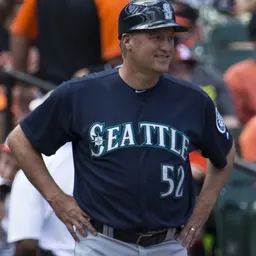
Stearns joined the Seattle Mariners as minor-league catching coordinator in 2011 and then served as a professional scout in 2012. On May 2, 2013, was named the interim manager for the Triple-A Tacoma Rainiers after Daren Brown replaced third-base coach Jeff Datz at his position due to Datz's cancer diagnosis. Stearns was named the Mariners' third base coach for the 2014 season. However, Stearns underwent surgery for a hiatal hernia prior to spring training and his slower-than-expected recovery compelled him to resign on March 7, 2014. He remained in the Mariners' organization, however, as a scout for the 2014 season. After attending a memorial service for his high school baseball coach in 2015, he said he was not sure how he would be involved with baseball again. Also in 2015, Stearns was interviewed at length in the book The Seventh Year Stretch: New York Mets, 1977-1983, by author Greg Prato.
Personal life Stearns and his wife, Martha Jo, married after the 1977 season.
In January 2022, Stearns was diagnosed with stage IV prostate cancer. Despite his diagnosis, Stearns was well enough to attend the Mets' Old Timers' Day at Citi Field on August 27. Stearns died of cancer on September 15, 2022, less than three weeks later, at the age of 71.
Career statistics
Don’t just read it —
keep it.
Full-length biographies made to live with: read them, listen on the way to work, watch them tonight.
- E-book
- Audio
- Video
Instant download · yours to keep · every purchase keeps this site free
Important facts
People in John Stearns's life
Named in this biography and alive at the same time




Related people
Same field, nearest in time


Contemporaries
People whose lives overlapped John Stearns's

Frequently asked questions
Who was John Stearns?
American baseball player and coach
When was John Stearns born?
John Stearns was born on 21 August 1951 in Denver.
When did John Stearns die?
John Stearns died on 15 September 2022 in Denver.
What was John Stearns's occupation?
John Stearns was a baseball player.
What nationality was John Stearns?
John Stearns was American.
Sources & further reading
Cite this page
APA: Biography.guide. (2026). John Stearns. https://biography.guide/john-stearns-baseball-player/
MLA: "John Stearns." Biography.guide, https://biography.guide/john-stearns-baseball-player/.
Chicago: "John Stearns." Biography.guide. https://biography.guide/john-stearns-baseball-player/.
Data last updated: 2026-09-20 · Spot an error? Report a correction.
Page generated 2026-09-27 05:22 UTC