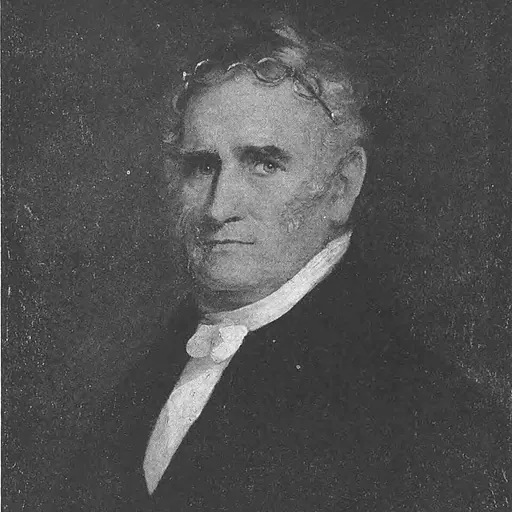
About John Rowan
Lived 1773 – 1843 (aged 70). John Rowan was an American politician, lawyer and judge.
John Rowan (July 12, 1773 – July 13, 1843) was a 19th-century politician and jurist from the U.S. state of Kentucky. Rowan's family moved from Pennsylvania to the Kentucky frontier when he was young. From there, they moved to Bardstown, Kentucky, where Rowan studied law with former Kentucky Attorney General George Nicholas. He was a representative to the state constitutional convention of 1799, but his promising political career was almost derailed when he killed a man in a duel stemming from a drunken dispute during a game of cards. Although public sentiment was against him, a judge found insufficient evidence against him to convict him of murder. In 1804, Governor Christopher Greenup appointed Rowan Secretary of State, and he went on to serve in the Kentucky House of Representatives and the U.S. House of Representatives.
In 1819, Rowan was appointed to the Kentucky Court of Appeals, serving until his resignation 1821. He was again elected to the state legislature in 1823. With the state reeling from the Panic of 1819, Rowan became the leader of a group of legislators dedicated to enacting laws favorable to the state's large debtor class. He believed the will of the people was sovereign and roundly denounced the Court of Appeals for striking down debt relief legislation as unconstitutional. He led the effort to impeach the offending justices, and when that effort failed, spearheaded a movement to abolish the court entirely and replace it with a new one, touching off the Old Court – New Court controversy. New Court partisans in the legislature elected Rowan to the U.S. Senate in 1824. During his term, the nascent Whig Party ascended to power in the state legislature, and at the expiration of his term in 1831, the Whigs replaced him with party founder Henry Clay.
After his term in the Senate, Rowan returned to Kentucky, where he served as the first president of the Louisville Medical Institute and the Kentucky Historical Society. In 1840, he was appointed to a commission to prosecute land claims of U.S. citizens against the Republic of Mexico, but resigned his commission in 1842 because of failing health. He died July 13, 1843, and was buried on the grounds of Federal Hill, his estate in Bardstown. According to tradition, Stephen Collins Foster, a distant relative of Rowan's, was inspired to write the ballad My Old Kentucky Home after a visit to Federal Hill in 1852, but later historians have been unable to conclude whether or not Foster ever visited the mansion at all. The mansion is now owned by the state of Kentucky and forms the centerpiece of My Old Kentucky Home State Park.
Early life and family John Rowan was born July 12, 1773, near York in the Province of Pennsylvania. He was third of five children born to Captain William and Sarah Elizabeth "Eliza" (Cooper) Rowan. His siblings included two older brothers – Andrew and Stephen – and two younger sisters – Elizabeth and Alice. Three of the families disembarked near what is now Maysville, Kentucky; the Rowans would later learn that most of these settlers were killed by Indians. The remaining settlers continued downriver, reaching Louisville, Kentucky, on March 10, 1783. The fort, then located approximately 100 miles from the nearest white settlement, is the present-day town of Calhoun. The settlers at Fort Vienna frequently clashed with the Shawnee who used the area as a hunting ground. Salem Academy was, at the time, considered one of the best educational institutions in the west. Among Rowan's classmates at the Academy were future U.S. Attorney General Felix Grundy, future U.S. Senator John Pope, future U.S. District Attorney Joseph Hamilton Daveiss, and future Kentucky state senator John Allen. Other notable members of the society included future Florida Governor William Pope Duval, future U.S. Postmaster General and Kentucky Governor Charles A. Wickliffe, and future Kentucky Senator Benjamin Hardin. Rowan struggled financially during his early years as a lawyer. An advocate of education, Rowan allowed several prominent young law students to study in his office, including future U.S. Treasury Secretary James Guthrie, future Supreme Court Justice John McKinley, and future Kentucky Governor Lazarus W. Powell.
Rowan married Anne Lytle on October 29, 1794. Rowan and his wife – who he affectionately nicknamed "Nancy" – had nine children: Eliza Cooper (Rowan) Harney, Mary Jane (Rowan) Steele, William Lytle Rowan, Atkinson Hill Rowan, John Rowan Jr., Josephine Daviess (Rowan) Clark, Ann (Rowan) Buchanan, Alice Douglass (Rowan) Shaw Wakefield, and Elizabeth (Rowan) Hughes. Atkinson Hill Rowan served as an emissary to Spain for President Andrew Jackson. John Rowan Jr. was appointed U.S. Chargé d'Affaires to Naples by President James K. Polk, serving from 1848 to 1849. After a fire destroyed the log cabin in which the Rowans lived in 1812, they moved into the part of the mansion that was completed, and continued to live there while construction on the rest of the house was finished.
Rowan owned slaves. He identified with the Democratic-Republican Party and espoused the Jeffersonian principles of limited government and individual liberty. On January 29, 1801, Rowan joined Dr. James Chambers and three other men for a game of cards at Duncan McLean's Tavern in Bardstown. After several beers and games of whist, Chambers suggested playing Vingt-et-un for money instead. According to Little, Rowan, embarrassed at his behavior, refused the challenge and repeatedly apologized for his actions, but Chambers was insistent on the duel and continued hurling insults of growing severity at Rowan until Rowan accepted the challenge. Bibb claims that he and Rowan had, after the night of the incident, gone to nearby Bullitt County on business, that Rowan had returned first, and that Rowan showed Bibb the letter upon his return on February 1. According to Bibb, he and Bullock met on February 1 to discuss the parameters for the duel. Despite medical aid, Chambers died the following day. The posse was fooled into thinking the slave was Rowan and gave chase, but the slave escaped and Rowan's life was spared as well. Heller also points out that Grundy was Commonwealth's Attorney not in Nelson County (the location of Bardstown), but in neighboring Washington County at the time. In 1802, he was one of 32 men who signed a pledge to bring James Madison to Transylvania University as superintendent. This action began a long relationship between Rowan and Transylvania, and the university presented him with an honorary Doctor of Laws degree in 1823. Joshua Barney, McCreery's opponent in the election, claimed that McCreery did not meet a requirement in the Maryland Constitution that a representative live in the district from which he was elected for twelve months prior to the election.
Also during the first session of the Tenth Congress, Rowan proposed that a congressional committee be formed to investigate accusations against General James Wilkinson that, in 1788, he took money from the government of Spain in exchange for efforts to separate Kentucky from Virginia and unite it with Spain rather than the United States. Rowan's proposal to form an investigative committee against Wilkinson failed, but he succeeded in gaining approval for a committee to investigate federal judge Harry Innes' purported role in the Conspiracy. He opined that Rowan's attempt to investigate Wilkinson had been a slap at party founder Thomas Jefferson (then in his second term as president), under whom Wilkinson was serving as Commanding General of the United States Army. Fackler observed that Rowan often disagreed with Jefferson as president, and that as a result, some historians labeled him a Federalist, a designation Fackler felt was in error. Representative James G. Birney vigorously opposed the resolution, and it was defeated.
Rowan was appointed as a judge of the Kentucky Court of Appeals in 1819. In the case of McCulloch v. Maryland, the U.S. Supreme Court delivered a contradictory opinion.
While Rowan was still a justice of the Court of Appeals, the General Assembly chose him and John J. Crittenden as commissioners to resolve a border dispute with Tennessee. The dispute had arisen from an erroneous survey of the border line conducted by Dr. Thomas Walker years earlier. The Tennessee commissioners, Felix Grundy and William L. Brown, proposed that, because it had been accepted for so long, the Walker line be observed as far west as the Tennessee River, with Kentucky being compensated with a more southerly line between the Tennessee and Mississippi Rivers. Crittenden was inclined to accept this proposal with some minor adjustments, but Rowan insisted that Tennessee honor the statutory border of 36 degrees, 30 minutes north. The case, which involved the constitutionality of laws passed by the General Assembly relating to land titles granted in Kentucky when the state was still a part of Virginia, was of interest to the legislature. The Supreme Court, however, refused the second rehearing, letting stand their previous opinion that Kentucky's laws were in violation of the compact of separation from Virginia. The state's politicians split into two factions. Those who advocated for measures that were more favorable to debtors were dubbed the Relief faction while those who insisted on sound money principles and the strict adherence to the obligation of contracts were called the Anti-Relief faction.
William T. Barry and Rowan were leaders of the New Court faction. Meanwhile, Rowan, who espoused the Relief position, was elected to the Kentucky House of Representatives in 1822 representing Jefferson and Oldham counties. He immediately became the leader of the Relief faction in the House. When Relief partisans decided to appeal Williams and Lapsley to the Kentucky Court of Appeals, which was at the time the court of last resort in the state, Rowan was chosen to argue the appeal before the court alongside George M. Bibb and Lieutenant Governor William T. Barry. Their efforts failed, however, as the Court found the measure unconstitutional, upholding the decisions of the lower courts.
On December 10, 1823, Rowan presented resolutions condemning the Court's decision to the legislature. The twenty-six page preamble to the resolutions laid out the Relief faction's reasoning upon the subject of debt relief and legislative supremacy. The offending judges – two of whom had been Rowan's colleagues during his service on the Court – were summoned before the legislature to defend their decisions later in December. Following their appearance, Rowan introduced a measure to remove them from office; the vote in the House was 56–40 in favor of the measure, but this fell short of the two-thirds majority needed to remove the judges. The Relief faction then introduced legislation to repeal the law that originally created the Court of Appeals, then replace the abolished court with a new court. In November 1824, Rowan heavily revised the preamble and resolutions he presented in the previous legislative session.
Rowan's role in the Old Court – New Court controversy strained his relationship with his former friend, Benjamin Hardin. Hardin and Rowan had once been so close that Hardin named one of his sons "Rowan" in his colleague's honor. The pro-Relief majority in the state Senate subsequently elected Rowan to the U.S. Senate, which had the inadvertent effect of weakening the faction's cause in the House by removing its leader there. Rowan served in the Senate from March 4, 1825, to March 3, 1831.
An ally of Senator Richard Mentor Johnson, who was a primary voice against the practice of debt imprisonment, Rowan made a notable speech denouncing the practice on the Senate floor in 1828. A consistent opponent of internal improvements and tariffs, even those that would benefit his own constituents, he voted against a measure allocating federal funds for the construction of a road connecting the cities of Lexington and Maysville. The vote was ill-received by the people of the state, and Rowan's popularity took a significant hit. Rowan's strict adherence to Jeffersonian democracy and leadership of the New Court faction during the court controversy of the 1820s had put him at odds with Whig founder Henry Clay. Henry Clay was elected instead. The spouses of William and Mary Jane also died of cholera, as did Mary Jane's daughter, and Rowan's sister Elizabeth and her husband. Aid from Bishop Joseph Flaget and a group of nuns who traveled to Federal Hill during the epidemic probably spared the life of Rowan's orphaned granddaughter, Eliza Rowan Harney. He also served as the first president of the Kentucky Historical Society from 1838 until his death. While there, he fell ill and was unable to return to Washington, D.C.; consequently, he resigned his commission. Rowan died July 13, 1843. Several years later, members of his family placed a marker over his grave, despite his wishes.
Cousin of the Rowan family, Stephen Collins Foster, was inspired by Harriet Beecher Stowe's anti-slavery novel Uncle Tom's Cabin to write his ballad My Old Kentucky Home. The song was not associated with Federal Hill until after the Civil War, and Stephen likely never visited the site, as attested by his biographers such as John Tasker Howard, William Austin, Ken Emerson, and JoAnne O’Connell. The mansion remained in the possession of Judge Rowan's family until 1922, when his granddaughter, Madge (Rowan) Frost, sold it to the state of Kentucky to be preserved as a state shrine. Today, it is a part of My Old Kentucky Home State Park in Bardstown. In 1856, the Kentucky General Assembly created a new county from parts of Fleming and Morgan counties and named it Rowan County in Rowan's honor.
Don’t just read it —
keep it.
Full-length biographies made to live with: read them, listen on the way to work, watch them tonight.
- E-book
- Audio
- Video
Instant download · yours to keep · every purchase keeps this site free
Important facts
People in John Rowan's life
Named in this biography and alive at the same time


Related people
Same field, nearest in time



Contemporaries
People whose lives overlapped John Rowan's


Frequently asked questions
Who was John Rowan?
American politician, Kentucky (1773-1843)
When was John Rowan born?
John Rowan was born on 12 July 1773 in York.
When did John Rowan die?
John Rowan died on 13 July 1843 in Louisville.
What was John Rowan's occupation?
John Rowan was a politician, lawyer and judge.
What nationality was John Rowan?
John Rowan was American.
Sources & further reading
· DBpedia: John Rowan (Kentucky politician)
Cite this page
APA: Biography.guide. (2026). John Rowan. https://biography.guide/john-rowan-politician/
MLA: "John Rowan." Biography.guide, https://biography.guide/john-rowan-politician/.
Chicago: "John Rowan." Biography.guide. https://biography.guide/john-rowan-politician/.
Data last updated: 2026-09-23 · Spot an error? Report a correction.
Portrait: Wikimedia Commons · author & licence
Page generated 2026-09-27 05:08 UTC