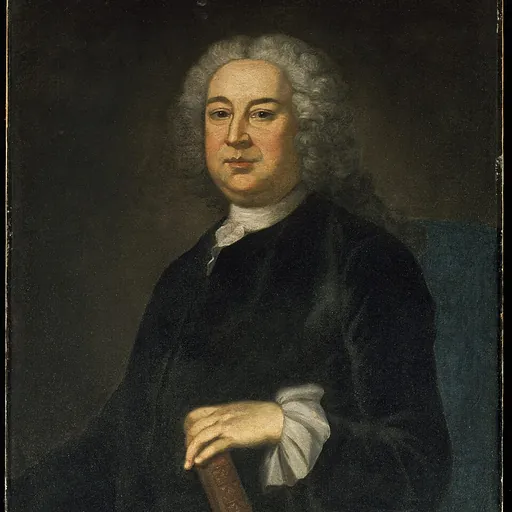
About John Robinson
Lived 1705 – 1766 (aged 61). John Robinson was an American politician.
John Robinson, Jr. (February 3, 1705 – May 11, 1766) was an American politician and landowner in the colony of Virginia. Robinson served as Speaker of the House of Burgesses from 1738 until his death, the longest tenure in the history of that office.
Early and family life
John Robinson was born to the former Catherine Beverley in Middlesex County and her planter husband John Robinson, both of the First Families of Virginia. His father would soon become one of the two members of the House of Burgesses representing Middlesex County, serving alongside his uncle Christopher Robinson. Robinson's father would ultimately serve on the Governor's Council (the upper house of the Virginia General Assembly, the House of Burgesses being the lower house) for 28 years, including a brief term as acting Governor until his unexpected death on August 24, 1749. Another uncle, also Bishop John Robinson was known for his loyalty to the Crown and diplomatic expertise.
Although documentation concerning this man's childhood is limited, he undoubtedly received a private education suitable to his class. He also studied at the College of William & Mary in Williamsburg instead of being sent to England to complete his education, as had his father and eldest brother, Christopher (1703-1738, who died unmarried at Oriel College of Oxford University).
Robinson married three times, surviving his first two wives, but his only descendants are by his daughter Susan of his final marriage. His first wife was Mary Storey (or "Story"). His second wife was Lucy Moore, daughter of wealthy merchant and planter Augustine Moore and sister of his man's political ally Bernard Moore. Robinson's third wife and widow was Susanna Chiswell, daughter of Col. John Chiswell of Williamsburg (and who remarried to William Griffin in 1771).
Career
Like his father, uncle and others of his class, Robinson was a planter who produced tobacco for export to Europe using enslaved labor. Although no records survive as to the date Robinson established his residence in King and Queen County, he resided at Pleasant Hill plantation along the Mattaponi River from 1744 (when he bought that plantation from Richard Johnson, who had inherited it from his uncle, also Richard Johnson, who may have inherited it from his father, Richard Johnson of the colony's Council of State, who died in 1699) until his death in 1766. Robinson's wife, Lucy Moore, was from King William County across the Mattaponi River. Rumors that her father, Col. Augustine Moore, built the mansion for his daughter could not be substantiated. The middle Richard Johnson left 1000 acres on that side of the Mattaponi River to his nephew, which grew to 4000 acres by Robinson's death. Robinson family members resided at Pleasant Hill until the executors of his estate sold it (advertised in April 1770 as 1300 acres of high land and 600 of marsh) by November 1773.
Robinson was first elected to public office in King and Queen County in 1727, but that election (as one of the Burgesses representing the area part-time during legislative session) was overturned following allegations of "illegal proceedings," although the House of Burgesses allowed Robinson to assume his seat as one of burgesses representing King and Queen County in 1730. Moreover in 1732, Robinson succeeded Chesley Corbin Thacker as clerk of the King and Queen county court. Continuing the tradition of both sides of his family, Robinson would then continually win re-election as one of the burgesses representing King and Queen County for nearly three decades, until his death. During this long tenure, Robinson demonstrated mastery of the rules of parliamentary procedure. When the previous treasurer, John Holloway, had resigned, the accounts were found in disorder, with £1,850 in arrears, possibly from amounts not forwarded by county sheriffs, though Holloway had also commingled state and personal funds. After Robinson died, burgesses discovered that he failed to burn redeemed notes, but instead used them to make personal loans exceeding £100,000 from the treasury to his friends. Auditors also discovered Robinson too failed to deposit funds received by local sheriffs into the Treasury. The resulting scandal reverberated in Virginia politics for years. Despite the sale of Mount Pleasant, and the next plantation upstream on the Mattaponi River, "Clifton", and a tobacco warehouse, Robinson's estate was not settled until decades after the end of the American Revolution.
While John Robinson was Speaker of the House of Burgesses, colonial relations with Britain deteriorated after the French and Indian War, as the British government attempted to recoup costs incurred defending the colonies. Following news of the Stamp Act 1765's passage, some burgesses proposed the Virginia Resolves against those fiscal measures. After Patrick Henry gave a speech favoring the resolution on May 29, in which he seemingly called for the killing of George III, Robinson and others shouted: "Treason! Treason!" Henry replied: "If this be treason, make the most of it!"
Meanwhile, Robinson's administrators found the late Speaker responsible for very large debts, and also located (mostly uncollectible) promissory notes from a number of fellow planters who were his allies in the House of Burgesses. A committee established to examine the treasury accounts found an arrearage of £100,761. Robert Carter Nicholas, his successor as treasurer, criticized Robinson by name in the Virginia Gazette, and as a result of the ensuing scandal, the two offices were not combined again. Peyton Randolph succeeded Robinson as Speaker, but chose not to administer Robinson's estate. Although three lawyers were appointed as the estate's administrators, Peter Randolph soon died, Peter Lyons chose to not participate actively, so Robinson's former ally Edmund Pendleton performed most of the work trying to both repay creditors and limit the scandal tarring Robinson's former beneficiaries.
Don’t just read it —
keep it.
Full-length biographies made to live with: read them, listen on the way to work, watch them tonight.
- E-book
- Audio
- Video
Instant download · yours to keep · every purchase keeps this site free
Important facts
People in John Robinson's life
Named in this biography and alive at the same time
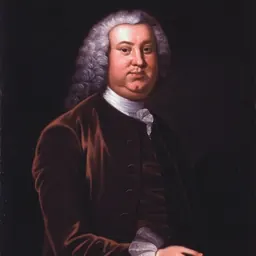




Related people
Same field, nearest in time



Contemporaries
People whose lives overlapped John Robinson's



Frequently asked questions
Who was John Robinson?
politician and landowner in British colony of Virginia (1705-1766)
When was John Robinson born?
John Robinson was born on 3 February 1705 in Middlesex County.
When did John Robinson die?
John Robinson died on 11 May 1766 in Virginia.
What was John Robinson's occupation?
John Robinson was a politician.
What nationality was John Robinson?
John Robinson was American.
Sources & further reading
· DBpedia: John Robinson (Virginia politician, born 1705)
Cite this page
APA: Biography.guide. (2026). John Robinson. https://biography.guide/john-robinson-politician-1705/
MLA: "John Robinson." Biography.guide, https://biography.guide/john-robinson-politician-1705/.
Chicago: "John Robinson." Biography.guide. https://biography.guide/john-robinson-politician-1705/.
Data last updated: 2026-09-20 · Spot an error? Report a correction.
Portrait: Wikimedia Commons · author & licence
Page generated 2026-09-27 04:57 UTC