
About John Patric
Lived 1902 – 1985 (aged 83). John Patric was a photographer and magazine writer.
John Patric (May 22, 1902 – August 31, 1985 ) was an American writer. He was a contributing writer for National Geographic during the mid- to late 1930s and early 1940s and was the author of two books. His 1943 book, Yankee Hobo in the Orient, sold twelve million copies domestically and internationally in both hardcover and digest format. In the 1940s, he was one of the best-known Oregon writers.
He wrote a National Geographic feature article, Imperial Rome Reborn, about fascist Italy, and after writing on World War II shipyard labor practices for Reader's Digest, he gave testimony at a United States congressional hearing. Patric or his works are briefly mentioned by other writers on a diverse range of topics, including political history, an artist biography, an author biography, media history, cultural criticism, and Korean history.
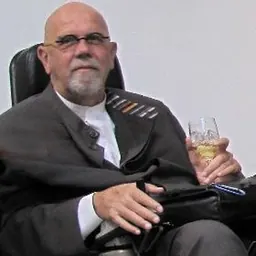
In later life, Patric was an early influence on portrait artist Chuck Close, Clayton Fox of The Olympian described Patric using phrases like, "the bearded bard of Snohomish", "gadfly of golliwoggs and gooser of governmental gophers," and "the pricker of political stuffed shirts, scourge of junkmailers, implacable foe of pollution and corruption, aider and abetter of bees, trees and ocean breezes".
Childhood Patric was born in Snohomish, Washington, on May 22, 1902. The ground floor of the family home in which he was raised served as the Snohomish public library, surrounding him with books and ideas from an early age. The Patric household consisted of John, his parents, and four siblings. His father, Arthur Noah Patric, originally from Mill City Pennsylvania, was a Snohomish hardware merchant. His mother, Emmeline Eleanor Crueger, originally from Racine Wisconsin, served as the town librarian.
At one point during his childhood, Patric "ran away, and hoboed [his] way from Seattle to Mexico and back, and nearly all railway men [he] met were kind to [him]. They shared their lunches with [him], they helped [him] locate other trains, and sometimes let [him] ride in the cab." Patric returned to Snohomish, and graduated from Snohomish High School as valedictorian This period of his life is covered in more detail in his unfinished memoir Hobo Years.
Education, career, and travels
Roaring twenties A self-styled "hobo", Patric traveled extensively throughout the Roaring Twenties. He worked sporadically as a journalist, and studied at a number of universities across the United States. In 1922, Patric was writing for the American Insurance Digest.
Universities he attended during this time included the University of Michigan (1924–1925), the University of Oregon, and that he had been expelled from eight schools in the course of his academic career. These and many other experiences are recounted in his nearly complete memoir manuscript Hobo Years.
Depression era
Blunderbuss
Nearing the height of the Great Depression, Patric studied writing and journalism at The University of Texas at Austin (1932–33) Patric involved himself in campus politics, and he wrote a number of articles and editorial pieces (often under the pen name Simon Legree) for the University newspaper named The Daily Texan. Following a highly contentious student body election, Patric got into an altercation as well as The Austin Statesman and Austin Daily Dispatch newspaper articles of the time.
Any concerns about Patric's whereabouts or well-being disappeared when it was learned that Patric had departed Texas in favor of the West Coast in his recently purchased 1927 Lincoln sedan. Living out of his car and selling surplus passenger capacity to fellow west-bound travelers, he wrote of his travel and experiences in a series of letters from the road that were published in The Daily Texan. At turns light-hearted or biting, these letters addressed a number of aspects American life during the Depression, The final installment announced his arrival in Carmel, California, by October 10, 1933.
Friendly Journeys in Japan Saving nearly $400 during the Great Depression selling rubber-stamp supplies
Libertarian views In 1940, Patric spent a few months touring the country in his automobile with the writer and Libertarian political theorist Rose Wilder Lane, from this time expressed similar deep concerns about governmental expansion and "the rise of the state's role in the lives of individuals" as Franklin D. Roosevelt's New Deal struggled to help the nation recover from the Great Depression.
WWII era
National Geographic Patric was still writing and traveling extensively for National Geographic while fascism and tensions were on the rise in Europe. Patric wrote profiles on Benito Mussolini's Italy and pre-war Czechoslovakia.
A Yankee Hobo in the Orient When war broke out in the Pacific, Patric quickly reworked his National Geographic Friendly Journeys in Japan material on Asian travel to fulfill the public's demand for more information on Japan. The repackaged and expanded book became his most notable work. First published in 1943 by Doubleday Doran, Inc. under the title Why Japan Was Strong. The book was retitled Yankee Hobo in the Orient for the British edition by Methuen Publishing, and that title was used for subsequent editions.
The edition of June 20, 1943, of The New York Times featured a review of this work, stating that Patric displayed "qualities of good sense and poise and instinct for honest reporting sufficiently to give his excellent account of Japan's 'common man' the favorable reception it deserves." In the book's second month of sales, it had climbed as high as seventh place in a list of nationwide best sellers.
The September 1945 7th edition of the book (published now by the author's own "Frying Pan Creek" publishing firm), was substantially revised and illuminated by the author, adding detailed maps and numerous illustrations to accompany the significantly expanded narrative. By November 1945, Yankee Hobo had grown from the 1st edition's 22 chapters in 320 pages, to 45 chapters in 512 pages in the 8th edition. Writing in a foreword, the author described the pains taken in the layout and printing of his still-$2.50 hardcover edition, stating that due to its "especially fine typography and sturdy binding, it is the author's belief that physically, this book has become one of the best for the money ever published." Released only months after the August 1945 atomic bombings of Japan and Japan's surrender, the book now contained lengthy parenthetical asides conveying the author's thoughts on those events, as they pertained to his original work.
In the book and subsequent interviews,
Wartime production Patric's wartime contributions to the Reader's Digest stirred controversy, and in May 1943 he was invited to give testimony before the House of Representatives' Committee on the Merchant Marine and Fisheries executive hearings, in which he contended that labor union rules were having a negative impact on shipyard productivity during World War II, and made controversial recommendations to address them. to working with tire shops to retread discarded tires from the dump and fitting these "War Treads" to his automobile for a cross-country "endurance test". He made sporadic but regular appearances in the print media of this period, on book tours, commenting on events of the day in letters to the editor, and interviews in Libertarian and conservative publications such as the following excerpts from Faith and Freedom, (an allusion to the Cornell University "Hugo N. Frye" hoax). For many years, the newsletter espoused Libertarian views on events of the day. On May 21, 1962, the prosecuting attorney filed an information charging Patric as follows:
At the trial, it was established that Patric signed the proposed initiative petition as alleged, "Hugo N. Frye," and that he was a registered voter and registered to vote under the name of John Patric. When exhibit No. 1, the proposed initiative petition, was offered in evidence, he objected to its admission on several grounds, stating "I challenge the validity of this document." He testified that he signed the name as he did because it was his pen name; that most people knew him by his pen name, and that he never intended to defraud the Secretary of State or anyone. The jury returned a guilty verdict, Patric's motions for arrest of judgement and new trial were denied, however, and he was sentenced to serve up to 10 years in prison. On appeal, his conviction was overturned on 13 Feb 1964 in a split decision in which the majority held that "the document which John Patric signed never reached the status of a legal petition" because the sheriff had confiscated the petition as the prosecution's evidence exhibit No. 1, it was never delivered to the League of Women Voters for inclusion in their proposed initiative, and never submitted to the Secretary of State.
His inventiveness, of course, sometimes gets him into legal difficulties. But he has a formula for this kind of trouble, too: Be meek, act stupid, say 'sir,' and pretend a respect and—always—an awe that you do not ever feel. and "launched into a tirade against the county". Judge Ed Nollmeyer signed an order requiring 60 days of observation at the hospital, which led to more than four months in Northern State Hospital in Sedro-Woolley, Washington, and the Snohomish County jail. He eventually won his release in a subsequent hearing, while "acting as his own attorney, Patric based his defense on the contention that he had always been a screwball", wrote Jack O'Donnell of The Herald (Everett, Washington). The insanity trial is covered in great detail in this five part podcast produced by his local Everett Public Library.
Political candidacies Owing to populist reforms advocated by the Washington State Grange movement and other allies, the unusual blanket primary system used by Washington between 1936 and 2003 enabled qualified candidates for partisan offices to list their party of preference without approval of the political parties themselves. Making use of this system, Patric, under the name Hugo N. Frye, ran five times as a Republican and eight times as a Democrat for federal or state political office. He also ran for numerous local offices in Snohomish County. Patric was known to make a point of paying his candidacy filing fee entirely with loose change In the same interview, he distributed a written sheet of paper that was stamped at the top, "Patric for governor, temporary headquarters, Snohomish county jail, Everett, WA".
Final years
From an interview with Northwest historian and Everett Public Library librarian David Dilgard on April 2, 2015:
Patric died on August 31, 1985, at the age of 83 in Everett, Washington.
Selected works Plays A play produced by The Carolina Playmakers.
Books A compilation of hoaxes and humor columns from The Daily Texan
Reissued as:
Reissued as:
National Geographic
Reader's Digest
Newspapers and pamphlets The Daily Texan, The University of Texas at Austin student newspaper. The Blunderbuss, "a devilish rebel newspaper of ten pages", self-published by Patric while attending The University of Texas at Austin. The Snohomish Free Press, later renamed The Saturday Evening Free Press, was a weekly newsletter edited, printed, and circulated by Patric.
Don’t just read it —
keep it.
Full-length biographies made to live with: read them, listen on the way to work, watch them tonight.
- E-book
- Audio
- Video
Instant download · yours to keep · every purchase keeps this site free
Important facts
People in John Patric's life
Named in this biography and alive at the same time




Related people
Same field, nearest in time

Contemporaries
People whose lives overlapped John Patric's




Frequently asked questions
Who was John Patric?
American writer (1902–1985)
When was John Patric born?
John Patric was born on 22 May 1902 in Snohomish.
When did John Patric die?
John Patric died on 31 August 1985 in Everett.
What was John Patric's occupation?
John Patric was a photographer and magazine writer.
Sources & further reading
Cite this page
APA: Biography.guide. (2026). John Patric. https://biography.guide/john-patric/
MLA: "John Patric." Biography.guide, https://biography.guide/john-patric/.
Chicago: "John Patric." Biography.guide. https://biography.guide/john-patric/.
Data last updated: 2026-09-20 · Spot an error? Report a correction.
Page generated 2026-09-27 05:25 UTC