
About John P. Bigelow
Lived 1797 – 1872 (aged 74). John P. Bigelow was an American politician.
Political Ascent Bigelow's rise to political prominence began in 1828, when he was elected to the Massachusetts House of Representatives as a member of the Whig Party, serving in the State House until 1836, where he was a prominent member on several committees. He notably championed several causes, including reducing the total number of members of the Massachusetts House of Representatives, which at the time stood at over 700, and sponsoring and developing railroad legislation.
While in the State House, he was a member of the Common Council for Ward 9 in the City of Boston, a position to which he was elected to in 1832, and, in the following year, was elected President of the Council. In 1836, he was elected as Secretary of the Commonwealth, serving until 1843 when he became a member of the Executive Council under Governor George N. Briggs. By the end of his administration, every section of the city was supplied with pure water. The entire cost of the water works project actually amounted to $4,321,000.
Cholera Epidemic In his first term as mayor, Bigelow faced a major crisis. Cholera swept across the city at an alarming rate. It 1849 alone, it killed over 5,000 people out of a population of 130,000, or approximately 4 percent of the city's citizens.
Mayor Bigelow earned praise for his efforts to reduce the outbreak of cholera. On August 15, 1849, the Boston Evening Transcript, published an article which highlighted the mayor's actions to remove the infirm to hospitals and educate those who lived in the vicinities of the outbreak about its prevention. As a result of Bigelow's leadership, the article concluded that he was entitled "to the respect and gratitude of our citizens." He had become "a model mayor."
Bigelow's seemingly successful efforts in combating the city's cholera epidemic had enhanced his political profile, which led some of his supporters to nominate him to be his party's candidate for governor. Most party insiders, including the incumbent governor's supporters, were not amused. Bigelow published a note on September 11, 1850, stating that he had not been informed of his supporters' efforts and that he would not place his name into nomination, regardless of whether or not the incumbent placed his. Instead, he offered his full-fledged support to his party's nominee.
Irish Immigration To fully appreciate the rapid transformation which Boston underwent in the mid-nineteenth century and to rightfully evaluate Bigelow's performance as mayor, it is important to emphasize how the Irish diaspora reshaped the City of Boston's societal structures. The Reverend Theodore Parker rather aptly commented that in a single decade the city had turned into "the Dublin of America."
While Bostonians had previously accepted new immigrants with open arms, particularly during the first influx of Irish in the 1820s, by the late 1840s and early '50s they had come to detest the "Famine Irish." In 1847 alone, more 37,000 new immigrants arrived in the city, most of whom came from Ireland. Previously, the city had been accepting, on average, only 5,000 new immigrants. The ships bringing the thousands who arrived in Boston Harbor on a daily basis came were euphemistically dubbed "coffin ships." The perception was that these Irish immigrants were weak and poor, starved and miserable, disease-ridden and confused. In response to the increasing Irish immigrant population, Bigelow once remarked, "Foreign paupers are rapidly accumulating on our hands." He told sympathetic taxpayers that large numbers of Irish immigrants were "aged, blind, paralytic, and lunatic immigrants who have become charges on our public charities." He further complained that they were living in "filth and wretchedness" and "foul and confined apartments."
Anti-slavery forces applauded Shadrach's escape, but they were distressed by the knee-jerk reactions of Massachusetts' politicians, including Mayor Bigelow. The Liberator wrote several scathing editorials, blasting Bigelow's decision to cave in to the wishes of the president, his secretary of state, and the slave-holding politicians of the south. In one article, the newspaper wrote, "they plump themselves down upon their knees . . . explain 'Great is Fillmore, and Webster is his prophet, we have deserved it all,' and hold up their cheeks, both sides at once, to be smitten and spit upon."
That the Mayor of Boston would be hostile to the freedom and liberty of a slave seems contradictory to understanding the history of relations between the North and the South in ante-bellum America. However, "the year 1851 still found the bulk of Boston respectability solidly arrayed against the 'fanaticism' which proposed to disregard the fundamental fact of private property in the interests of an impracticable ideal."
The mayor and the citizens of Boston would be tested once again only a few months later. In April 1851, another fugitive slave, Thomas Simms, was captured by authorities in a hotel where he was working as a waiter. This time, Mayor Bigelow acted promptly and forcefully, writing to the colonel in charge of the state militia, "Now therefore, I command you that you cause one or more companies of your Regiment armed and equipped with ammunition, as the law directs, and with proper officers either attached to the troops or detailed by you to parade at said Boston on this and every subsequent day and night until further orders from me at Faneuil Hall." After being incarcerated for several days, Simms was escorted by more than 100 police officers to a boat in Boston harbor and returned to his master.
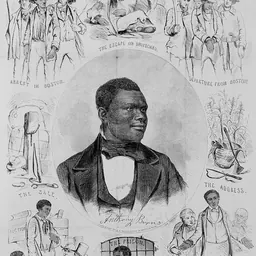
The reactions to the Fugitive Slave Law of 1850 intensified after Bigelow's terms as mayor. Over the course of the next three years, sentiment grew so heated that Anthony Burns, the last escaped slave to leave Boston under the law, cost the city more than $40,000 and the life of one police officer.
Boston Public Library The crowning achievement of Bigelow's tenure as mayor and during his years in retirement was his support of the Boston Public Library, the first publicly funded municipal building in the United States. The initial money donated to support the library was called the "Bigelow Fund." To honor the mayor for his services to the city during the cholera epidemic of 1849, a group of citizens proposed to raise funds to purchase a silver vase. Bigelow declined their gift, and instead asked that the cost of the vase, which was valued at over $1,000, be contributed to a fund for the library. In that year he also accepted a donation of books to the library, saying, "They are treasured not only as the gift of an illustrious people, but as the basis and no insignificant portion of a free municipal library, which we are taking active measures to establish."
In the last year of his administration, the mayor referred to the proposed library in his address to the city. He informed members of the City Council and Boston's citizens, "I commend the subject to your favorable consideration, and trust that an appropriation will be made, worthy of a project which has an auspicious bearing, prospectively, upon the moral and intellectual character of the people of Boston."
Honors Elected a member of the American Antiquarian Society in 1843, and chosen to serve on its board of councilors from 1854 to 1868.
Don’t just read it —
keep it.
Full-length biographies made to live with: read them, listen on the way to work, watch them tonight.
- E-book
- Audio
- Video
Instant download · yours to keep · every purchase keeps this site free
Important facts
People in John P. Bigelow's life
Named in this biography and alive at the same time

Related people
Same field, nearest in time



Contemporaries
People whose lives overlapped John P. Bigelow's






Frequently asked questions
Who was John P. Bigelow?
American politician
When was John P. Bigelow born?
John P. Bigelow was born on 25 August 1797 in Groton.
When did John P. Bigelow die?
John P. Bigelow died on 4 July 1872 in Boston.
What was John P. Bigelow's occupation?
John P. Bigelow was a politician.
What nationality was John P. Bigelow?
John P. Bigelow was American.
Sources & further reading
Cite this page
APA: Biography.guide. (2026). John P. Bigelow. https://biography.guide/john-p-bigelow/
MLA: "John P. Bigelow." Biography.guide, https://biography.guide/john-p-bigelow/.
Chicago: "John P. Bigelow." Biography.guide. https://biography.guide/john-p-bigelow/.
Data last updated: 2026-09-20 · Spot an error? Report a correction.
Page generated 2026-09-27 05:28 UTC