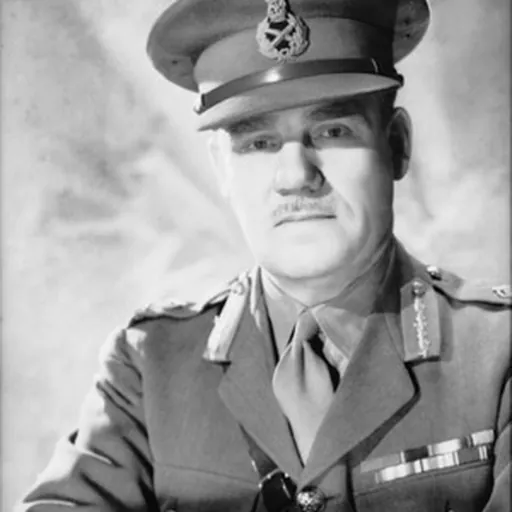
About John Northcott
Lived 1890 – 1966 (aged 76). John Northcott was an Australian politician, military personnel and military officer.
Lieutenant General Sir John Northcott (24 March 1890 – 4 August 1966) was an Australian Army general who served as Chief of the General Staff during the Second World War, and commanded the British Commonwealth Occupation Force in the Occupation of Japan. He was the first Australian-born Governor of New South Wales.
Northcott joined the Australian Army as a reservist in 1908, before becoming a regular officer in 1912. On duty in Tasmania when the Great War broke out in 1914, he joined the 12th Infantry Battalion, a unit from that state. He was wounded in the landing at Gallipoli on Anzac Day and invalided to Egypt, the United Kingdom, and ultimately Australia, taking no further part in the fighting. After the war, Northcott served on a series of staff posts. He attended the Staff College, Camberley and Imperial Defence College and also spent time overseas as an exchange officer with the British Army and as a military attaché in the United States and Canada.
During World War II, Northcott was attached to the British 7th Armoured Division in the Middle East to study armoured warfare, returning to Australia in December 1941 to organise the new 1st Armoured Division. In March 1942, he assumed command II Corps. In September 1942, he was appointed Chief of the General Staff. As General Sir Thomas Blamey's principal non-operational subordinate, he was responsible for administering and training the wartime army. After the war, he served as commander of the British Commonwealth Occupation Force in the post-war Occupation of Japan. He retired from the Army in 1946 to become the Governor of New South Wales.
Early life John Northcott was born on 24 March 1890 at Creswick, Victoria, the eldest son of a storekeeper, John Northcott, and his wife Elizabeth Jane, née Reynolds. Northcott was educated at Dean State School, Grenville College, Ballarat, and the University of Melbourne. While at school, he served in the Australian Army Cadets. He was commissioned as second lieutenant in the 9th Light Horse, a Militia unit, on 14 August 1908, and was promoted to lieutenant on 31 October 1910 and captain on 31 July 1911.
On 16 November 1912, he was granted a commission as a lieutenant in the Administrative and Instructional Staff of the regular forces, then known as the Permanent Military Forces (PMF), retaining the rank of honorary captain until he was promoted to that rank in the PMF on 1 June 1918.
First World War Northcott was assigned to staff of the 6th Military District, the military district covering the state of Tasmania, where he was serving when the First World War broke out in August 1914. His initial task was assisting with the raising of Australian Imperial Force (AIF) units in Tasmania. He joined the AIF as a lieutenant on 24 August 1914 and was appointed adjutant of the 12th Infantry Battalion, which was forming at Anglesea Barracks near Hobart. He was promoted to captain in the AIF on 18 October 1914. This was one of the first battalions ashore in the landing at Anzac Cove on the first Anzac Day, 25 April 1915. Northcott's part in the battle was brief, for that day he was wounded in the chest by a Turkish bullet. He lay among a pile of dead bodies until the evening, when he was found to be alive. He was evacuated to Alexandria and later to England.
While recuperating, he was joined by his fiancée, Winifred Mary Paton, who had travelled to England to be with him. The two were married at the parish church in Oxted on 14 September 1915.
Northcott served on the staff of the 4th Division from 17 September 1931 to 31 January 1932 and then with the 3rd Division from 1 February to 22 November 1932. He returned to England as an exchange officer with the British Army, where he served the staff of the 44th (Home Counties) Infantry Division.
Northcott with officers of the Australian Army Ordnance Corps inspecting an American M3 Stuart Light Tank. On 26 January 1940, Northcott became acting Chief of the General Staff (CGS) following the death of Lieutenant General Ernest Ker Squires. In August, his successor, General Sir Brudenell White, died in an air crash and Lieutenant General Vernon Sturdee succeeded him. The post of commander of the 8th Division thereby became available but Northcott was excluded from consideration because his knowledge was vital to the new CGS. When the commander of the 9th Division, Major General Henry Wynter, fell ill in January 1941, Lieutenant General Sir Thomas Blamey asked for Northcott to replace him, but Northcott was involved in organising the 1st Armoured Division and the appointment instead went to Brigadier Leslie Morshead. In March 1942, Northcott found out from The Herald newspaper that he was to be promoted to command II Corps. "This is what they do to me", was his comment, "just as my first tank is coming down the road". The new post came with a promotion to the temporary rank of lieutenant general on 6 April 1942, which became substantive on 12 December 1945.
Northcott spent much of his time from 1943 on in a long battle with the government over the number of men and women allocated to the Army. He attempted to do so without Blamey being dragged into a political fight but this proved to be impossible. In September 1944, the government reduced the Army's monthly intake of women from 925 to 500, while it only received 420 out of 4,020 men allocated to the three services. Such a meagre allocation was below what the Army needed to maintain its strength, and formations had to be disbanded. Blamey took up the matter with Prime Minister John Curtin, and managed to get a more satisfactory monthly allocation of 1,500 men per month out of 3,000 allocated to the three services.
The relationship between Northcott as Chief of the General Staff and Blamey as Commander-in-Chief bore some similarities to the one between the RAAF's Chief of the Air Staff, Air Vice Marshal George Jones, and Air Vice Marshal William Bostock, the commander of the RAAF forces in the field, but Blamey was senior to Northcott, both in rank and in the Army's command structure. The relationship could still have been a delicate one, but in the event it was characterised by none of the rancour and rivalry that marred the wartime administration of the RAAF. However, when Blamey travelled to Washington, D.C. and London in April 1944, he arranged for Northcott to act as Commander-in-Chief in his absence. After Wynter's death in February 1945, the post of LGA was abolished and the CGS again became responsible for administration. Northcott, as Commander In Chief, British Commonwealth Occupation Force (BCOF), inspects the guard of honour at HQ 9th New Zealand Infantry Brigade in Japan.
British Commonwealth Occupation Force At the end of World War II, Sturdee was again invited to become CGS. He made it a condition of his acceptance that Northcott be given the appointment of Commander-in-Chief of the British Commonwealth Occupation Force (BCOF) in Japan.
Northcott headed the BCOF from December 1945 until June 1946. As such, he negotiated the Northcott-MacArthur agreement with General of the Army Douglas MacArthur, which governed the terms and conditions under which the BCOF would occupy part of Japan. The BCOF would serve under American command, with American policy being followed. Northcott was offered, and accepted, the post of Governor of New South Wales in April 1946. He remained in Japan until June though, because Prime Minister Ben Chifley wanted the changeover to coincide with his own visit to Japan in May, and because he needed to obtain consent of the other governments concerned for the appointment of Lieutenant General Horace Robertson as Northcott's successor. As the first Australian-born, and one of the longest-serving, Governors of New South Wales, he gave patronage and support to many charitable organisations and to youth, church and citizens' groups. Blamey was unable to secure a knighthood for Northcott for his military service, it then being Australian Labor Party policy not to award knighthoods. He was, however, made a Knight of the Venerable Order of St John of Jerusalem in December 1946.
In 1949 the Liberals came to power and Northcott was knighted for his services as governor in 1950, and further honoured in 1954 for his work with the Royal Tour of Queen Elizabeth II. He was a freemason who, during his term as governor, was Viceregal Grand Master of the Grand Lodge of New South Wales.
In April 1949 Northcott took part in an event of historic importance at Sydney's famous Australia Hotel, being the venue of the first successful television demonstration in Australia. Northcott was televised in the hotel's ballroom as he opened the demonstration.
Northcott was Administrator of the Commonwealth in the absence of the governor-general from 19 July to 14 December 1951, and again from 30 July to 22 October 1956. While occupying that office, he held the honorary rank of general. He was awarded honorary degrees of Doctor of Letters by the University of Sydney in 1952 and the University of New England in 1956, and Doctor of Science by the New South Wales University of Technology in 1956. He retired in July 1957.
Death and legacy Sir John's wife, Winifred Mary predeceased him on 7 June 1960. Survived by his two daughters, Sir John died on 4 August 1966 in his home at Wahroonga, New South Wales. He was accorded a state funeral with military honours and was cremated with his ashes interred with his wife at Northern Suburbs Memorial Gardens.
In 1968 the Northcott Municipal Council, comprising large areas formerly in the City of Sydney, and the Electoral district of Northcott in the New South Wales Legislative Assembly were dedicated in his name (the council was renamed in December 1968, while the electoral district existed until abolition in 1999). In his military career, Northcott was both highly regarded and successful staff officer, as commander of the 1st Armoured Division, II Corps and BCOF he was "noted neither for innovation nor conspicuous success",
Honours
Honorary military appointments 22px 20 December 1951 – 14 August 1958: Honorary Air Commodore of No. 22 Squadron, Royal Australian Air Force. 1949 – 31 January 1958: Honorary Colonel of the 1st/15th Royal New South Wales Lancers.
Don’t just read it —
keep it.
Full-length biographies made to live with: read them, listen on the way to work, watch them tonight.
- E-book
- Audio
- Video
Instant download · yours to keep · every purchase keeps this site free
Important facts
People in John Northcott's life
Named in this biography and alive at the same time




Related people
Same field, nearest in time






Contemporaries
People whose lives overlapped John Northcott's


Frequently asked questions
Who was John Northcott?
Australian general
When was John Northcott born?
John Northcott was born on 24 March 1890 in Creswick.
When did John Northcott die?
John Northcott died on 4 August 1966 in Sydney.
What was John Northcott's occupation?
John Northcott was a politician, military personnel and military officer.
What nationality was John Northcott?
John Northcott was Australian.
Sources & further reading
Cite this page
APA: Biography.guide. (2026). John Northcott. https://biography.guide/john-northcott/
MLA: "John Northcott." Biography.guide, https://biography.guide/john-northcott/.
Chicago: "John Northcott." Biography.guide. https://biography.guide/john-northcott/.
Data last updated: 2026-09-22 · Spot an error? Report a correction.
Portrait: Wikimedia Commons · author & licence
Page generated 2026-09-27 05:01 UTC