
About John Norris
Lived 1671 – 1749 (aged 77–78). John Norris was a diplomat, politician and soldier.
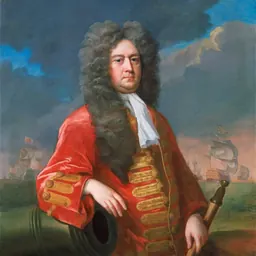
Admiral of the Fleet Sir John Norris (1670 or 167113 June 1749) was a Royal Navy officer and Whig politician. After serving as a junior officer during the Nine Years' War and the Williamite War in Ireland, he was given command of a squadron sent to North America to protect British settlements on the banks of Hudson Bay in 1697. Although he developed a plan to recapture some territories in Newfoundland and Labrador taken by French forces the previous winter, he was prevented from implementing that plan when the local council overruled him.
Norris served under Admiral Sir George Rooke at the Battle of Cádiz at an early stage of the War of the Spanish Succession. He went on to command the vanguard at the Battle of Malaga in August 1704 and then served under Admiral the Earl of Peterborough at the capture of Barcelona in October 1705.
As a flag officer, Norris was sent with a fleet to the Baltic Sea to support a coalition of naval forces from Russia, Denmark and Hanover taking in the Great Northern War. Tsar Peter took personal command of the coalition fleet and appointed Norris as his deputy in 1716: together they protected British and other allied merchant vessels from attack by warships of the Swedish Empire. In November 1718, following the death of Charles XII of Sweden, Britain switched sides and Norris returned to the region to protect British merchant shipping from attack by Russian raiders. Norris also acted as a commissioner in the negotiations leading to the Treaty of Nystad which ended the War in September 1721.
Norris went on to be commander-in-Chief of the Channel Fleet at the outset of the War of Jenkins' Ear in 1739. In 1744 he was asked to defend Britain from an imminent French Invasion: he was preparing for battle against the French fleet, when storms intervened scattering the invasion transports, with heavy loss of life, thereby ending the immediate threat of invasion.
Early career
Born of uncertain Irish parentage, Norris joined the Royal Navy as a captain's servant in 1680. Promoted to lieutenant in August 1689, he joined the third-rate HMS Edgar commanded by Cloudesley Shovell during the Nine Years' War. He transferred to the third-rate HMS Monck early in 1690 and served off the Coast of Ireland during the Williamite War in Ireland. Although he developed a plan to recapture some territories in Newfoundland and Labrador taken by French forces the previous winter, he was prevented from implementing that plan when the local council overruled him and he received some criticism when he returned to England for his inaction. his successful career continued and he was given command of the fourth-rate HMS Winchester later in 1697. Promoted to vice admiral on 26 January 1708, Norris transferred his flag to the third-rate HMS Ranelagh. While still serving as second-in-command of the Mediterranean Fleet, he took personal charge a squadron deployed to the Baltic Sea to prevent Swedish grain arriving in France in 1709. He was sent with a fleet to the Baltic Sea to support a coalition of naval forces from Russia, Denmark and Hanover taking in the Great Northern War. In November 1718, following the death of Charles XII of Sweden, Britain switched sides and Norris returned to the region to protect British merchant shipping from attack by Russian raiders. Norris also acted as a commissioner in the negotiations leading to the Treaty of Nystad which ended the War in September 1721. but stood down as a Lord Commissioner of the Admiralty when the Walpole–Townshend Ministry fell in May 1730. and was appointed Vice-Admiral of Great Britain in April 1739 and went on to be Commander-in-Chief of the Channel Fleet at the outset of the War of Jenkins' Ear in Autumn 1739.
Family In May 1699 Norris married Elizabeth Aylmer, daughter of Admiral Matthew Aylmer; they had five children, including Vice Admiral Henry Norris, Captain Richard Norris, and Lucy Hewett (previously Dame Lucy Aylmer), mother of Sir FitzGerald Aylmer, 6th Baronet and artist John Norris Hewett.
Don’t just read it —
keep it.
Full-length biographies made to live with: read them, listen on the way to work, watch them tonight.
- E-book
- Audio
- Video
Instant download · yours to keep · every purchase keeps this site free
Important facts
People in John Norris's life
Named in this biography and alive at the same time

Related people
Same field, nearest in time



Contemporaries
People whose lives overlapped John Norris's




Frequently asked questions
Who was John Norris?
British naval officer (1671-1749)
When was John Norris born?
John Norris was born in 1671.
When did John Norris die?
John Norris died on 14 June 1749 in Hemsted Park.
What was John Norris's occupation?
John Norris was a diplomat, politician and soldier.
Sources & further reading
· DBpedia: John Norris (Royal Navy officer)
Cite this page
APA: Biography.guide. (2026). John Norris. https://biography.guide/john-norris-diplomat/
MLA: "John Norris." Biography.guide, https://biography.guide/john-norris-diplomat/.
Chicago: "John Norris." Biography.guide. https://biography.guide/john-norris-diplomat/.
Data last updated: 2026-09-25 · Spot an error? Report a correction.
Page generated 2026-09-27 05:11 UTC