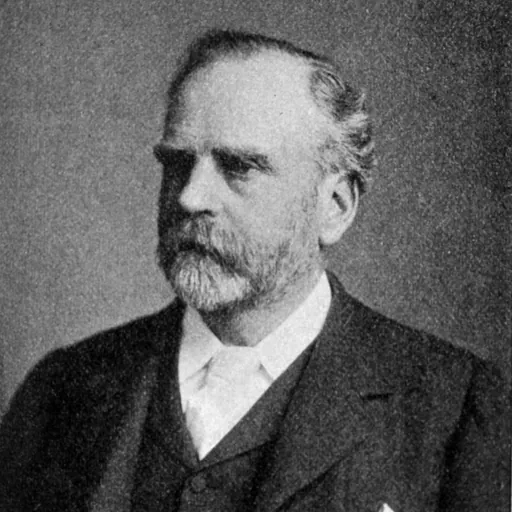
John Murray
Scottish oceanographer, marine biologist and limnologist
About John Murray
Lived 1841 – 1914 (aged 73). John Murray was a Canadian and British explorer, oceanographer, limnologist, marine biologist, surgeon and hydrobiologist.
Sir John Murray (3 March 1841 – 16 March 1914) was a pioneering Canadian-born British oceanographer, marine biologist and limnologist. He is considered to be the father of modern oceanography.
In 1868, he joined the whaling ship, Jan Mayen, as ship's surgeon and visited Spitsbergen and Jan Mayen Island. During the seven-month trip, he collected marine specimens and recorded ocean currents, ice movements and the weather.
On his return to Edinburgh he re-entered the University to complete his studies (1868–72) in geology under Sir Archibald Geikie.
Challenger Expedition In 1872, Murray assisted in preparing scientific apparatus for the Challenger Expedition under the direction of the expedition's chief scientist, Charles Wyville Thomson. When a position on the expedition became available Murray joined the crew as a naturalist. During the four-year voyage, he assisted in the research of the oceans including collecting marine samples, making and noting observations, and making improvements to marine instrumentation. After the expedition, Murray was appointed Chief Assistant at the Challenger offices in Edinburgh where he managed and organised the collection. After Thomson's death in 1882, Murray became Director of the office and in 1896 published The Report on the Scientific Results of the Voyage of HMS Challenger, a work of more than 50 volumes of reports. The building now houses St Columba's Hospice.
Marine Laboratory, Granton In 1884, Murray set up the Marine Laboratory at Granton, Edinburgh, the first of its kind in the United Kingdom. In 1894, this laboratory was moved to Millport, Isle of Cumbrae, on the Firth of Clyde, and became the University Marine Biological Station, Millport, the forerunner of today's Scottish Association for Marine Science at Dunstaffnage, near Oban, Argyll and Bute.
Bathymetrical survey of the fresh-water lochs of Scotland After completing the Challenger Expedition reports, Murray began work surveying the freshwater lochs of Scotland. He was assisted by Frederick Pullar and over a period of three years, they surveyed 15 lochs together. In 1901, Pullar drowned as a result of an ice-skating accident which caused Murray to consider abandoning the survey work. However, Pullar's father, Laurence Pullar, persuaded him to continue and gave £10,000 towards the completion of the survey. Murray coordinated a team of nearly 50 people who took more than 60,000 individual depth soundings and recorded other physical characteristics of the 562 lochs. The resulting 6 volume Bathymetrical Survey of the Fresh-Water Lochs of Scotland was published in 1910. The cartographer John George Bartholomew, who strove to advance geographical and scientific understanding through his cartographic work, drafted and published all the maps of the Survey.
North Atlantic oceanographic expedition In 1909, Murray indicated to the International Council for the Exploration of the Sea that an oceanographic survey of the North Atlantic should be undertaken. After Murray agreed to pay all expenses, the Norwegian Government lent him the research ship Michael Sars and its scientific crew. He was joined on board by the Norwegian marine biologist Johan Hjort and the ship departed Plymouth in April 1910 for a four-month expedition to take physical and biological observations at all depths between Europe and North America. Murray and Hjort published their findings in The Depths of the Ocean in 1912 and it became a classic for marine naturalists and oceanographers.
He was the first to note the existence of the Mid-Atlantic Ridge and of oceanic trenches. He also noted the presence of deposits derived from the Saharan desert in deep ocean sediments and published many papers on his findings.
Awards, recognition and legacy
Fellow of the Royal Society of Edinburgh (1877) Knight Commander of the Order of the Bath (1898) Clarke Medal from the Royal Society of New South Wales (1900) International Honorary Member of the American Academy of Arts and Sciences (1900) Livingstone Medal from the Royal Scottish Geographical Society (1910) International Member of the American Philosophical Society (1911) Vega Medal from the Swedish Society for Anthropology and Geography (1912) International Member of the United States National Academy of Sciences (1912) Other awards included the Cuvier Prize and Medal from the Institut de France and the Humboldt Medal of the Gesellschaft für Erdkunde zu Berlin.
He was president of the Royal Scottish Geographical Society from 1898 to 1904.
In 1911, Murray founded the Alexander Agassiz Medal which is awarded by the National Academy of Sciences, in memory of his friend Alexander Agassiz (1835–1910).
After his death his estate funded the John Murray Travelling Studentship Fund and the 1933 John Murray Mabahiss Expedition to the Indian Ocean.
Death Murray lived at Challenger Lodge (renamed after his expedition) on Boswall Road in Trinity, Edinburgh, with commanding views over the Firth of Forth. This house is now the St Columba's Hospice, a palliative care facility.
Murray was killed when his car overturned west of his home on 16 March 1914 at Kirkliston near Edinburgh. He is buried in Dean Cemetery in Edinburgh on the central path of the north section in the original cemetery.
Tribute The John Murray Laboratories at the University of Edinburgh, the John Murray Society at the University of Newcastle and the Scottish Environment Protection Agency research vessel, the S.V. Sir John Murray, and the Murray Glacier are named after him.
Taxa named in his honor Animals named in his honor include the entire Murrayonida order of sea sponges.
Anthoptilum murrayi Kölliker, 1880 Bathyraja murrayi Günther, 1880 Bythotiara murrayi Günther, 1903 Cirrothauma murrayi Chun, 1911
Culeolus murrayi Herdman, 1881 Deltocyathus murrayi Gardiner & Waugh, 1938 Halieutopsis murrayi H. C. Ho, 2022 Lanceola murrayi Norman, 1900 Lithodes murrayi Henderson, 1888 Melanocetus murrayi, commonly known as Murray's abyssal anglerfish, is a deep sea anglerfish in the family Melanocetidae, found in tropical to temperate parts of the world's oceans at depths down to over . Mesothuria murrayi Théel, 1886 Millepora murrayi Quelch, 1886 Munneurycope murrayi Walker, 1903 Munnopsurus murrayi Walker, 1903 Murrayona Kirkpatrick, 1910 Phallonemertes murrayi Brinkmann, 1912 Phascolion murrayi Stephen, 1941 †Pipistrellus murrayi Andrews, 1900 Potamethus murrayi M'Intosh, 1916 Psammastra murrayi Sollas, 1886 Pythonaster murrayi Sladen, 1889 Silvascincus murrayi Boulenger, 1887 Sophrosyne murrayi Stebbing, 1888 Stellitethya murrayi Sarà & Bavestrello, 1996 Trachyrhynchus murrayi Günther, 1887 Triglops murrayi Günther, 1888
Botanical references
Don’t just read it —
keep it.
Full-length biographies made to live with: read them, listen on the way to work, watch them tonight.
- E-book
- Audio
- Video
Instant download · yours to keep · every purchase keeps this site free
Important facts
People in John Murray's life
Named in this biography and alive at the same time





Related people
Same field, nearest in time


Contemporaries
People whose lives overlapped John Murray's
Frequently asked questions
Who was John Murray?
Scottish oceanographer, marine biologist and limnologist (1841-1914)
When was John Murray born?
John Murray was born on 3 March 1841 in Ontario.
When did John Murray die?
John Murray died on 16 March 1914 in Kirkliston.
What was John Murray's occupation?
John Murray was an explorer, oceanographer, limnologist, marine biologist, surgeon and hydrobiologist.
What nationality was John Murray?
John Murray was Canadian and British.
Sources & further reading
· DBpedia: John Murray (oceanographer)
Cite this page
APA: Biography.guide. (2026). John Murray. https://biography.guide/john-murray-explorer-1841/
MLA: "John Murray." Biography.guide, https://biography.guide/john-murray-explorer-1841/.
Chicago: "John Murray." Biography.guide. https://biography.guide/john-murray-explorer-1841/.
Data last updated: 2026-09-22 · Spot an error? Report a correction.
Portrait: Wikimedia Commons · author & licence
Page generated 2026-09-27 05:03 UTC