
About John Mungo-Park
Lived 1918 – 1941 (aged 23). John Mungo-Park was a British flying ace.
John Colin Mungo-Park, (25 March 1918 – 27 June 1941) was a Royal Air Force fighter pilot and flying ace of the Second World War. He was awarded the Distinguished Flying Cross in 1940, and a Bar to the medal in 1941.
Background and early life Born John Colin Park on 25 March 1918 in Wallasey on the Wirral, he was the second son and third child of Colin Archibald Mungo Park and Marion (née Haswell) Park. His sister Linda had been born in 1913, and brother Geoffrey in 1915. Mungo-Park's father, Colin, had joined the British Army at the start of the First World War as a private with the 7th Battalion of the Royal Sussex Regiment. On 24 October 1918, just seven months after his son's birth, Lance Corporal Colin Park was killed in action during the Hundred Days Offensive. He is buried in the Valenciennes (St Roch) Military Cemetery in France.
John Mungo-Park was educated as a boarder at Liverpool College, where he was a successful athlete and sportsman. 'Mungo' had been a family forename for many generations, and he used the surname Mungo-Park from his schooldays onward.
The family moved to Bolton in 1934, where a neighbour had a pilot's licence and keen interest in aviation. He and Mungo-Park became firm friends, and it was here that the passion for flying was born. He was confirmed as a pilot officer on 31 May 1938, and was posted to the Anti Aircraft Co-operation Unit of the Fleet Air Arm at Lee on Solent and then in August 1938 to flying Fairey Swordfish.
On 24 May 1940, while No. 74 Squadron were providing cover for the British retreat from France and the Dunkirk evacuation, Mungo-Park was wounded and his Spitfire damaged during an engagement with a Henschel Hs 126, but he managed to recross the Channel and land at RAF Rochford.
He was awarded the Distinguished Flying Cross (DFC) on 15 November 1940. The citation read:
Now recognised as one of the cream of the Allied fighter pilots, he was one of the fraction of The Few selected by Fighter Command to have their portraits drawn by Cuthbert Orde, sitting for it in December 1940.
On 14 November 1940 No. 74 Squadron claimed a total of 13 Ju 87s in a mass dogfight over Dover, Mungo-Park personally claiming two.
On 30 November he and Harbourne Stephen jointly claimed a Bf 109 (of Uffz. Wagelin 5./JG 53) that was deemed the 600th victory claimed by squadrons flying from RAF Biggin Hill.
Exactly a year since his last promotion, on 31 December 1940, he was promoted to flight lieutenant.
On 10 March 1941 Sailor Malan was promoted, and Mungo-Park became acting squadron leader.
On 16 June 1941 while on a sweep ("Circus 14") over the Channel he shot down two Messerschmitt Bf 109s, but in the fight his plane was damaged. He turned for home but his engine seized as he crossed the coast. Nonetheless, Mungo-Park managed to stay airborne, gliding his Spitfire back to RAF Hawkinge.
On the evening of 27 June 1941, flying Spitfire Vb X4668, Mungo-Park was part of an escort for a bombing raid over northern France coded 'Circus 25'. They were attacked by two formations of Bf 109s, led by Rolf Pingel of I./JG 26 (who had been spared by Bob Doe during the Battle of Britain) and Wilhelm Balthasar of JG 2.
He was shot down and killed when his plane crashed just north of Dunkirk, a couple of miles over the Belgian border. He is buried in Adinkerke Military Cemetery, about 60 miles north of his father. In a twist of fate, Wilhelm Balthasar died in an air crash less than a week later and was buried in a Flanders cemetery alongside his father who had been killed in the First World War.
A Bar to Mungo-Park's DFC was announced posthumously on 11 July 1941 with the citation:
Mungo-Park had claimed 11 aircraft destroyed (and 2 shared), 5 probables, and 4 damaged.
Memorials Thanks to the efforts of Belgian Johny Recour, who had witnessed Mungo-Park's crash as a boy, a memorial service was held on 22 May 2006.
Mungo Park Way in Orpington, Mungo Park Road in South Hornchurch and Mungo Park Close in Bushey are named after John Mungo-Park. In all three places, other roads in the surrounding estates are also named after pilots in the Battle of Britain.
Don’t just read it —
keep it.
Full-length biographies made to live with: read them, listen on the way to work, watch them tonight.
- E-book
- Audio
- Video
Instant download · yours to keep · every purchase keeps this site free
Important facts
People in John Mungo-Park's life
Named in this biography and alive at the same time




Related people
Same field, nearest in time

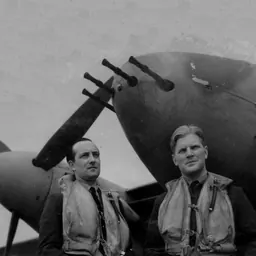
Contemporaries
People whose lives overlapped John Mungo-Park's


Frequently asked questions
Who was John Mungo-Park?
British flying ace
When was John Mungo-Park born?
John Mungo-Park was born on 25 March 1918 in Wallasey.
When did John Mungo-Park die?
John Mungo-Park died on 27 June 1941 in Adinkerke.
What was John Mungo-Park's occupation?
John Mungo-Park was a flying ace.
What nationality was John Mungo-Park?
John Mungo-Park was British.
Sources & further reading
Cite this page
APA: Biography.guide. (2026). John Mungo-Park. https://biography.guide/john-mungo-park/
MLA: "John Mungo-Park." Biography.guide, https://biography.guide/john-mungo-park/.
Chicago: "John Mungo-Park." Biography.guide. https://biography.guide/john-mungo-park/.
Data last updated: 2026-09-20 · Spot an error? Report a correction.
Page generated 2026-09-27 05:12 UTC