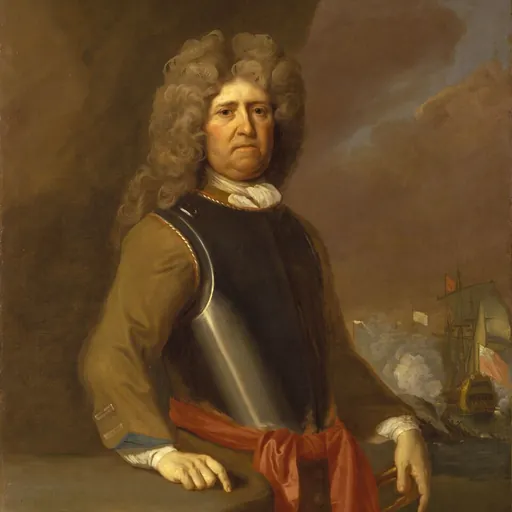
About John Munden
Lived 1645 – 1719 (aged 73–74). John Munden was an English and British military officer.
Rear-Admiral Sir John Munden (c. 1645 – 13 March 1719) was a Royal Navy officer who was dismissed from the service for having failed to engage a French fleet, despite having been acquitted by a court-martial of any misconduct in the matter.
Early life and career
He was born around 1645, the younger son of Richard Munden (1602–1672), a ferryman of Chelsea, and his wife Elizabeth (1608–1694). He was appointed second lieutenant aboard the on 30 November 1677, and served aboard her in the Mediterranean until 1680, under the command of his older brother Sir Richard Munden. Afterwards, he transferred on the on 16 July 1681, the on 17 June 1685, and the on 31 July 1686. On 23 July 1688 he was made commander of the Half Moon fire ship. He fought at the battle of Barfleur on 19 May 1692, commanding the in the van of the red squadron, under the immediate orders of Sir Ralph Delaval. He was appointed to command the in 1693, the in 1695, the in 1696, and the in 1697. In May 1699 he was given command of the , only to be moved to the two months later and sent to the Mediterranean in command of a small squadron. He returned to England in November 1700.
Admiral
His service in the Mediterranean brought him to the notice and favour of King William III, and led to his promotion to rear admiral of the blue on 14 April 1701. On 30 June he was further promoted to rear admiral of the white, and given command of a squadron charged with escorting the king to Holland.
Early in the reign of Queen Anne, in April 1702, it was learned that the French were planning to send a convoy from Corunna to the West Indies and Mexico, carrying the Duke of Alburquerque and a number of troops. Munden, by then rear admiral of the red, was chosen to intercept this force with a flotilla comprising eight third-rates, one fourth-rate and three smaller craft. Munden sailed from St. Helens on 10 May 1702, and arrived off the coast of Galicia five days later. Learning soon after of the expected approach of thirteen French men-of-war from La Rochelle, he positioned his fleet to intercept and sighted them off Cape Ortegal on 28 May. He gave chase, but they were able to enter Corunna before he could catch them. Munden called a council at war at which it was decided that the harbour was too well defended to be assaulted. Consequently, having cruised the area until running short of provisions, the British fleet headed home on 20 June, with nothing to show for the expedition but two captured merchantmen from Martinique.
Dismissal from service
The failure of the expedition caused a public outcry, and, on 13 July, Munden was tried by a court-martial aboard the at Spithead on a charge of negligence. In his defence, he wrote: It is an easy matter for any standers-by to say, after a design has miscarried, that, if you had been on this place instead of that, you had infallibly succeeded ... But if it be considered that the sea is a wide place, and that we did not miss the enemy above an hour and a half's time, I hope my enemies will be persuaded to have another opinion of me. This decision was justified in the Annals of Queen Anne thus: For though Sir John behaved himself worthily on all other occasions, and even acted to the best of his knowledge on this, yet the least appearance of misconduct deserves censure in the beginning of a new reign; for a vigorous inflicting of punishments contributes no less to the establishment of a throne than an equal and generous dispensation of rewards. He died there on 13 March 1719, unmarried and without issue. His estate was split between three nephews, including Brigadier Richard Munden, and five nieces.
Don’t just read it —
keep it.
Full-length biographies made to live with: read them, listen on the way to work, watch them tonight.
- E-book
- Audio
- Video
Instant download · yours to keep · every purchase keeps this site free
Important facts
People in John Munden's life
Named in this biography and alive at the same time


Related people
Same field, nearest in time





Contemporaries
People whose lives overlapped John Munden's





Frequently asked questions
Who was John Munden?
English naval officer
When was John Munden born?
John Munden was born in 1645.
When did John Munden die?
John Munden died in 1719 in Chelsea.
What was John Munden's occupation?
John Munden was a military officer.
What nationality was John Munden?
John Munden was English and British.
Sources & further reading
Cite this page
APA: Biography.guide. (2026). John Munden. https://biography.guide/john-munden/
MLA: "John Munden." Biography.guide, https://biography.guide/john-munden/.
Chicago: "John Munden." Biography.guide. https://biography.guide/john-munden/.
Data last updated: 2026-09-21 · Spot an error? Report a correction.
Portrait: Wikimedia Commons · author & licence
Page generated 2026-09-27 04:59 UTC