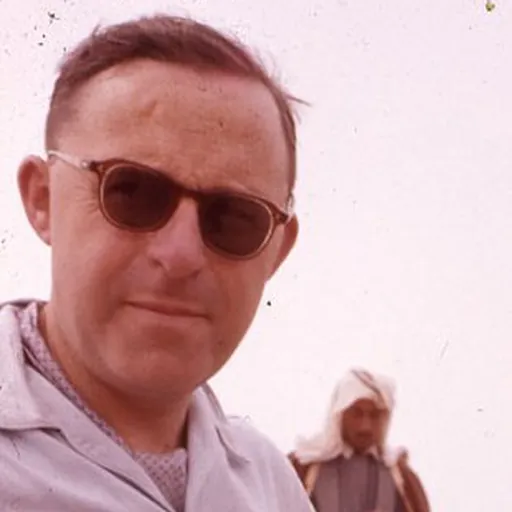
John M. Allegro
English archaeologist and Dead Sea Scrolls scholar
About John M. Allegro
Lived 1923 – 1988 (aged 65). John M. Allegro was a British anthropologist, archaeologist, university teacher, linguist and photographer, known for Dead Sea Scrolls and The Sacred Mushroom and the Cross.
John Marco Allegro (17 February 1923 – 17 February 1988) was an English archaeologist and Dead Sea Scrolls scholar. He was a populariser of the Dead Sea Scrolls through his books and radio broadcasts. He was the editor of some of the most famous and controversial scrolls published, the pesharim. A number of Allegro's later books, including The Sacred Mushroom and the Cross, brought him both popular fame and notoriety, and also complicated his career.
Allegro served in the Royal Navy during World War II, began training for the Methodist ministry but shifted to Oriental Studies, earning degrees from Manchester and Oxford before joining the Dead Sea Scrolls research team in Jerusalem and becoming a lecturer in Semitic Philology in 1954. He played a pivotal role in the early study and popularization of the Copper Scroll by arranging its physical opening, producing the first translation, controversially publishing it ahead of the official edition, and promoting theories about its content that drew criticism from his peers.
John Marco Allegro published the Dead Sea Scrolls fragments 4Q158–4Q186, which contained pesharim—unique biblical commentaries—in a minimalist edition after delays from the late 1950s until 1968. Although his approach faced widespread scholarly criticism, it nonetheless provided decades of material for study while other editors worked on their volumes.
By 1960, Allegro, holding controversial views on the Dead Sea Scrolls and clashing with colleagues, moved to theology at Manchester where he wrote the provocative book The Sacred Mushroom and the Cross and subsequently resigned due to its impact. John Allegro’s controversial theory argued that Christianity originated from an Essene shamanistic cult using psychoactive mushrooms, interpreting the New Testament as a coded record of this cult, but his ideas were widely rejected by scholars and led to his academic ostracism. Married with two children, he died of a heart attack on his 65th birthday in 1988, and was noted for his flamboyant style in biblical studies.
Early life and training Allegro was born in 1923, son of John Allegro and Mabel (nee Perry). Allegro went through Wallington County Grammar School Allegro received his Honours degree in Oriental Studies at the University of Manchester in 1951. This was followed in 1952 by a master's degree under supervision of H. H. Rowley. While engaged in further research in Hebrew dialects at Oxford under Godfrey Driver in 1953, Allegro was invited by Gerald Lankester Harding to join the team of scholars working on the Dead Sea Scrolls in Jerusalem, where he spent one year working on the scrolls. He became a lecturer in Comparative Semitic Philology in Manchester in 1954.
The Copper Scroll It was on Allegro's recommendation in 1955 that the Copper Scroll was sent by the Jordanian government to Manchester University in order for it to be cut into sections, allowing the text to be read. He was present during the cutting process in 1956 and later made a preliminary transcription of the text, which he soon translated, sending copies of his work back to Gerald Lankester Harding in Jordan. While he was in England he made a series of radio broadcasts on BBC Radio aimed at popularising the scrolls, in which he announced that the leader discussed in the scrolls may have been crucified. (a position that he re-iterated in 1986). His colleagues in Jerusalem immediately responded with a letter to the Times on 16 March 1956 refuting his claim.
One result of this letter seemed to be that his appointment at Manchester was not to be renewed. However, in July after several uneasy months the appointment was renewed.
Allegro was asked a number of times by the Jordanian Director of Antiquities if he would publish the text of the Copper Scroll. After a few years of waiting for Milik's publication of the scroll, Allegro succumbed and set about publishing the text. His book, The Treasure of the Copper Scroll, was released in 1960, while the official publication had to wait another two years. Although several of his readings in the text are acknowledged, Allegro's book was disparaged by his colleagues. He believed that the treasure in the scroll was real—a view now held by most scholars and published several preliminary editions in learned journals during the late 1950s. He told de Vaux that he could have his share of the texts ready in 1960, but due to hold ups had to wait until 1968 for his volume, Discoveries in the Judaean Desert of Jordan V: 4Q158–4Q186, to be published. He reworked his material in 1966 with the assistance of a Manchester colleague, Arnold Anderson, before publication.
John Strugnell published a severe critique of the volume, "Notes en Marge du volume V des 'Discoveries in the Judean Desert of Jordan'" in Revue de Qumran. Allegro's minimalist approach has received widespread scorn in the scholarly world, which nevertheless had the opportunity to analyse the Allegro texts for decades while waiting for other editors to publish their allotments. The first part of Strugnell's allotment was published in 1994.
Change of direction As early as 1956 Allegro held controversial views regarding the content of the scrolls, stating in a letter to de Vaux, "It's a pity that you and your friends cannot conceive of anything written about Christianity without trying to grind some ecclesiastical or non-ecclesiastical axe." The bulk of his work on the Dead Sea Scrolls was done by 1960 and he was at odds with his scrolls colleagues. When a conflict broke out with H.H. Rowley concerning Allegro's interpretation of the scrolls, Allegro, on the invitation of F. F. Bruce, moved from the Department of Near East Studies in the Faculty of Arts at Manchester to the Faculty of Theology. Allegro further argued that the authors of the Christian gospels did not understand the Essene thought. When writing down the Gospels based on the stories they had heard, the evangelists confused the meaning of the scrolls. In this way, according to Allegro, the Christian tradition is based on a misunderstanding of the scrolls. He also argued that the story of Jesus was based on the crucifixion of the Teacher of Righteousness in the scrolls. Mark Hall writes that Allegro suggested the Dead Sea Scrolls all but proved that a historical Jesus never existed.
Allegro argued that Jesus in the Gospels was in fact a code for a type of hallucinogen, the Amanita muscaria, and that Christianity was the product of an ancient "sex-and-mushroom" cult. Critical reaction was swift and harsh: fourteen British scholars (including Allegro's mentor at Oxford, Godfrey Driver) denounced it.
Allegro's theory of a shamanistic cult as the origin of Christianity was criticised sharply by Welsh historian Philip Jenkins who wrote that Allegro was an eccentric scholar who relied on texts that did not exist in quite the form he was citing them. Jenkins called the Sacred Mushroom and the Cross "possibly the single most ludicrous book on Jesus scholarship by a qualified academic". Based on the reactions to the book, Allegro's publisher later apologized for issuing the book and Allegro was forced to resign his academic post. In November 2009 The Sacred Mushroom and the Cross was reprinted in a 40th anniversary edition with a 30-page addendum by Carl Ruck of Boston University.
Personal life and death Allegro married Joan Lawrence in 1948, by whom he had a son and a daughter. His obituarist in the Daily Telegraph, Hugh Massingberd, described him as "the Liberace of Biblical scholarship".
Works Among Allegro's works are the following:
His scholarly journal articles include:
An undated play 'The Lively Oracles' (with Roy Plomley).
Don’t just read it —
keep it.
Full-length biographies made to live with: read them, listen on the way to work, watch them tonight.
- E-book
- Audio
- Video
Instant download · yours to keep · every purchase keeps this site free
Important facts
People in John M. Allegro's life
Named in this biography and alive at the same time







Related people
Same field, nearest in time

Contemporaries
People whose lives overlapped John M. Allegro's
Frequently asked questions
Who was John M. Allegro?
English archaeologist and Dead Sea Scrolls scholar (1923–1988)
When was John M. Allegro born?
John M. Allegro was born on 17 February 1923 in London.
When did John M. Allegro die?
John M. Allegro died on 17 February 1988 in Sandbach.
What was John M. Allegro's occupation?
John M. Allegro was an anthropologist, archaeologist, university teacher, linguist and photographer.
What was John M. Allegro known for?
John M. Allegro was known for Dead Sea Scrolls and The Sacred Mushroom and the Cross.
What nationality was John M. Allegro?
John M. Allegro was British.
Sources & further reading
Cite this page
APA: Biography.guide. (2026). John M. Allegro. https://biography.guide/john-m-allegro/
MLA: "John M. Allegro." Biography.guide, https://biography.guide/john-m-allegro/.
Chicago: "John M. Allegro." Biography.guide. https://biography.guide/john-m-allegro/.
Data last updated: 2026-09-23 · Spot an error? Report a correction.
Portrait: Wikimedia Commons · author & licence
Page generated 2026-09-27 05:07 UTC