
John Hospers
American philosopher and politician
About John Hospers
Lived 1918 – 2011 (aged 93). John Hospers was an American philosopher, university teacher, politician, writer, journalist and political scientist.
John Hospers (June 9, 1918 – June 12, 2011) was an American philosopher and political activist. Hospers was interested in Objectivism, and was once a friend of the philosopher Ayn Rand, though he later broke with her. In 1972, Hospers became the first presidential candidate of the Libertarian Party, and was the only minor party candidate to receive an electoral vote in that year's U.S. presidential election.
Background John Hospers was born to a Dutch-American family in Pella, Iowa, on June 9, 1918, the son of Dena Helena (Verhey) and John De Gelder Hospers. He graduated from Central College in 1939 before earning an MA in English from the University of Iowa in 1942 and a PhD in philosophy from Columbia University in 1946. He conducted research, wrote, and taught in areas of philosophy, including aesthetics and ethics. He taught philosophy at the University of Minnesota, Brooklyn College, California State College Los Angeles (1966–1968) and at the University of Southern California, where for many years he was chairman of the philosophy department and professor emeritus.
In 2002, an hour-long video about Hospers' life, work, and philosophy was released by the Liberty Fund of Indianapolis, as part of its Classics of Liberty series.
Multiple sources, including the Libertarian Party, have referred to Hospers as the first openly gay person to run for president of the United States. However, The Guardian reported that his family "strenuously denied" that he was gay.
Libertarianism
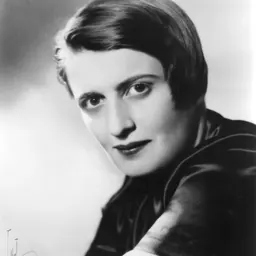
Friendship with Ayn Rand During the period he taught philosophy at Brooklyn College, Hospers was very interested in Objectivism. He appeared on radio shows with Ayn Rand, and devoted considerable attention to her ideas in his ethics textbook Human Conduct.
According to Rand's biographer, Barbara Branden, Hospers met Rand when she addressed the student body at Brooklyn College. They became friends, and had lengthy philosophical conversations. Rand's discussions with Hospers contributed to her decision to write non-fiction. Hospers read Atlas Shrugged (1957), which he considered an aesthetic triumph. Although Hospers became convinced of the validity of Rand's moral and political views, he disagreed with her about issues of epistemology, the subject of their extensive correspondence. Hospers also disagreed with Rand about free will (with him favoring determinism, while she advocated a libertarian view) and conscription (Hospers supported it, Rand was opposed).
1972 presidential candidacy
In the 1972 U.S. presidential election, Hospers and Tonie Nathan were the first presidential and vice-presidential nominees, respectively, of the newly formed Libertarian Party. (Washington and Colorado), receiving 3,674 popular votes.
Hospers and Nathan received one electoral vote from faithless elector Roger MacBride, a Republican from Virginia, resulting in Nathan's becoming the first woman and the first Jew to receive an electoral vote in a United States presidential election.
Later views By 1991, Hospers had left the Libertarians for the Republican Party, where he helped establish the Republican Liberty Caucus. Meaning and Truth in the Arts (1946) Introductory Readings in Aesthetics (1969) Artistic Expression (1971) Libertarianism – A Political Philosophy for Tomorrow (1971) Understanding the Arts (1982) Law and the Market (1985) Human Conduct (now in its 3rd edition, 1995) An Introduction to Philosophical Analysis (now in the 4th edition, 1996)
Hospers was editor of three anthologies, and contributed to books edited by others. He wrote more than 100 articles in various scholarly and popular journals.
Hospers was editor of The Personalist (1968–1982) and The Monist (1982–1992), Additionally Hospers wrote the article "Art and Morality" for the Journal of Comparative Literature and Aesthetics (JCLA), Vol. 1, No. 1, Summer 1978.
Don’t just read it —
keep it.
Full-length biographies made to live with: read them, listen on the way to work, watch them tonight.
- E-book
- Audio
- Video
Instant download · yours to keep · every purchase keeps this site free
Important facts
People in John Hospers's life
Named in this biography and alive at the same time





Related people
Same field, nearest in time


Contemporaries
People whose lives overlapped John Hospers's


Frequently asked questions
Who was John Hospers?
American philosopher and politician (1918–2011)
When was John Hospers born?
John Hospers was born on 9 June 1918 in Pella.
When did John Hospers die?
John Hospers died on 12 June 2011 in Los Angeles.
What was John Hospers's occupation?
John Hospers was a philosopher, university teacher, politician, writer, journalist and political scientist.
What nationality was John Hospers?
John Hospers was American.
Sources & further reading
Cite this page
APA: Biography.guide. (2026). John Hospers. https://biography.guide/john-hospers/
MLA: "John Hospers." Biography.guide, https://biography.guide/john-hospers/.
Chicago: "John Hospers." Biography.guide. https://biography.guide/john-hospers/.
Data last updated: 2026-09-20 · Spot an error? Report a correction.
Page generated 2026-09-27 05:22 UTC