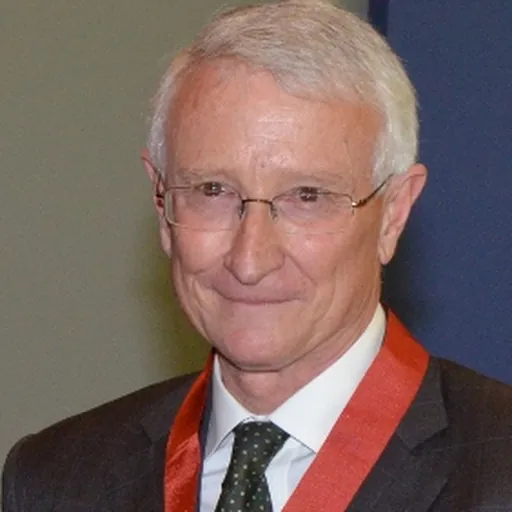
About John Hood
Born 1952. John Hood is a New Zealand cricketer and academic.
Sir John Antony Hood (born 2 January 1952) is a New Zealand businessman and administrator. He was Vice-Chancellor of the University of Oxford from 5 October 2004 until 30 September 2009. He was the first Vice-Chancellor to be elected from outside Oxford's academic body in 900 years, and the first to have addressed the scholars' congregation via a webcast. In March 2007 New Zealand Prime Minister Helen Clark awarded him the World Class New Zealand supreme award to honour his contribution to profiling New Zealand and New Zealanders internationally.
Early life and education Hood was born on 2 January 1952 in Napier, New Zealand. Both his parents were schoolteachers. His father, George Hood began as teaching headmaster of the primary school in the Gisborne District settlement of Whatatutu, and finished his career at North Shore Teachers' College and Takapuna Normal Intermediate. His mother, Frances Hood, was a physical education specialist. One of the six school houses at Westlake is named after him (Hood House).
From 1970 to 1976, Hood attended the University of Auckland, where he graduated with a B.E. in 1972 and a PhD in Civil Engineering in 1976. His doctoral thesis was entitled A theoretical and experimental investigation of a curved, single cell box-girder bridge. He was then awarded a Rhodes Scholarship to Oxford, where he resided in Worcester College and studied for an M.Phil. in Management. He played first-class cricket for Oxford University in 1977.
Career Career in New Zealand He has held a number of directorships in prominent New Zealand companies and bodies, including Fonterra, Fletcher Challenge and the New Zealand Cricket review of 1995.
Fletcher Challenge Hood first entered the Fletcher business on a Fletcher Construction Company engineering cadetship, a non-bonded scholarship which, in return, saw Hood working on construction sites around New Zealand during university vacations.
During this period he also played an important role in developing the Fletcher Challenge Art Collection. During his tenure, he was named by North & South Magazine as 2002 New Zealander of the Year.
Catching the Knowledge Wave conference While in the Vice-Chancellor role at the University of Auckland, Hood co-chaired, along with then Prime Minister Helen Clark, the 2001 'Catching the Knowledge Wave' conference. Said to be one of the largest meeting of minds to take place in New Zealand history, the conference was attended by 450 delegates, and 37 national and international speakers and expatriate New Zealanders - academics, officials, politicians, economists and business leaders - discussing how to lift economic performance In New Zealand.
The conference is said to represent the realisation that New Zealand should look to become a high value, knowledge-based economy rather than continuing to rely on commodity agriculture.
University of Oxford From 2004 to 2009, Hood was vice-chancellor of the University of Oxford. Hood's term as vice-chancellor of Oxford has been the subject of controversy. Hood had proposed to reform the 900-year-old tradition of complete self-governance by introducing a number of external members to council, and by separating academic and financial boards. The initial proposal called for a majority of external members of council, bringing Oxford into line with all other UK universities except the University of Cambridge. Following a two-hour debate, the proposal was amended by Congregation to allow the election of a college fellow, a further insider, to the council within five years, resulting in a majority of eight insiders (including the vice-chancellor) on the 15-member council. A postal vote was called on 5 December, with ballots being sent to all 3000 members of Congregation and votes being accepted until 18 December. On 19 December it was announced that the proposal had once again been defeated, this time by 1540 to 997 votes. Hood stated that he would not treat the defeat as a vote of no confidence, citing a need to "put aside division, continue dialogue with all shades of opinion and, in an atmosphere of trust, tolerance and goodwill, promote the academic aims and ideals of Oxford".
The proposed reform met with opposition not because it would invite outside opinion on the university's financial and academic decisions, but because of the impression that control would be wrested from Congregation, thus threatening the university's academic reputation. Other critics questioned the applicability of corporate models of governance in educational institutions. Chris Patten stated in December 2006 that without reforms to Oxford's governance it would be more difficult to raise money he said was needed by the university, particularly with respect to needs-based funding to support students from poorer backgrounds. no formal motions were brought forward calling for his resignation. However, an informal letter of confidence organised by his supporters in February 2006 attracted only about fifty signatories from Members of Congregation. and Donald Fraser, who was elected unopposed, also in 2006.
In June 2007 it was revealed that the university press office had been monitoring and editing comments in Hood's Wikipedia article in an attempt to protect his reputation. In the same month, two further critics of Hood, Colin Thompson and Peter Robbins, were elected to the council.
Andrew Hamilton, who had previously served as the Provost of Yale University, was nominated on 3 June 2008 to succeed John Hood as Vice-Chancellor of Oxford University from 1 October 2009. His appointment was confirmed on 16 June 2008.
Later career Hood (right) in 2014, after his investiture as a Knight Companion of the New Zealand Order of Merit by the governor-general, Sir Jerry MateparaeHe is a non-executive director of BG Group Plc, and will be President and Chief Executive Officer of the Robertson Foundation from 2010.
In December 2011, John Hood became Chair of Rhodes Trustees.
In January 2012, the board of global private education provider Study Group appointed John Hood as chairman.
In the 2014 Queen's Birthday Honours, Hood was appointed a Knight Companion of the New Zealand Order of Merit (KNZM) for services to tertiary education.
On May 8, 2018, New York-based investment firm Blackstone announced Sir John Hood's appointment on its board of directors.
Research Awards and Grants
Hon. Doc., Korea University (2008) LLD (Hon), University of British Colombia (2006) Hon. Doc., Beida University (2005) LLD (Hon), The University of Auckland (2004) Rhodes Scholar (1976-1978)
The fund provides travelling fellowships of up to $25,000 NZD which support academic staff to take short-term research at prestigious international institutions, and visiting fellowships which support overseas academics to visit the University of Auckland.
Personal life Hood has three children. His wife, Emma, Lady Hood, was a contemporary of Theresa May at St Hugh's College, Oxford.
Don’t just read it —
keep it.
Full-length biographies made to live with: read them, listen on the way to work, watch them tonight.
- E-book
- Audio
- Video
Instant download · yours to keep · every purchase keeps this site free
Important facts
People in John Hood's life
Named in this biography and alive at the same time





Related people
Same field, nearest in time

Contemporaries
People whose lives overlapped John Hood's



Frequently asked questions
Who is John Hood?
New Zealand academic administrator
When was John Hood born?
John Hood was born on 2 January 1952 in Napier.
What is John Hood's occupation?
John Hood is a cricketer and academic.
What nationality is John Hood?
John Hood is New Zealand.
Sources & further reading
· DBpedia: John Hood (university administrator)
Cite this page
APA: Biography.guide. (2026). John Hood. https://biography.guide/john-hood-cricketer/
MLA: "John Hood." Biography.guide, https://biography.guide/john-hood-cricketer/.
Chicago: "John Hood." Biography.guide. https://biography.guide/john-hood-cricketer/.
Data last updated: 2026-09-20 · Spot an error? Report a correction.
Page generated 2026-09-27 05:10 UTC