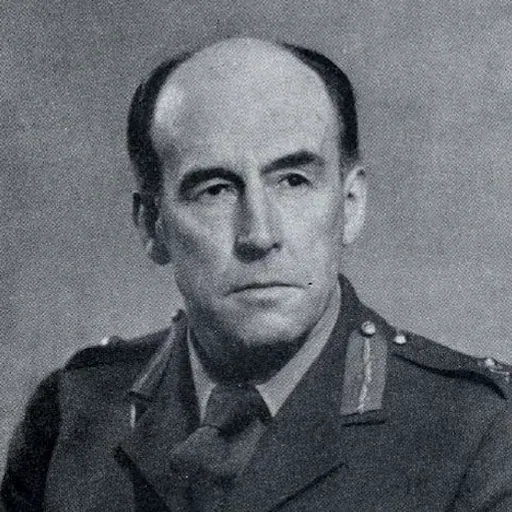
About John Holland
Lived 1897 – 1956 (aged 58). John Holland was a British military personnel.
John Charles Francis "Jo" Holland was a British Army officer and one of the founders of the modern apparatus of irregular warfare. At the outbreak of hostilities in World War II, Holland went to work for the War Office and recruited the heads of a large swathe of the sections of the Directorate of Military Intelligence. His recruits at this time included; Colin Gubbins, Norman Crockatt, E.R. Coombe, and Gerald Templer. For the first half of the war, he was the director of the irregular warfare efforts for the War Office, managing at first an organization called GS (R), which was later the Military Intelligence (Research) Department, abbreviated as MI(R). In 1940, he was one of the creators of the Special Operations Executive (SOE), and MI(R) was then merged into the SOE. Holland went back into regimental staffs shortly after becoming the progenitor of the British Commandos.
Biography
Early life Holland was born in India during the rule of the British Raj. He was the only son and the eldest child of Thomas Henry Holland and Frances Maud. His father was a high-ranking geologist who later served as the director of the Geological Survey of India.
Irish War of Independence In 1919, at the end of the First World War, Holland was almost immediately deployed to respond to what were then called the "Troubles in Ireland," today known as the Irish War of Independence. His deployments to Ireland were co-mingled with his supplemental education at Jesus College at the University of Cambridge. He was a student for most of the year, but on the academic breaks, he served on deployments to Ireland. It was during the Christmas academic break of 1920 when he was severely wounded in Dublin. Despite his injury, he is noted by military historians as having grown to admire both the cause and the technical skills of his enemy, the guerrilla warfighters of the Irish Republican Army. Irregular warfare and guerrilla war became a personal and professional hobby of study for Holland at this time, and it was a hobby that he kept for the rest of his life. Contrary to popular misconception, Holland was not the first chief of GS (R). The section had actually been established in 1936, but the section chief who created the office has not yet been identified, because GS (R)'s operations for its first two years, between 1936 and 1938, were not revealed to the public. GS (R) was only made known to the public during a session of the House of Commons in 1938.
Holland had no prior experience in intelligence work, which was representative of the improvised nature of recruitment to British Military Intelligence at the time. His appointment was initially viewed as temporary and of limited significance. Nevertheless, with the collaboration of Lieutenant Colonel Laurence Grand, head of Section D at the Secret Intelligence Service and an acquaintance from Woolwich, Holland succeeded in establishing a new area of study within the War Office devoted to irregular warfare.
Section D had been created in April 1938 within SIS to develop plans for covert sabotage and subversion through civilian channels. Holland’s parallel work at the War Office likely stemmed from a concern among senior officers that the Army should not be sidelined in this emerging field, and that the potential military application of guerrilla operations warranted systematic examination.
Drawing on his earlier experiences with guerrilla warfare in Ireland, he developed ideas that extended beyond conventional military doctrine. He sent in for nearly every book that had been written on the subject, endeavoring to produce a replicable modus operandi from historical accounts. He is known to have studied at this point T.E. Lawrence’s Seven Pillars of Wisdom, the tactics of Cossack hosts deployed in the Napoleonic Wars, the Francs-tireurs during the Battle of Sedan, guerrilla tactics used in the Second Boer War and the Anglo-Zulu War, certain recent actions in the Chinese Civil War, and the Spanish Civil War. His largest area of study, however, was that of the Irish Republican and earlier Fenian tactics and strategies. Of the Irish guerrilla movement, he wrote that: "there is little doubt that the Irish made guerrilla warfare into a science, which has been followed since... It is proposed to base this present study on such information as can be obtained of Irish principles and their application by other revolutionaries subsequently."
Holland's first official GS (R) department hire was for a Secretarial clerk typist and personal assistant named Joan Bright Astley, who would eventually become an inspiration for the fictional character Miss Moneypenny. In early 1939, his branch was restructured and renamed the Military Intelligence (Research) Department, becoming part of the Directorate of Military Intelligence. Although administratively within intelligence, his focus remained on planning and operations. With the support of General Archibald Wavell, he contributed to the creation of several wartime covert organizations and was among the early advocates for the formation of commando units.
During the summer of 1939, he worked for a brief period at 2 Caxton Street in Westminster, sharing offices with Lieutenant Colonel Laurence Grand.
World War II When war was declared in September 1939, Holland returned to his duties at the War Office.
Holland assembled a group of officers who shared his interest in unconventional operations, assigning each to responsibilities that matched their abilities. He tasked Norman Crockatt to manage the newly established MI9. He sent E. R. Coombe to establish the Inter-Services Security Board, which coordinated matters of security, deception, and the use of code names. He placed Gerald Templer in charge of security for the British Expeditionary Force, while Millis Jefferis was directed to develop and oversee the use of experimental weapons and devices.
Holland also dispatched Colin Gubbins to the Independent Companies in Norway and later assigned him to form resistance units intended to disrupt German communications in the event of invasion. Gubbins subsequently became head of the Special Operations Executive (SOE), created in July 1940 through the merger of Holland’s section, Section D of the SIS, and the Electra House, a covert propaganda unit of the Foreign Office.
Following the establishment of the SOE, Holland returned to regimental service after receiving command as a Lieutenant Colonel. He rejoined the War Office in July 1943 as Deputy Chief Engineer with the rank of Major General.
Postwar life and death In recognition of his wartime service, he was appointed Companion of the Order of the Bath (CB) in 1945, and was also awarded the U.S. Legion of Merit and the Medal of Freedom with Silver Palm. He later served as Chief of Staff for Western Command from 1947 to 1948, undertook further classified planning work in 1949–1950, and retired from the Army in 1951.
On 14 March 1956, Holland died at his son's house in Wimbledon.
Don’t just read it —
keep it.
Full-length biographies made to live with: read them, listen on the way to work, watch them tonight.
- E-book
- Audio
- Video
Instant download · yours to keep · every purchase keeps this site free
Important facts
People in John Holland's life
Named in this biography and alive at the same time

Related people
Same field, nearest in time
Contemporaries
People whose lives overlapped John Holland's
Frequently asked questions
Who was John Holland?
British army and intelligence officer (1897–1956)
When was John Holland born?
John Holland was born on 21 November 1897 in India.
When did John Holland die?
John Holland died on 17 March 1956 in Wimbledon.
What was John Holland's occupation?
John Holland was a military personnel.
What nationality was John Holland?
John Holland was British.
Sources & further reading
· DBpedia: John Charles Francis Holland
Cite this page
APA: Biography.guide. (2026). John Holland. https://biography.guide/john-holland-military-personnel/
MLA: "John Holland." Biography.guide, https://biography.guide/john-holland-military-personnel/.
Chicago: "John Holland." Biography.guide. https://biography.guide/john-holland-military-personnel/.
Data last updated: 2026-09-28 · Spot an error? Report a correction.
Portrait: Wikimedia Commons · author & licence
Page generated 2026-10-04 12:36 UTC