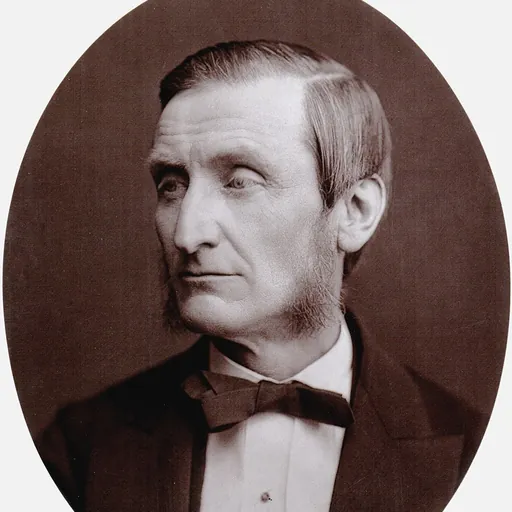
About John Hall Gladstone
Lived 1827 – 1902 (aged 75). John Hall Gladstone was a British chemist and physicist.
John Hall Gladstone FRS (7 March 1827 – 6 October 1902) was a British chemist. He served as President of the Physical Society between 1874 and 1876 and during 1877–1879 was President of the Chemical Society. Apart from chemistry, where one of his most notable publications was on bromination of rubber, he undertook pioneering work in optics and spectroscopy.
Biography He was born to John Gladstone, a wholesale draper in Hackney, London and Alison Hall, as the eldest of three sons. The three brothers were educated entirely at home under tutors, and from very early days all showed a strong inclination toward natural science. In 1842, the father retired from business, and the family spent a year in travelling on the continent. Part of this time was passed in Italy with their old friends: Charles Tilt, his wife and their daughter May, who in 1852 became the wife of John Hall Gladstone.
From early years Gladstone had shown strong religious tendencies, and when, at the age of seventeen, the question of his future career came to be discussed, he wished to enter the Christian ministry. From this course he was dissuaded both by his father and by Mr. Tilt, and in December 1844 he entered University College, London. Here he attended Graham's lectures on chemistry and worked in his private laboratory, and here he prepared his earliest scientific contribution on "Analysis of Sand from St. Michael's Bay, Normandy", which was read at a meeting of the Royal Chemical Society on 16 November 1846. Next year, he received a gold medal from the college for his study on "Gun Cotton and Xyloidine". Later in the same year he went to University of Giessen to work under Justus von Liebig, returning in April 1848 with the degree of Doctor of Philosophy. The subject of his dissertation was possibly "Artificial Formation of Urea from Fulminic Acid".
Research In his early years, Gladstone conducted studies of phosphamide and similar compounds, suggested by Liebig and revised ten years later; an inquiry into the composition of nitrogen iodide (1852). His more important work was published in the Philosophical Transactions in 1855, on "Circumstances modifying the Action of chemical Affinity". Here, the author examined the question, arising out of the researches of Bunsen and Debus, whether when two substances act on each other an increase in the quantity of one of them leads to a corresponding increase in the amount of chemical change observed, and whether such change occurs continuously or discretely, in atomic proportions.
Optical phenomena and the properties of elements and compounds in relation to light have always been a major interest for Gladstone. This comes out quite early in his career, and in a variety of forms. Thus in 1854 he lectured at the Royal Institution on "Chromatic Phenomena exhibited by Transmitted Light." In 1855 there were "Notes on some substances which exhibit the Phenomena of Fluorescence", and in 1856 on "Some Dichromatic Phenomena among Solutions". In 1858 he drew attention to the use of the prism in qualitative analysis (Quart. Journ. Chem. Soc., 1O, 79), and discovered distinct lines in the absorption spectrum of didymium, a substance long afterwards resolved by Auer von Welsbach into the two elements known as praseodymium and neodymium. A little later he studied the absorption spectrum of the atmosphere, and found that the Fraunhofer lines varied according to the time of day, and that the change must be due to some constituents of the Earth's atmosphere. In this research he was joined by Sir David Brewster, and together they produced a paper on the lines of the solar spectrum in 1860. The most important work of Gladstone in this direction was the long series of observations on the refraction and dispersion of liquids, which originated with a study of the "Influence of Temperature on the Refraction of Light," (Phil. Trans., 1858) and followed by "Researches on the Refraction, Dispersion, and Sensitiveness of Liquids," (Phil. Trans., 1863), leading to the Gladstone–Dale relation (with Pelham Dale).
Another memorable series of researches commenced about 1872, in conjunction with his assistant Alfred Tribe, resulted in the discovery of the zinc-copper couple, and its application to the production of the organozinc compounds and to other purposes. The couple has long since found its way into every laboratory in the world, and as a reducing agent has met with applications not only in connection with carbon compounds but for many purposes in analysis.
Don’t just read it —
keep it.
Full-length biographies made to live with: read them, listen on the way to work, watch them tonight.
- E-book
- Audio
- Video
Instant download · yours to keep · every purchase keeps this site free
Important facts
People in John Hall Gladstone's life
Named in this biography and alive at the same time



Related people
Same field, nearest in time



Contemporaries
People whose lives overlapped John Hall Gladstone's




Frequently asked questions
Who was John Hall Gladstone?
British chemist (1827-1902)
When was John Hall Gladstone born?
John Hall Gladstone was born on 7 March 1827 in London.
When did John Hall Gladstone die?
John Hall Gladstone died on 6 October 1902 in London.
What was John Hall Gladstone's occupation?
John Hall Gladstone was a chemist and physicist.
What nationality was John Hall Gladstone?
John Hall Gladstone was British.
Sources & further reading
· Wikipedia: John Hall Gladstone
· DBpedia: John Hall Gladstone
Cite this page
APA: Biography.guide. (2026). John Hall Gladstone. https://biography.guide/john-hall-gladstone/
MLA: "John Hall Gladstone." Biography.guide, https://biography.guide/john-hall-gladstone/.
Chicago: "John Hall Gladstone." Biography.guide. https://biography.guide/john-hall-gladstone/.
Data last updated: 2026-09-23 · Spot an error? Report a correction.
Portrait: Wikimedia Commons · author & licence
Page generated 2026-09-27 05:06 UTC