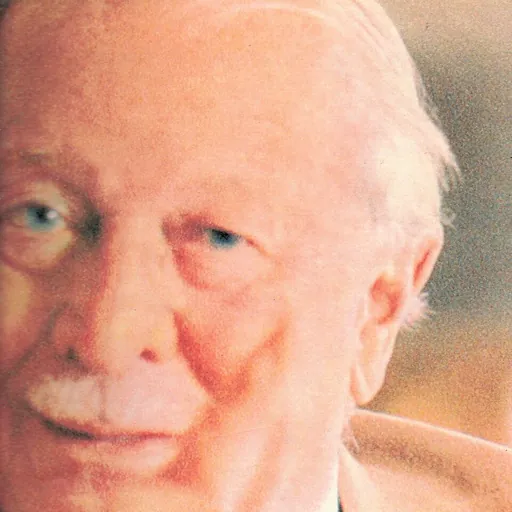
John Hackett
Australian-born British soldier, painter and author
About John Hackett
Lived 1910 – 1997 (aged 86). John Hackett was a British and Australian military personnel, writer and military historian.
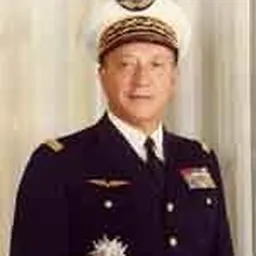
General Sir John Winthrop Hackett, (5 November 1910 – 9 September 1997) was an Australian-born British soldier, painter, university administrator, author and in later life, a commentator.
Early life Hackett, nicknamed "Shan", was born in Perth, Western Australia. His Irish Australian father, also named Sir John Winthrop Hackett (1848–1916), originally from County Tipperary, was educated at Trinity College, Dublin (B.A., 1871; M.A., 1874), and he emigrated to Australia in 1875, eventually settling in Western Australia in 1882, where he became a newspaper proprietor and editor and a politician. His mother was Deborah Drake-Brockman (1887-1965), whose parents were prominent members of Western Australian society. Her six siblings included Grace Bussell, famous for rescuing shipwreck survivors as a teenager, and Frederick Slade Drake-Brockman, a prominent surveyor and explorer.
On 3 August 1905, aged 57, Hackett Sr married Deborah Drake-Brockman, who was only 18 at the time — she later became Deborah, Lady Hackett; Deborah, Lady Moulden; and Deborah Buller Murphy — having married a director of several mining companies. They had four daughters and a son. Hackett senior died in 1916. Lady Hackett remarried in 1918.
Hackett junior received secondary schooling at Geelong Grammar School in Victoria and then travelled to London to study painting at the Central School of Art. He then studied Greats and Modern History at New College, Oxford, earning an M.A. As his degree was not good enough for an academic career, Hackett joined the British Army and was commissioned into the 8th King's Royal Irish Hussars in 1933, having previously joined the Supplementary Reserve of Officers in 1931. During his military training, he completed a thesis in history with a focus on the crusades and the Early Middle Ages, particularly Saladin's campaign in the Third Crusade, for which he was awarded a B. Litt. He also qualified as an interpreter in French, German and Italian, studied Arabic and eventually became fluent in ten languages. Whilst recuperating at GHQ in Cairo, he was instrumental in the formation of the Long Range Desert Group, the Special Air Service and Popski's Private Army. since such cases were thought hopeless. However, he was operated on by Alexander Lipmann-Kessel, who, with superb surgery, managed to save the brigadier's life. and was knighted (KCB) on 2 June 1962. In 1963, he was appointed to Ministry of Defence as Deputy Chief of the Imperial General Staff (DCIGS), responsible for forces organisation and weapon development and became the leading figure in the reorganisation of the Territorial Army (TA), which made him unpopular. He relinquished his appointment on 4 February 1966.
On 14 April 1966, he was appointed command of the British Army of the Rhine (BAOR) and the parallel command of NATO's Northern Army Group, and his ability to speak several languages made him a natural choice, as did his friendship with foreign soldiers such as Johann von Kielmansegg of the Bundeswehr.
In 1968 he wrote a highly controversial letter to The Times that was critical of the British government's apparent lack of concern over the strength of NATO forces in Europe but signed the letter as a NATO officer, not as a British commander. In 1978, he wrote a novel, The Third World War: August 1985, which was a fictionalized scenario of the Third World War based on a Red Army invasion of West Germany in 1985. It was followed in 1982 by The Third World War: The Untold Story, which elaborated on the original, including more detail from a Soviet perspective. American author Max Brooks cited Hackett's novels as one source of inspiration for his novel World War Z. Hackett also appeared in the documentary In Search of the Trojan War, where he described The Iliad as "a story about the sort of people I know."
Decorations Hackett's honours include being appointed a Knight Grand Cross of the Bath, Commander of the Most Excellent Order of the British Empire and Companion of the Distinguished Service Order with Bar, and being awarded the Military Cross. His obituary in The Times called him a man of "intellect and prodigious courage."
Don’t just read it —
keep it.
Full-length biographies made to live with: read them, listen on the way to work, watch them tonight.
- E-book
- Audio
- Video
Instant download · yours to keep · every purchase keeps this site free
Important facts
People in John Hackett's life
Named in this biography and alive at the same time






Related people
Same field, nearest in time


Contemporaries
People whose lives overlapped John Hackett's





Frequently asked questions
Who was John Hackett?
Australian-born British soldier, painter and author (1910–1997)
When was John Hackett born?
John Hackett was born on 5 November 1910 in Perth.
When did John Hackett die?
John Hackett died on 9 September 1997.
What was John Hackett's occupation?
John Hackett was a military personnel, writer and military historian.
What nationality was John Hackett?
John Hackett was British and Australian.
Sources & further reading
· DBpedia: John Hackett (British Army officer)
Cite this page
APA: Biography.guide. (2026). John Hackett. https://biography.guide/john-hackett-military-personnel/
MLA: "John Hackett." Biography.guide, https://biography.guide/john-hackett-military-personnel/.
Chicago: "John Hackett." Biography.guide. https://biography.guide/john-hackett-military-personnel/.
Data last updated: 2026-09-20 · Spot an error? Report a correction.
Page generated 2026-09-27 05:09 UTC