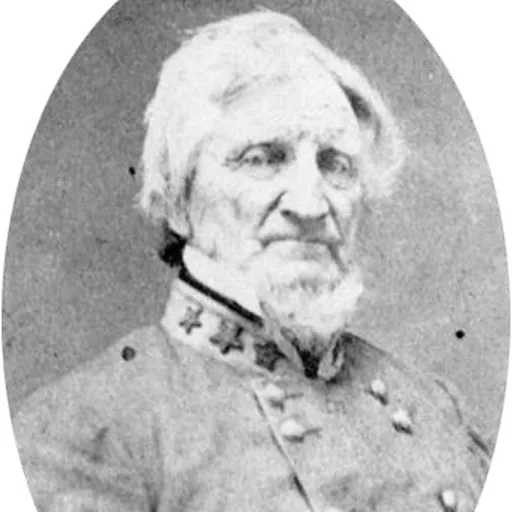
About John H. Winder
Lived 1800 – 1865 (aged 65). John H. Winder was an American military officer.
John Henry Winder (February 21, 1800 – February 7, 1865) was a career United States Army officer who served with distinction during the Mexican–American War. He later served as a Confederate general officer during the American Civil War.
Winder commanded prisoner-of-war camps throughout the South during the war, and was charged with improperly supplying the prisoners in his charge.
Early life and career Winder was born on February 21, 1800, at "Rewston" in Somerset County, Maryland, a son of U.S. Army Brig. Gen. William H. Winder and his wife Gertrude Polk. Winder's father fought in the War of 1812, most notably as the American commander in the disastrous and rallying defeat at the Battle of Bladensburg and was a second cousin to future Confederate general Charles Sidney Winder.
In 1814, Winder entered the United States Military Academy at West Point, and graduated 11th of 30 cadets in 1820. He was commissioned a second lieutenant in the artillery, Winder resigned his commission on August 31, 1823, and would not return to the Army for almost four years. The next year his father died, placing him in deep economic strain, and his mother was forced to turn her home into a boardinghouse. Winder failed to manage his father-in-law's plantation successfully, and he was unable to help his mother. In 1826, Elizabeth died, leaving him to raise their young son William A. Winder, which forced him back into the U.S. Army. but lost his position after one year having lost his temper with a cadet.
At the battle of Chapultepec, Winder was responsible for attacking the Military Academy that was defended by Felipe Xicoténcatl and a few hundred cadets.
American Civil War In January 1861, Florida became the third state to secede from the Union. At this time, the pro-secession Winder was in command of the defenses in Pensacola, which included Fort Pickens. However, he was away on leave and so Lt. Adam J. Slemmer took command and prevented the fort from falling into rebel hands. The Union would retain control of the fort for the rest of the war.
Winder resigned his U.S. Army commission on April 20, 1861, and offered his services to the state of North Carolina. He was appointed a colonel in the Confederate Army infantry on May 21. He was then promoted to brigadier general on June 21 and the next day was made Assistant Inspector General of the Camps of Instruction that were in the Confederacy's capital of Richmond, Virginia, a post he would hold until October 21. Winder designated Samuel B. Maccubbin chief of detectives and gave him a force of Plug Uglies imported from Baltimore to police the population of Richmond. Winder's first order was established prohibition of alcohol and required all citizens to surrender their firearms. Even though there were daily accusations or entrapment and corruption against his "plug-ugly" police force, Winder refused to order an investigation. By October 1864 newspapers reported the crime rate in Richmond exceeded the worst days of Baltimore or New York and much of the blame went to the corrupt police force. This earned him the moniker "The Dictator of Richmond".
In addition to his duties involving prisons, he was responsible for dealing with deserters, local law enforcement, and for a short time setting the commodity prices for the residents of a city dealing with a doubled population. During this time, he commanded Libby Prison in Richmond as well.
In April 1864, Winder appointed Captain Henry Wirz commandant of a new prison camp in Georgia called Camp Sumter, better known as the infamous Andersonville Prison. Winder commanded the Department of Henrico for much of the war, until May 5, 1864. He then commanded the 2nd District of the Department of North Carolina & Southern Virginia from May 25 until June 7.
...President Davis, Secretary Seddon, and Adjutant Cooper declared that he was a much-maligned man. He was set to perform a task made impossible by the inadequacy of supplies of men, food, clothing, and medicines. McElroy claims that on July 27, 1864, Winder issued an order that if Union troops (under General Stoneman) were to come within seven miles of Andersonville, the guards were to "open upon the Stockade [i.e. upon the prisoners] with grapeshot, without reference to the situation beyond these lines of defense".
Death and legacy Winder died on duty in Florence, South Carolina, of a heart attack on February 7, 1865, aged 64. His body was brought back to Maryland and interred at Green Mount Cemetery in Baltimore.
After the Civil War, Winder's son, Capt. William Sidney Winder unsuccessfully tried to clear his father's name.
In 1965, a sign recognizing Winder was erected in Salisbury, Maryland, near the intersection of U.S. Business 13 and U.S. 50 where a historically Black neighborhood was razed in 1950s to make room for the highways. In 1983, due to damage from traffic accidents, the sign was moved to the Wicomico County Courthouse in Salisbury.
Don’t just read it —
keep it.
Full-length biographies made to live with: read them, listen on the way to work, watch them tonight.
- E-book
- Audio
- Video
Instant download · yours to keep · every purchase keeps this site free
Important facts
People in John H. Winder's life
Named in this biography and alive at the same time


Related people
Same field, nearest in time

Contemporaries
People whose lives overlapped John H. Winder's






Frequently asked questions
Who was John H. Winder?
Confederate Army general (1800–1865)
When was John H. Winder born?
John H. Winder was born on 7 February 1800 in Somerset County.
When did John H. Winder die?
John H. Winder died on 21 February 1865 in Florence.
What was John H. Winder's occupation?
John H. Winder was a military officer.
What nationality was John H. Winder?
John H. Winder was American.
Sources & further reading
Cite this page
APA: Biography.guide. (2026). John H. Winder. https://biography.guide/john-h-winder/
MLA: "John H. Winder." Biography.guide, https://biography.guide/john-h-winder/.
Chicago: "John H. Winder." Biography.guide. https://biography.guide/john-h-winder/.
Data last updated: 2026-09-22 · Spot an error? Report a correction.
Portrait: Wikimedia Commons · author & licence
Page generated 2026-09-27 05:02 UTC