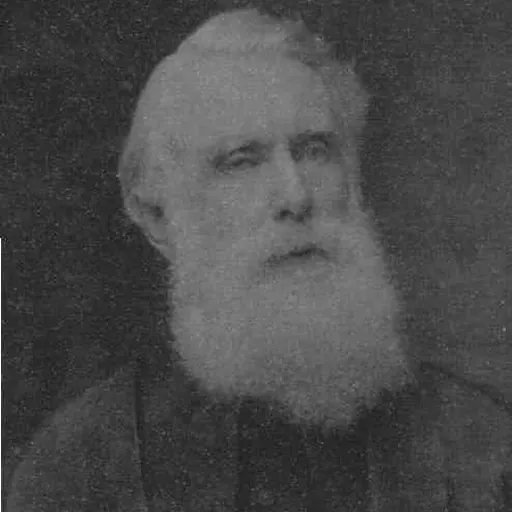
About John Gwynn
Lived 1827 – 1917 (aged 89). John Gwynn was a British syriacist, theologian and anglican priest.
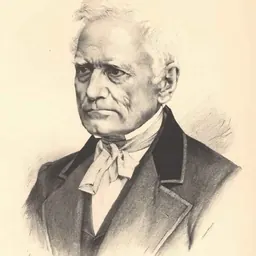
John Gwynn (28 August 1827 – 3 April 1917) was an Irish Syriacist. He was Regius Professor of Divinity at Trinity College Dublin from 1888 to 1907.
Biography
John Gwynn (1827–1917) was born in Larne, the eldest son of the Reverend Stephen Gwynne (1792–1873). The Gwynne family had been settled in Ulster since the 17th century. The spelling of the family surname had varied throughout the earlier years; it was John Gwynn, the subject of this article, who settled on "Gwynn" with no "e".
John was educated at Enniskillen Royal School in Ulster, and then followed family tradition by going to Trinity College Dublin. His father's diary (still preserved at Trinity) records John's success in the entrance examinations, in the winter of 1845:
Four years later, as an undergraduate, John Gwynn stood outside Trinity College and watched William Smith O'Brien and other political prisoners being marched through the streets of Dublin on their way to Kingstown (Dún Laoghaire), where a convict ship was waiting to transport them to Van Diemen's Land (Tasmania).
At TCD, John studied mathematics, and was awarded a BA in that subject in 1850. He soon became a Fellow of Trinity, spending the years 1853 to 1856 in minor academic posts at the university. He was then appointed Warden (Headmaster) of St Columba's College at Rathfarnham in County Dublin, a secondary school for sons of the gentry, on the lines of an English public school, which had been founded fourteen years earlier.
John continued studying while working. He took his MA in 1854 and became a Bachelor of Divinity in 1861. After taking holy orders he spent the next twenty years (1863 to 1883) working as a clergyman in County Donegal and County Londonderry. He was much involved in the process of "disestablishment" of the Church of Ireland, which took place in 1869. Simultaneously he was preparing to take his Doctorate in Divinity from Trinity, which he achieved in 1880. He worked from twenty different manuscripts for the epistles, but had to rely on only one, the Crawford Aramaic New Testament manuscript, for Revelation. These were later added to the Gospels and Epistles of Philip E. Pusey and George Gwilliam to produce the 1905 United Bible Societies standard edition of the Syriac Peshitta.
Family
John and Lucy Gwynn had eight sons and two daughters. Their elder daughter, Lucy Penelope Gwynn (1865–1947), made a notable contribution to the cause of women's education when she was appointed the first Lady Registrar at Trinity College. In this role, she helped private women students from England to benefit from the college's pioneering "equal rights" policy and proceed to a degree, as well as looking after the interests of female Trinity students. She never married.
The younger daughter, Mary Katharine Gwynn (1879–1955), married widower Henry Cole Bowen of Bowen's Court, County Cork, thus becoming the stepmother of writer Elizabeth Bowen. In later life Mary suffered from severe deafness.
Stephen Lucius Gwynn (1864–1950), the eldest and most famous of the sons, was an MP, a prominent Irish patriot and a prolific writer. He married his first cousin, Mary Louise (1865–1941), known as May Gwynn, who was the eldest daughter of the Reverend James Gwynn (1829–1869), pastor of the fashionable Octagon Chapel in Bath. May, with her children, entered the Roman Catholic church while in her thirties, and her second son Aubrey Osborn Gwynn SJ later became a Jesuit priest.
Other sons were Edward John Gwynn (1868–1941), an academic like his father, sometime Provost of Trinity College Dublin; Major General Sir Charles William Gwynn KCB (1870–1963), sometime Commandant of the Staff College, Camberley; Lucius Henry Gwynn (1873–1902), another Trinity academic as well as a brilliant cricketer and footballer, who died of TB at an early age; Arthur Percival Gwynn (1875–1898), again a talented cricketer, who joined the Indian Civil Service, was sent out to Burma and died there, of septicaemia, at the age of twenty-one; Robert (Robin) Malcolm Gwynn (1877–1962), a cleric-academic like his father, who was a long-serving, very active Fellow of Trinity College and a bold champion of liberal causes; John Tudor Gwynn (1881–1956), at various times Indian Civil Servant, journalist and writer, and head of Baymount Preparatory School near Dublin; and Brian James Gwynn (1883–1972), soldier then Irish civil servant.
E.M. Green's letter to John Gwynn reads: "I know that my Father was the nearest & best loved relative of Mr John Gwynne who founded the Institution..." She further mentions that her brother John was the Derry benefactor's godson and inherited a gold watch from him.
Photographs
Works The Book of Armagh: Liber Ardmachanus, Dublin, 1913 Two Memoirs on the Syriac Versions of the New Testament, Dublin, 1893 The Apocalypse of St. John: In a Syriac Version Hitherto Unknown, Dublin, 1897
Don’t just read it —
keep it.
Full-length biographies made to live with: read them, listen on the way to work, watch them tonight.
- E-book
- Audio
- Video
Instant download · yours to keep · every purchase keeps this site free
Important facts
People in John Gwynn's life
Named in this biography and alive at the same time




Related people
Same field, nearest in time


Contemporaries
People whose lives overlapped John Gwynn's





Frequently asked questions
Who was John Gwynn?
Irish dean (1827-1917)
When was John Gwynn born?
John Gwynn was born on 28 August 1827 in Larne.
When did John Gwynn die?
John Gwynn died on 3 April 1917 in Dublin.
What was John Gwynn's occupation?
John Gwynn was a syriacist, theologian and anglican priest.
What nationality was John Gwynn?
John Gwynn was British.
Sources & further reading
· DBpedia: John Gwynn (Syriacist)
Cite this page
APA: Biography.guide. (2026). John Gwynn. https://biography.guide/john-gwynn/
MLA: "John Gwynn." Biography.guide, https://biography.guide/john-gwynn/.
Chicago: "John Gwynn." Biography.guide. https://biography.guide/john-gwynn/.
Data last updated: 2026-09-24 · Spot an error? Report a correction.
Portrait: Wikimedia Commons · author & licence
Page generated 2026-09-27 05:08 UTC