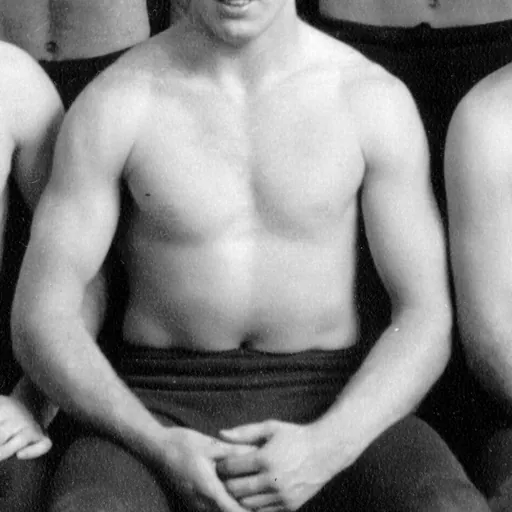
About John Greene
Lived 1920 – 2010 (aged 90). John Greene was an American american football player.
John Joseph Greene (April 21, 1920 – November 4, 2010) was an American collegiate wrestler and football player.
Greene competed in wrestling and football at the University of Michigan from 1940 to 1944. He was captain of the Michigan wrestling team in 1944 and was also selected to play in the 11th annual Chicago College All-Star Game that same year. He was inducted into the University of Michigan Athletic Hall of Honor in 1989.
Greene was drafted by the Detroit Lions in the 1944 NFL draft and played seven seasons for the Lions from 1944 to 1950. After moving to the end position in 1945, Greene became a star, ranking among the National Football League (NFL) leaders in receptions and/or receiving yards each year from 1945 to 1949.
He had an 88-yard touchdown reception that was the longest pass play in the NFL during the 1946 season and the longest in Detroit Lions history up to that time. When he retired, he was the Lions' all-time leading receiver with 2,965 receiving yards, 26 touchdown catches, and 173 receptions. He also served as an assistant coach for the Lions during the 1951 season.
University of Michigan Greene enrolled at the University of Michigan in 1940. While he was a student at Michigan, Greene was a member of the Michigan Wolverines wrestling team coached by Cliff Keen. In 1943, he lost 15 pounds to qualify for the 175-pound weight class. He finished the 1943 season in third place in the Big Ten Conference. In 1944, he was the team captain, compiled a 16–7 record, and was the Big Ten Conference runner up.
Green also played for the Michigan Wolverines football team under head coach Fritz Crisler. In 1940, he played for Michigan's all-freshman team. As a sophomore, he was a 6-foot, 0 inch, 191-pound backup at the quarterback position for the 1941 Michigan Wolverines football team.
Greene remained at Michigan during the World War II years, having been classified 4-F due to a perforated or punctured eardrum. and Greene became a backup at the tackle position. As a senior, Greene remained a backup at the tackle position, but he was awarded a varsity letter for his contributions to the 1943 Michigan Wolverines football team.
Despite the fact that he was not a starter at Michigan, Greene was invited in the summer of 1944 to participate on the 11th annual Chicago College All-Star Game, an annual game matching a collegiate all-star team against the prior season's NFL championship team.
Detroit Lions Greene was drafted by the Detroit Lions in the fifth round (35th overall) of the 1944 NFL draft. As a rookie in 1944, Greene appeared in nine games, five of them as a starter.
1945 season Greene pulls down a pass good for 48 yards against the Green Bay Packers, Oct. 7, 1945.
For the 1945 season, the Lions' head coach Gus Dorais moved Greene to the end position after being impressed with his speed. Even with the reduced playing time, Greene's 22 receptions in 1946 ranked eighth in the NFL. Greene acquired the nickname "the Cinderella Kid" while playing for the Lions, a reference to "his rise to stardom after comparative obscurity while a lineman in college and early in his Lions' career." Greeene appeared in all 12 games for the 1949 Lions, 11 of them as a starter. He had career highs in receptions (44) and receiving touchdowns (7), and ranked seventh and fifth among all NFL players in those two categories. Greene appeared in all 12 games for the 1950 Lions, but he was not a starter. He caught 22 passes for 368 yards.
Career statistics Greene played seven seasons in the National Football League, all for the Lions. When he retired after the 1950 season, he was the Lions' all-time leading receiver with 2,965 receiving yards, 26 touchdown catches and 173 receptions.
Greene remained with the Lions in 1951 as an assistant coach. After several consecutive years finishing near the bottom of their division, the 1951 Lions compiled a 7–4–1 record and finished in second place in the NFL National Division.
Legend Led the league Bold Career high
Year Team Games Receiving GP GS Rec Yds Avg Lng TD 1944 DET 9 5 0 0 0.0 0 0 1945 DET 10 10 26 550 21.2 63 5 1946 DET 11 2 22 289 13.1 88 2 1947 DET 12 6 38 621 16.3 47 5 1948 DET 12 5 25 595 23.8 83 5 1949 DET 12 12 42 542 12.9 28 7 1950 DET 12 2 22 368 16.7 46 2 78 42 175 2,965 16.9 88 26
Later life Greene lived in Franklin, Michigan, a suburb of Detroit, in his later years. He was inducted into the University of Michigan Athletic Hall of Honor as a wrestler in 1989. He was survived by his wife Alice and his sister Margaret E. Greene McArdle.
Don’t just read it —
keep it.
Full-length biographies made to live with: read them, listen on the way to work, watch them tonight.
- E-book
- Audio
- Video
Instant download · yours to keep · every purchase keeps this site free
Important facts
People in John Greene's life
Named in this biography and alive at the same time




Related people
Same field, nearest in time




Contemporaries
People whose lives overlapped John Greene's





Frequently asked questions
Who was John Greene?
American collegiate wrestler and football player (1920–2010)
When was John Greene born?
John Greene was born on 21 April 1920 in Pittsburgh.
When did John Greene die?
John Greene died on 4 November 2010 in Franklin.
What was John Greene's occupation?
John Greene was an american football player.
What nationality was John Greene?
John Greene was American.
Sources & further reading
· DBpedia: John Greene (American football)
Cite this page
APA: Biography.guide. (2026). John Greene. https://biography.guide/john-greene-american-football-player/
MLA: "John Greene." Biography.guide, https://biography.guide/john-greene-american-football-player/.
Chicago: "John Greene." Biography.guide. https://biography.guide/john-greene-american-football-player/.
Data last updated: 2026-09-24 · Spot an error? Report a correction.
Portrait: Wikimedia Commons · author & licence
Page generated 2026-09-27 05:08 UTC