
About John Goldicutt
Lived 1793 – 1842 (aged 49). John Goldicutt was an architect and antiquarian.
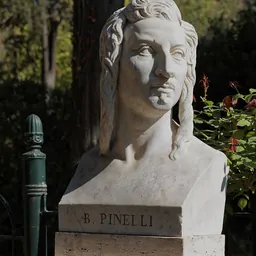
John Goldicutt, View in Rome, 1820. Watercolor over pencil. The Huntington Library, Art Collections, and Botanical Gardens, Gilbert Davis Collection. Fountain of Arethusa in Syracuse. Plate from The Antiquities of Sicily (1819). Drawn by John Goldicutt, etched by Bartolomeo Pinelli. Title page of Specimens of Ancient Decorations from Pompeii, 1825. Drawn by John Goldicutt. John Goldicutt (1793 – 3 October 1842) was a British architect, the son of a bank cashier, who was better known for his architectural drawings than his completed buildings. He won medals in London and Paris for his drawings and a gold medal from the Pope for his drawing of a section of St Peter's, Rome.
Early life John Goldicutt was born in 1793, to Hugh Goldicutt (died 1823), a bank cashier, and his wife, Celia, née Scholar (1756–1813). Goldicutt's early career was in banking and in 1803 he followed his father into the bank of Herries, Farquhar & Co. (now Lloyds) but he left the next year to join the architectural practice of Henry Hakewill.
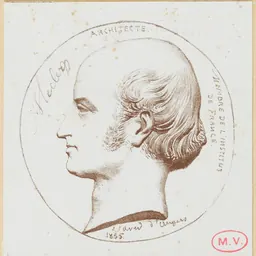
Goldicutt began to study at the Royal Academy in 1812. He became a member of the Architectural Students' Society, and a skilled draughtsman and colourist, winning the Royal Academy silver medal in 1814 with drawings of the Mansion House. In 1815 he won the silver medal of the Society of Arts. In the same year he travelled to Paris where he studied at the school of Achille Leclère and entered the monthly competition of the Académie des Beaux-Arts. (c. 1841) which was finished by George Gutch after Goldicutt's death. Goldicutt's original scheme was for a neo-classical design in yellow brick, influenced by his travels in Italy.
Appointments Goldicutt was honorary secretary of the Institute of British Architects (1834–36), a member of the Academy of St Luke in Rome, and of the Accademia di Belle Arti in Naples. He was a justice and commissioner of sewers for Middlesex and Westminster and from 1828 he was surveyor for St Clement Danes and St Mary-le-Strand.
Selected publications The antiquities of Sicily, 1819. (Plates etched by Bartolomeo Pinelli of Rome) Specimens of ancient decorations from Pompeii. Rodwell & Martin, London, 1825. Heriot's Hospital, Edinburgh, 1826. (With illustrations lithographed by Goldicutt) "Ancient wells and reservoirs, with observations upon their decorative character", The Institute of British Architects Sessional Papers, 1836. The competition for the erection of the Nelson Monument critically examined, 1841.
Don’t just read it —
keep it.
Full-length biographies made to live with: read them, listen on the way to work, watch them tonight.
- E-book
- Audio
- Video
Instant download · yours to keep · every purchase keeps this site free
Important facts
People in John Goldicutt's life
Named in this biography and alive at the same time

Related people
Same field, nearest in time


Contemporaries
People whose lives overlapped John Goldicutt's




Frequently asked questions
Who was John Goldicutt?
British architect and antiquarian
When was John Goldicutt born?
John Goldicutt was born on 17 January 1793.
When did John Goldicutt die?
John Goldicutt died on 3 October 1842.
What was John Goldicutt's occupation?
John Goldicutt was an architect and antiquarian.
Sources & further reading
Cite this page
APA: Biography.guide. (2026). John Goldicutt. https://biography.guide/john-goldicutt/
MLA: "John Goldicutt." Biography.guide, https://biography.guide/john-goldicutt/.
Chicago: "John Goldicutt." Biography.guide. https://biography.guide/john-goldicutt/.
Data last updated: 2026-09-20 · Spot an error? Report a correction.
Page generated 2026-09-27 05:14 UTC