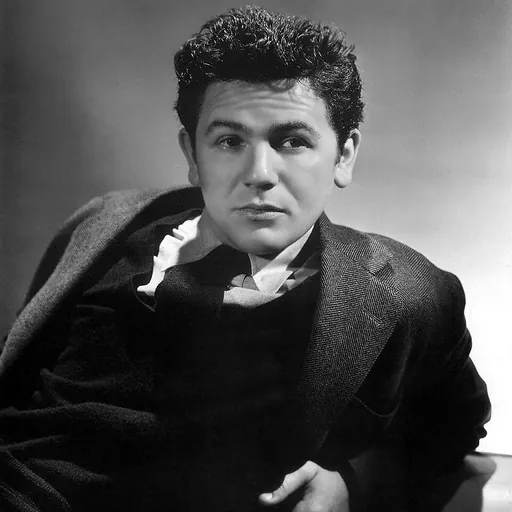
About John Garfield
Lived 1913 – 1952 (aged 39). John Garfield was an American actor, stage actor, film actor, character actor and film producer.
John Garfield (born Jacob Julius Garfinkle; March 4, 1913 – May 21, 1952) was an American actor who played brooding, rebellious, working-class characters. He grew up in poverty in New York City. In the early 1930s, he became a member of the Group Theatre. In 1937, he moved to Hollywood, eventually becoming one of Warner Bros.' stars. He received Academy Award nominations for his performances in Four Daughters and Body and Soul (1947).
Called to testify before the U.S. House Committee on Un-American Activities (HUAC), he denied communist affiliation and refused to "name names", effectively ending his film career. Some have alleged that the stress of this persecution led to his premature death at 39 from a heart attack. Garfield is acknowledged as a predecessor of such Method actors as Marlon Brando, Montgomery Clift, and James Dean.
Early life
Jacob Garfinkle (Yiddish: ) was born in a small apartment on Rivington Street in Manhattan's Lower East Side, to David and Hannah Garfinkle, Russian Jewish immigrants, and grew up in the heart of the Yiddish Theater District. In infancy, a middle name—Julius—was added, and for the rest of his life those who knew him well called him Julie.
A notable exception to this trend was Daughters Courageous (also 1939), a not-quite-sequel (same cast, different story and characters) to his debut film. The film did well critically, but failed to find an audience, the public being dissatisfied that it was not a true sequel (hard to pull off, since the original character Mickey Borden died in the first picture). The director, Curtiz, called the film "my obscure masterpiece". However, his forced testimony before the committee had severely damaged his reputation. He was listed in Red Channels and allegedly barred from future employment by Hollywood studio bosses for the remainder of his career. Garfield met with the FBI to press his case, but at the meeting, the FBI showed him a dossier on his wife Roberta (known as "Robbe"), which included her old Communist Party membership card and canceled checks to events sponsored by the party. The FBI offered to clear him if he would sign a statement asserting that his wife was a communist. Garfield responded with an angry expletive and left the meeting.
Personal life Garfield married Roberta Seidman in February 1935. She had been a member of the Communist Party. They had three children: Katherine (1938 – March 18, 1945), who died of an allergic reaction; David Patton, became actor, later film editor ; and Julie (born 1946), became an actress.
In 1954, his widow Roberta married motion picture and labor lawyer Sidney Cohn, who died in 1991; Roberta died in a Los Angeles nursing home in 2004. At the time of Roberta's death, Julie Garfield told the Los Angeles Times that her mother was embittered over Garfield's treatment by studio executives, who she believed, "had used Garfield as a scapegoat to take attention from others in Hollywood because he had 'formed his own production company and they felt threatened by him.
Death
On May 9, 1952, Garfield moved out of his New York apartment for the last time, indicating to friends that the separation from his wife Robbe was not temporary. He confided to columnist Earl Wilson that he would soon be divorced. Close friends speculated that it was his wife's opposition to his planned confession in Look magazine that triggered the separation. He heard that a HUAC investigator was reviewing his testimony for possible perjury charges. His agent reported that Twentieth Century-Fox wanted him for a film titled Taxi but would not begin talks unless the investigation concluded in his favor.
Garfield's funeral was the largest in New York since that of Rudolph Valentino, with more than 10,000 crowding the streets outside. Garfield's estate, valued at more than $100,000, was left entirely to his wife. Shortly afterward, the HUAC closed its investigation of Garfield, leaving him in the clear. He was interred at Westchester Hills Cemetery in Hastings-on-Hudson, Westchester County, New York.
Filmography Feature films Year Title Role Director Notes 1938 Four Daughters Mickey Borden Michael Curtiz Film debut Nominated—Academy Award for Best Supporting Actor Nominated—New York Film Critics Circle Award for Best Actor 1939 They Made Me a Criminal Johnnie Bradfield Busby Berkeley Blackwell's Island Tim Haydon William C. McGann Juarez Porfirio Díaz William Dieterle Daughters Courageous Gabriel Lopez Michael Curtiz Dust Be My Destiny Joe Bell Lewis Seiler Four Wives Mickey Borden Michael Curtiz 1940 Castle on the Hudson Tommy Gordon Anatole Litvak Alternate title: Years Without Days Saturday's Children Rims Rosson Vincent Sherman Flowing Gold John Alexander / Johnny Blake Alfred E. Green East of the River Joseph Enrico "Joe" Lorenzo Alfred E. Green 1941 The Sea Wolf George Leach Michael Curtiz Out of the Fog Harold Goff Anatole Litvak Dangerously They Live Dr. Michael "Mike" Lewis Robert Florey 1942 Tortilla Flat Daniel "Danny" Alvarez Victor Fleming 1943 Air Force Sgt. Joe Winocki, Aerial Gunner Howard Hawks The Fallen Sparrow John "Kit" McKittrick Richard Wallace Thank Your Lucky Stars Himself (cameo) David Butler Destination Tokyo Wolf Delmer Daves 1944 Between Two Worlds Tom Prior Edward A. Blatt Hollywood Canteen Himself (cameo) Delmer Daves 1945 Pride of the Marines Al Schmid Delmer Daves 1946 The Postman Always Rings Twice Frank Chambers Tay Garnett Nobody Lives Forever Nick Blake Jean Negulesco Humoresque Paul Boray Jean Negulesco 1947 Body and Soul Charley Davis Robert Rossen Nominated—Academy Award for Best Actor Nominated—New York Film Critics Circle Award for Best Actor Gentleman's Agreement Dave Goldman Elia Kazan Daisy Kenyon Himself (cameo) Otto Preminger Uncredited 1948 Difficult Years Narrator (American version) Luigi Zampa Originally titled Anni difficili Force of Evil Joe Morse Abraham Polonsky 1949 Jigsaw Loafer with Newspaper (cameo) Fletcher Markle Uncredited We Were Strangers Tony Fenner John Huston 1950 Under My Skin Dan Butler Jean Negulesco The Breaking Point Harry Morgan Michael Curtiz 1951 He Ran All the Way Nick Robey John Berry Final film role
Short subjects Swingtime in the Movies (1938) Meet the Stars #1: Chinese Garden Festival (1940) Show Business at War (1943) Screen Snapshots: The Skolsky Party (1946) Screen Snapshots: Out of This World Series (1947)
Documentary The John Garfield Story (2003) (available on Warner Home Video's 2004 DVD of The Postman Always Rings Twice)
Radio Appearances Date Program Episode Ref. April 14, 1941 Lux Radio Theatre "Dust Be My Destiny" May 10, 1943The Front Line TheaterJohnny Eager December 28, 1943 Burns and Allen "John Garfield The Gangster" May 19, 1946 Theatre Guild on the Air "They Knew What They Wanted" 1946 Academy Award "Blood on the Sun" 1947 Screen Guild Players "Saturday's Children" 1948 Suspense "Death Sentence"
Awards and nominations Year Award Category Nominated work Result Ref. 1938 Academy Awards Best Supporting Actor Four Daughters 1947 Best Actor Body and Soul 1938 National Board of Review Awards Best Acting Four Daughters 1938 New York Film Critics Circle Awards Best Actor 1947 Body and Soul
He was given a star on the Hollywood Walk of Fame at 7065 Hollywood Boulevard.
Cultural references In The Exorcist (1973), Detective Kinderman says Father Damien Karras "looks like a boxer", and more specifically John Garfield as he appeared in Body and Soul. In the film Hustle (1975), Burt Reynolds' character references Garfield during a discussion of screen heroes. In the film Indecent Proposal (1993), when discussing the contract for one night with his wife, there is a "John Garfield" clause in the contract stating he pays even if he dies during the event. The John Prine song "The Late John Garfield Blues" (ca. 1997) is inspired by Garfield. The actor is also mentioned by Prine in "Picture Show", a song in the musician's Grammy Award-winning album The Missing Years. Garfield is a character in Names (1997), Mark Kemble's play about former Group Theatre members' struggles with the House Un-American Activities Committee. The protagonist in Thomas Pynchon's novel Inherent Vice (pub. 2009), Larry "Doc" Sportello, discusses Garfield's film appearances throughout the detective story. The narrator of Philip Roth's Portnoy's Complaint (pub. 1969), Alexander Portnoy at one point notes his cousin Harold's strong resemblance to Garfield.
Don’t just read it —
keep it.
Full-length biographies made to live with: read them, listen on the way to work, watch them tonight.
- E-book
- Audio
- Video
Instant download · yours to keep · every purchase keeps this site free
Important facts
People in John Garfield's life
Named in this biography and alive at the same time




Related people
Same field, nearest in time


Contemporaries
People whose lives overlapped John Garfield's





Frequently asked questions
Who was John Garfield?
American actor (1913-1952)
When was John Garfield born?
John Garfield was born on 4 March 1913 in New York City, Lower East Side.
When did John Garfield die?
John Garfield died on 21 May 1952 in New York City.
What was John Garfield's occupation?
John Garfield was an actor, stage actor, film actor, character actor and film producer.
What nationality was John Garfield?
John Garfield was American.
Sources & further reading
Cite this page
APA: Biography.guide. (2026). John Garfield. https://biography.guide/john-garfield/
MLA: "John Garfield." Biography.guide, https://biography.guide/john-garfield/.
Chicago: "John Garfield." Biography.guide. https://biography.guide/john-garfield/.
Data last updated: 2026-09-23 · Spot an error? Report a correction.
Portrait: Wikimedia Commons · author & licence
Page generated 2026-09-27 05:05 UTC