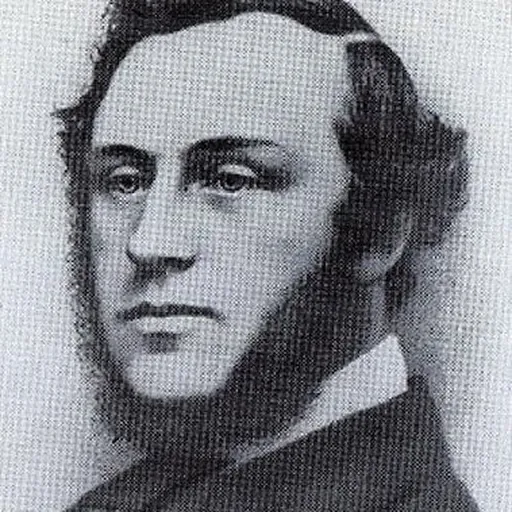
About John Fowler
Lived 1826 – 1864 (aged 38). John Fowler was a British agricultural engineer, inventor, engineer and agricultural engineering.
John Fowler (11 July 1826 – 4 December 1864) was an English agricultural engineer who was a pioneer in the use of steam engines for ploughing and digging drainage channels. His inventions significantly reduced the cost of ploughing farmland, and also enabled the drainage of previously uncultivated land in many parts of the world.
Early life Fowler was born in Melksham, Wiltshire. His father, John Fowler senior was a wealthy Quaker merchant, who had married Rebecca Hull, and together they had three daughters and five sons, of whom Fowler was the third son. His father dealt most successfully in tea but also coal and animals. When he left school Fowler followed his father's wishes and began working for a local corn merchant, but when he came of age in 1847 he turned his back on the corn business and joined the engineering firm of Gilkes Wilson and Company of Middlesbrough. Amongst other things, the company was involved in building steam locomotives and colliery winding engines. The company built a number of locomotives for the Stockton and Darlington Railway. .
First drainage plough Fowler's ploughing engine dragged itself across the field on rollers, pulling the mole plough as it went. The engine was driven by a team of horses that walked round a capstan, winding in a rope which was passed through a pulley securely anchored at the far end of the field. The mole would have a string of drainage pipes attached at the rear end and these would be dragged through the channel created by the mole. On completing each length of drains, the engine would be turned, the rope would be let out and the pulley repositioned ready for the next length. Fowler had trouble with the capstan gears and with the rope slipping on the capstan,
Second drainage plough Fowler then decided to change his design so that the horse engine remained stationary at the corner of the field. The team of horses drove a vertical winch around which a rope was wound. The rope would pass along the edge of the field to a securely anchored pulley and would then pass at right angles across the field to the mole plough. As the horses drove the winch, the rope would drag the mole plough across the field, digging a drainage channel and inserting a length of drainage pipes. When each length had been completed, the pulley would be moved to a new position, the rope would be let out and the plough would be taken to the far side of the field, ready to start the next channel. The design was a vast improvement on the previous one, in that the horsepower was not being expended in dragging the machine across the field, only the plough. Fowler demonstrated his new drainage plough at the Great Exhibition in 1851
Second steam-driven drainage plough Following the failure of his first steam-driven plough, Fowler reverted to the design used for his second horse-driven plough. His new design consisted of a steam engine placed in a corner of the field driving a winch. A rope led from the winch along the side of the field, around a securely anchored pulley and across the field to the mole plough. As the winch drew in the rope the mole plough was drawn across the field digging a drainage channel as it went. The engine also had a second winch with a rope passing round the same anchored pulley and then passing across the field and around a second pulley and back to the plough. This second rope would be used to drag the plough back to its starting point after completing a drainage line. Both pulleys would then be re-anchored at both ends of the next channel to be dug and the ploughing process would be repeated. The steam plough was demonstrated at the Royal Agricultural Society of England meeting at Lincoln in 1854. Fowler returned to contest the R.A.S.E. ploughing trial at Chester in 1858. He was opposed by a number of competitors but was successful in being awarded the £500 prize. to build (and later improve) his revolutionary steam-based machines.
John Fowler and Company In 1862 Fowler formed a partnership with William Watson Hewitson of the above firm and founded Hewitson and Fowler based at Hunslet. A year later Hewitson died and the firm became John Fowler and Company. Fowler's ploughing sets were sold all over the world and were responsible for bringing land into production that was previously unable to be cultivated.
Retirement Fowler had worked so hard in developing his ideas that he had undermined his health. He was advised to take more rest and so he retired to Ackworth in Yorkshire, to recuperate. He was persuaded to take up hunting as a way of getting exercise and whilst out with the hunt he had a fall and sustained a compound fracture of his arm. Whilst recovering from this mishap, he developed tetanus and died on 4 December 1864, at his home in Ackworth. He died only months after his great triumph at the Newcastle ploughing trial, at age 38.
His brothers Robert, William and Barnard had joined him in the business he had founded and they continued to run the firm after his death. Fowler's method of ploughing continued to be used until well into the twentieth century when the internal combustion engine allowed the development of light but powerful tractors that could draw a plough behind them.
A monument to John Fowler's invention of the steam plough was placed on his father-in-law's Pierremont estate in Darlington in 1856, but was moved in 1870 to South Park, Darlington. The plinth may still be seen there, but the plough that it supported disappeared in 1970.
Don’t just read it —
keep it.
Full-length biographies made to live with: read them, listen on the way to work, watch them tonight.
- E-book
- Audio
- Video
Instant download · yours to keep · every purchase keeps this site free
Important facts
People in John Fowler's life
Named in this biography and alive at the same time
Related people
Same field, nearest in time



Contemporaries
People whose lives overlapped John Fowler's





Frequently asked questions
Who was John Fowler?
agricultural engineer (born 1826)
When was John Fowler born?
John Fowler was born on 11 July 1826 in Wiltshire.
When did John Fowler die?
John Fowler died on 4 December 1864 in Yorkshire.
What was John Fowler's occupation?
John Fowler was an agricultural engineer, inventor, engineer and agricultural engineering.
What nationality was John Fowler?
John Fowler was British.
Sources & further reading
· DBpedia: John Fowler (agricultural engineer)
Cite this page
APA: Biography.guide. (2026). John Fowler. https://biography.guide/john-fowler-agricultural-engineer/
MLA: "John Fowler." Biography.guide, https://biography.guide/john-fowler-agricultural-engineer/.
Chicago: "John Fowler." Biography.guide. https://biography.guide/john-fowler-agricultural-engineer/.
Data last updated: 2026-09-22 · Spot an error? Report a correction.
Portrait: Wikimedia Commons · author & licence
Page generated 2026-09-27 05:01 UTC